Bania Julia, Wrona Joanna, Fudali Kacper, Stęga Franciszek, Rębisz Piotr Filip, Murawski Marek
Faculty of Medicine, Wroclaw Medical University, 50-367 Wroclaw, Poland.
Clinical Department of Gynecologic Surgery and Oncology, Wroclaw Medical University, Borowska 213, 50-556 Wroclaw, Poland.
J Clin Med. 2025 Mar 23;14(7):2188. doi: 10.3390/jcm14072188.
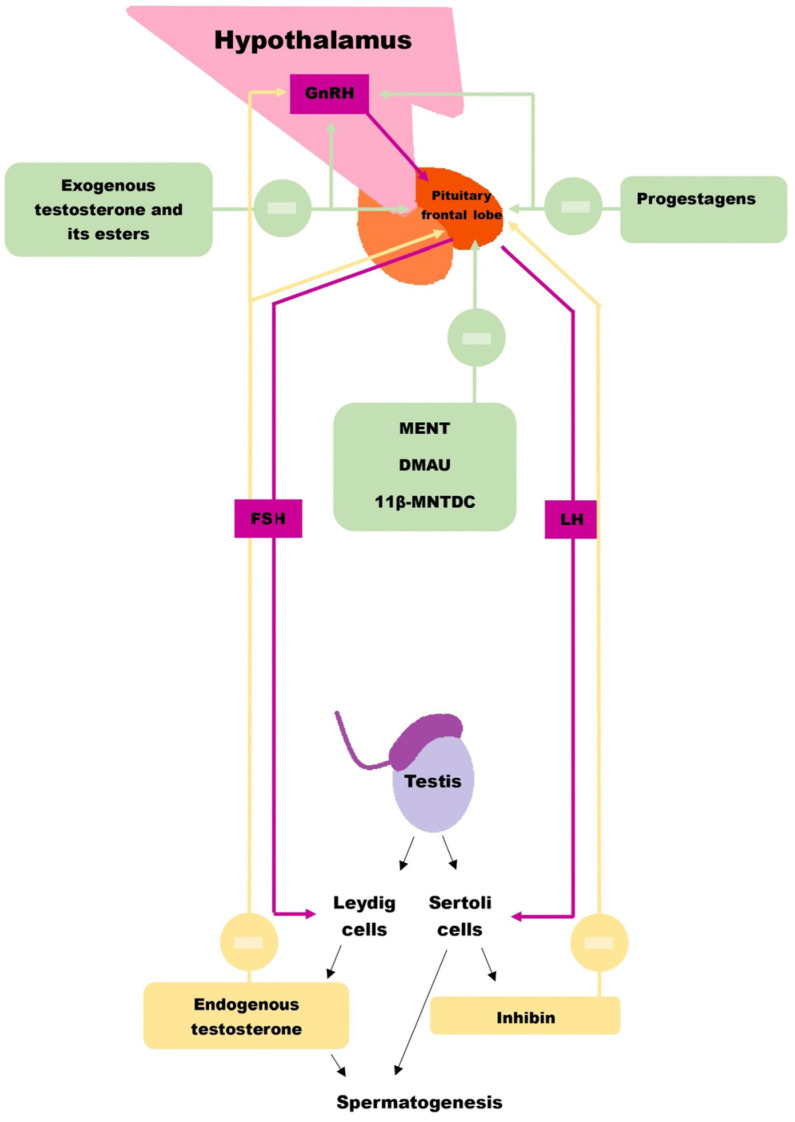
Male hormonal contraception has been the focus of extensive research efforts aimed at identifying effective and reversible methods for male fertility control. This review summarizes the current state of knowledge, key achievements, and future directions in the development of male hormonal contraception. A review was conducted using the PubMed, Embase, and Scopus databases. The search strategy included terms such as "male hormonal contraception", "Nestorone", "7α,11β-Dimethyl-19-nortestosterone 17β-undecanoate (DMAU)" and "11β-methyl-19-nortestosterone 17β-dodecylcarbonate (11β-MNTDC)". A total of 107 references were analyzed to synthesize the most relevant findings regarding the hormonal contraceptive agents under investigation. The review outlines historical and recent advancements in male hormonal contraception, highlighting compounds that have demonstrated limitations in effectiveness, side effects, or inconvenient administration. Notable candidates under study include 7α-methyl-19-nortestosterone (MENT), DMAU, 11β-MNTDC, and the combination of segesterone acetate with testosterone in gel form. These agents show promise due to their ability to suppress follicle-stimulating hormone (FSH) and luteinizing hormone (LH), leading to effective spermatogenesis inhibition with minimal side effects. Additionally, the phenomenon of spermatogenic rebound is considered. Among the investigated agents, oral DMAU, 11β-MNTDC, and the Nestorone-testosterone gel appear to be the most promising candidates for male hormonal contraception due to their high efficacy, user-friendly administration, and favorable safety profiles. However, further large-scale clinical trials are necessary to confirm their long-term effects on human health and fertility, ensuring their viability as future contraceptive options.
男性激素避孕一直是广泛研究的重点,旨在确定有效且可逆的男性生育控制方法。本综述总结了男性激素避孕发展的当前知识状态、关键成就和未来方向。使用PubMed、Embase和Scopus数据库进行了一项综述。搜索策略包括“男性激素避孕”、“内斯特龙”、“7α,11β - 二甲基 - 19 - 去甲睾酮17β - 十一烷酸酯(DMAU)”和“11β - 甲基 - 19 - 去甲睾酮17β - 十二烷基碳酸酯(11β - MNTDC)”等术语。共分析了107篇参考文献,以综合有关所研究激素避孕药物的最相关发现。该综述概述了男性激素避孕的历史和近期进展,强调了在有效性、副作用或给药不便方面存在局限性的化合物。正在研究的显著候选药物包括7α - 甲基 - 19 - 去甲睾酮(MENT)、DMAU、11β - MNTDC以及醋酸孕烯醇酮与睾酮凝胶形式的组合。这些药物显示出前景,因为它们能够抑制促卵泡激素(FSH)和促黄体生成素(LH),从而以最小的副作用有效抑制精子发生。此外,还考虑了精子发生反弹现象。在所研究的药物中,口服DMAU、11β - MNTDC和内斯特龙 - 睾酮凝胶由于其高疗效、用户友好的给药方式和良好的安全性,似乎是男性激素避孕最有前景的候选药物。然而,需要进一步的大规模临床试验来确认它们对人类健康和生育的长期影响,以确保它们作为未来避孕选择的可行性。