Tamini Sofia, Bondesan Adele, Caroli Diana, Marazzi Nicoletta, Sartorio Alessandro
Istituto Auxologico Italiano, Istituto di Ricovero e Cura a Carattere Scientifico (IRCCS), Experimental Laboratory for Auxo-Endocrinological Research, 28824 Piancavallo-Verbania, Italy.
J Clin Med. 2025 Mar 28;14(7):2341. doi: 10.3390/jcm14072341.
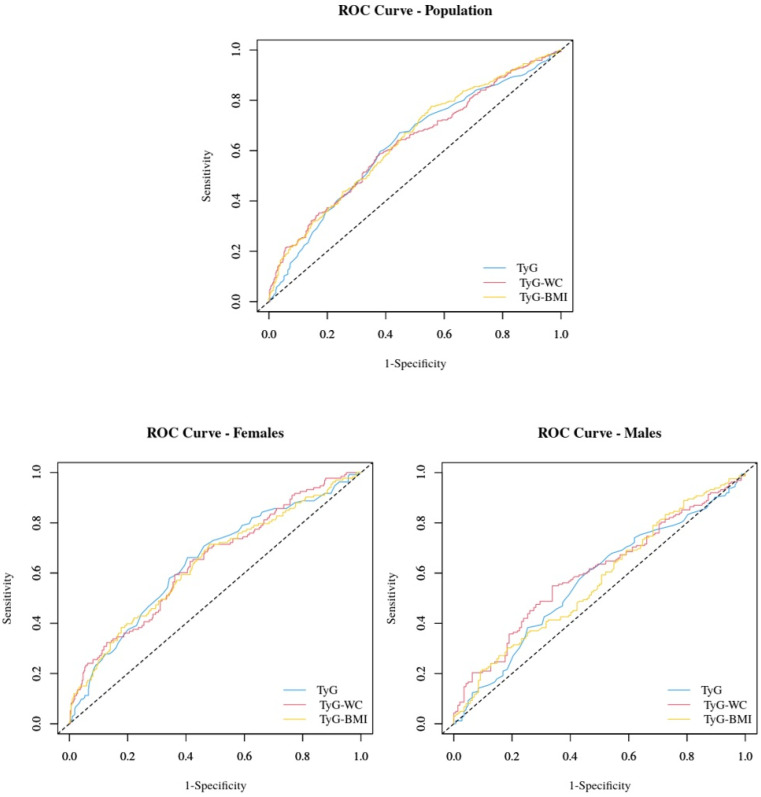
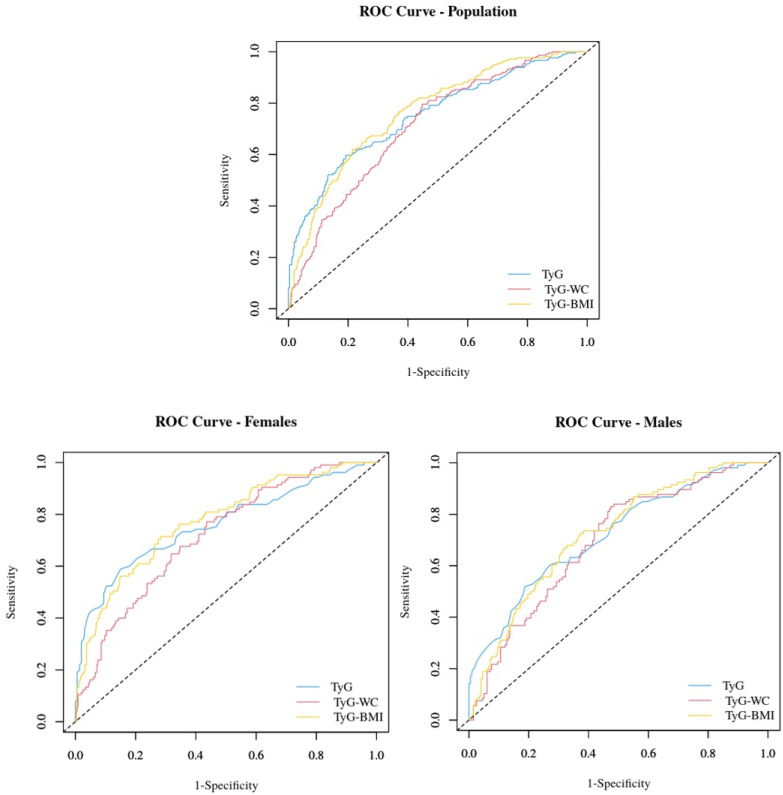
: Metabolic-associated fatty liver disease (MASLD) and metabolic syndrome (MetS) are increasingly prevalent among children and adolescents with obesity, posing significant long-term metabolic and cardiovascular risks. Non-invasive identification of at-risk individuals is crucial for a timely intervention. This study aimed to evaluate the diagnostic performance of the triglyceride-glucose (TyG) index and its modified versions, TyG-body mass index (TyG-BMI) and TyG-waist circumference (TyG-WC), in predicting MASLD and MetS in a large cohort of children and adolescents with obesity. : A total of 758 children and adolescents with obesity (454 females, 304 males; mean age 14.8 ± 2.1 years; mean BMI 37.9 ± 6.2 kg/m) were included. MASLD was diagnosed via ultrasonography, while MetS was defined using International Diabetes Federation criteria. TyG, TyG-WC, and TyG-BMI were calculated for all participants. Receiver operating characteristic (ROC) curves were generated to assess the diagnostic accuracy of these indexes, including sensitivity, specificity, positive predictive value (PPV), and negative predictive value (NPV). : MASLD was detected in 38.9% of participants, with a higher prevalence in males ( < 0.0001). MetS was present in 27.8% of the cohort, with higher prevalence in males ( < 0.0001). Among the indexes, TyG-WC exhibited the highest sensitivity for MASLD (77.6%), whereas TyG-BMI had the highest specificity (63.3%). In predicting MetS, all three indexes performed better than for MASLD, with TyG demonstrating the highest PPV (54.5%) and TyG-BMI the highest NPV (87.5%). Predictive performance was lower in males than females, potentially due to sex-specific differences in fat distribution and metabolic response. : TyG, TyG-WC, and TyG-BMI are promising, non-invasive tools for identifying children and adolescents with obesity at risk for MASLD and MetS. The superior sensitivity of TyG-WC and the high specificity of TyG-BMI highlight the value of incorporating anthropometric parameters into metabolic screening. Integrating these indexes into routine clinical practice may enhance early detection, allowing for timely intervention and personalized management strategies, ultimately reducing the long-term burden of metabolic and liver diseases in pediatric populations.
代谢相关脂肪性肝病(MASLD)和代谢综合征(MetS)在肥胖儿童和青少年中日益普遍,带来了重大的长期代谢和心血管风险。对高危个体进行非侵入性识别对于及时干预至关重要。本研究旨在评估甘油三酯-葡萄糖(TyG)指数及其改良版本,即TyG体重指数(TyG-BMI)和TyG腰围(TyG-WC),在一大群肥胖儿童和青少年中预测MASLD和MetS的诊断性能。
共纳入758名肥胖儿童和青少年(454名女性,304名男性;平均年龄14.8±2.1岁;平均BMI 37.9±6.2kg/m²)。通过超声诊断MASLD,而MetS则根据国际糖尿病联盟标准进行定义。为所有参与者计算TyG、TyG-WC和TyG-BMI。生成受试者工作特征(ROC)曲线以评估这些指标的诊断准确性,包括敏感性、特异性、阳性预测值(PPV)和阴性预测值(NPV)。
38.9%的参与者被检测出患有MASLD,男性患病率更高(P<0.0001)。该队列中27.8%的人患有MetS,男性患病率更高(P<0.0001)。在这些指标中,TyG-WC对MASLD的敏感性最高(77.6%),而TyG-BMI的特异性最高(63.3%)。在预测MetS方面,所有三个指标的表现均优于预测MASLD,其中TyG的PPV最高(54.5%),TyG-BMI的NPV最高(87.5%)。男性的预测性能低于女性,这可能是由于脂肪分布和代谢反应存在性别差异。
TyG、TyG-WC和TyG-BMI是用于识别有MASLD和MetS风险的肥胖儿童和青少年的有前景的非侵入性工具。TyG-WC的卓越敏感性和TyG-BMI的高特异性凸显了将人体测量参数纳入代谢筛查的价值。将这些指标纳入常规临床实践可能会加强早期检测,从而实现及时干预和个性化管理策略,最终减轻儿科人群代谢和肝脏疾病的长期负担。