
28只犬颅交叉韧带断裂手术修复后髌韧带病的回顾性研究
A Retrospective Study on Patellar Desmopathy Following Surgical Resolution of Cranial Cruciate Ligament Rupture in 28 Dogs.
作者信息
Vidal-Negreira Francisco, Valiño-Cultelli Victoria, García-González Mario, Varela-López Óscar, Barreiro-Vázquez Jose-Daniel, González-Cantalapiedra Antonio
机构信息
Rof-Codina Veterinary Teaching Hospital, Faculty of Veterinary, Universidad de Santiago de Compostela, 27002 Lugo, Spain.
Department of Anatomy, Animal Production and Veterinary Clinical Sciences, Veterinary Faculty, Universidad de Santiago de Compostela, 27002 Lugo, Spain.
出版信息
Animals (Basel). 2025 Apr 4;15(7):1052. doi: 10.3390/ani15071052.
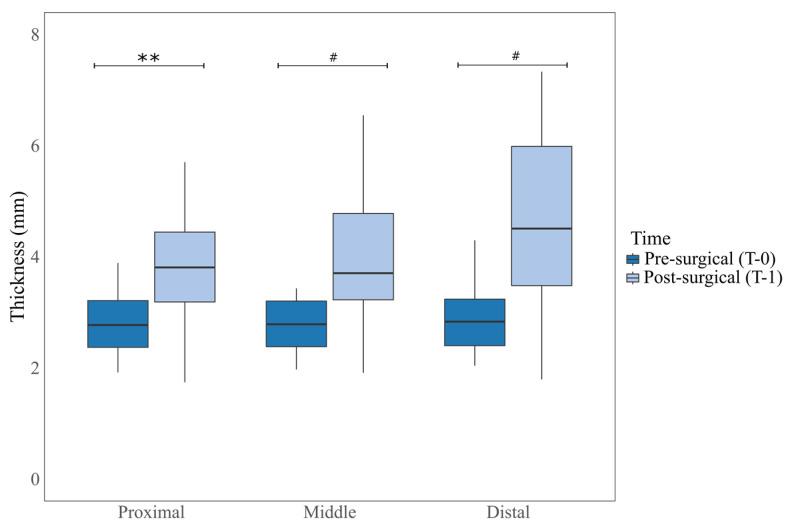
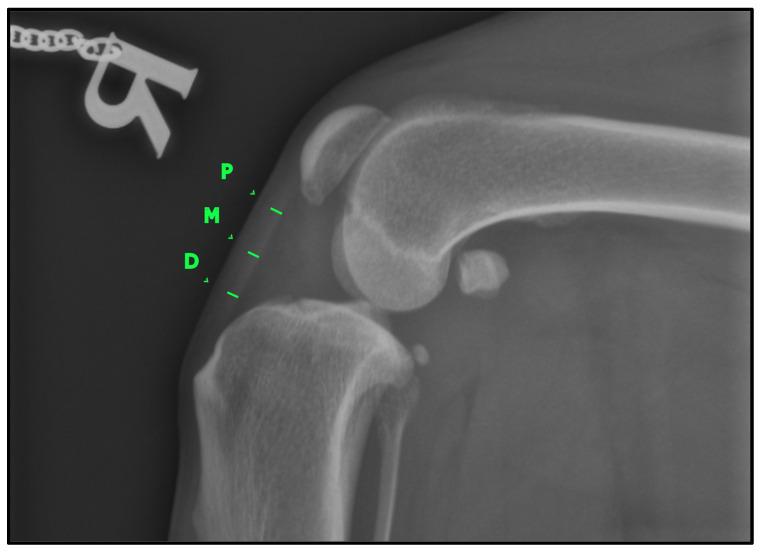
Cranial cruciate ligament rupture is the most common orthopedic condition in dogs, causing lameness, joint instability, and discomfort due to its role in knee stability. Surgical treatment, particularly osteotomies in the proximal tibia, is the preferred approach, with tibial tuberosity advancement (TTA), tibial plateau leveling osteotomy (TPLO), and the modified Maquet technique (MMT) being widely used. A common postoperative complication is patellar desmopathy-thickening of the ligament that is detectable on radiographs and can cause further discomfort. However, studies on this complication in TPLO are limited, and there are no direct comparisons of ligament thickening between these surgical techniques. This study aimed to determine the prevalence of ligament desmopathy in TPLO, examine any associations with age, sex, or weight, and compare findings with those from other techniques. A retrospective analysis was conducted, with ligament thickness measured at three points during postoperative follow-up, which had a mean of approximately 2.5 months. Results showed an 86.7% prevalence of desmopathy, with average thicknesses of 3.90 mm proximally, 4.69 mm at mid-ligament, and 5.98 mm distally. These findings align with previous TPLO studies and suggest that TPLO may cause greater ligament thickening than TTA or MMT, particularly in the distal portion.
颅交叉韧带断裂是犬类最常见的骨科疾病,因其在膝关节稳定性中的作用,会导致跛行、关节不稳定和不适。手术治疗,尤其是胫骨近端截骨术,是首选方法,胫骨结节前移术(TTA)、胫骨平台水平截骨术(TPLO)和改良马凯特技术(MMT)被广泛应用。一种常见的术后并发症是髌韧带病变——韧带增厚,在X线片上可检测到,会导致进一步不适。然而,关于TPLO中这种并发症的研究有限,且这些手术技术之间韧带增厚情况没有直接比较。本研究旨在确定TPLO中韧带病变的患病率,检查其与年龄、性别或体重的任何关联,并将结果与其他技术的结果进行比较。进行了一项回顾性分析,在术后随访期间的三个点测量韧带厚度,平均随访时间约为2.5个月。结果显示韧带病变的患病率为86.7%,近端平均厚度为3.90毫米,韧带中部为4.69毫米,远端为5.98毫米。这些发现与之前的TPLO研究一致,表明TPLO可能比TTA或MMT导致更大程度的韧带增厚,尤其是在远端部分。
 Zotero 插件