
通过2.4GHz远程无线链路实现纳秒级时间同步。
Nanosecond Time Synchronization over a 2.4 GHz Long-Range Wireless Link.
作者信息
Müller Pascal, Berger Dominic, Sarperi Luciano
机构信息
Institute of Signal Processing and Wireless Communications, ZHAW School of Engineering, 8401 Winterthur, Switzerland.
出版信息
Sensors (Basel). 2025 Mar 21;25(7):1961. doi: 10.3390/s25071961.
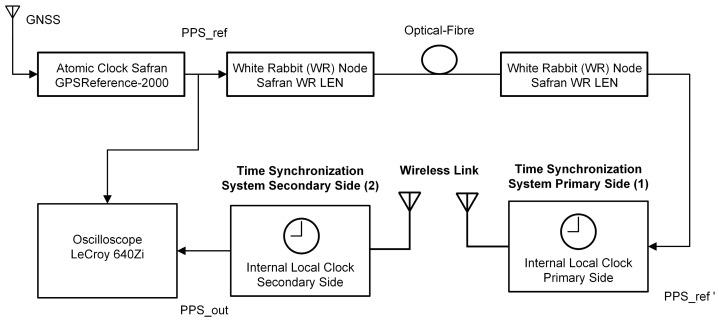
Time synchronization between geographically separated equipment, such as, for example, that required in sensor networks for radio localization, is often based on global navigation satellite systems (GNSSs). However, in environments that are GNSS-denied due to signal blockage or interference, alternative timing synchronization methods are necessary. In this work, an experimental wireless time synchronization system based on long-range (LoRa) modulation has been developed and tested in the field. LoRa modulation operating in the license-free 2.4 GHz industrial, scientific and medical (ISM) band was chosen due to the potentially large coverage area of several kilometers and the availability of a ranging engine in the SX1280 transceiver by Semtech, which facilitates the implementation of time synchronization. The prototype system was tested over 170 m, where it achieved a time deviation (TDEV) of 30 ps for an average time of 1 s and a maximum TDEV of 3 ns over one day of measurement, improving over existing work on time synchronization with LoRa modulation by around three orders of magnitude. The field tests showed that ns accuracy can be achieved using LoRa modulation, making it suitable for the synchronization of remote sites, for example, for radio localization.
地理上分离的设备之间的时间同步,例如无线定位传感器网络中所需的时间同步,通常基于全球导航卫星系统(GNSS)。然而,在由于信号阻塞或干扰而无法使用GNSS的环境中,需要替代的定时同步方法。在这项工作中,已经开发了一种基于远距离(LoRa)调制的实验性无线时间同步系统,并在现场进行了测试。选择在免许可的2.4 GHz工业、科学和医疗(ISM)频段运行的LoRa调制,是因为其潜在覆盖范围可达数公里,并且Semtech的SX1280收发器中具备测距引擎,这有利于时间同步的实现。该原型系统在170米的距离上进行了测试,在平均1秒的时间内实现了30皮秒的时间偏差(TDEV),在一天的测量中最大TDEV为3纳秒,比现有的LoRa调制时间同步工作提高了约三个数量级。现场测试表明,使用LoRa调制可以实现纳秒级精度,使其适用于远程站点的同步,例如用于无线定位。




 Zotero 插件