
含可再生能源、无功功率补偿器及电动汽车充电站的配电电力系统的能量损耗降低
Energy Loss Reduction for Distribution Electric Power Systems with Renewable Power Sources, Reactive Power Compensators, and Electric Vehicle Charge Stations.
作者信息
Kien Le Chi, Loi Tran Duc, Duong Minh Phuc, Nguyen Thang Trung
机构信息
Faculty of Electrical and Electronics Engineering, Ho Chi Minh City University of Technology and Education, Ho Chi Minh City 700000, Vietnam.
Power System Optimization Research Group, Faculty of Electrical and Electronics Engineering, Ton Duc Thang University, Ho Chi Minh City 700000, Vietnam.
出版信息
Sensors (Basel). 2025 Mar 22;25(7):1997. doi: 10.3390/s25071997.
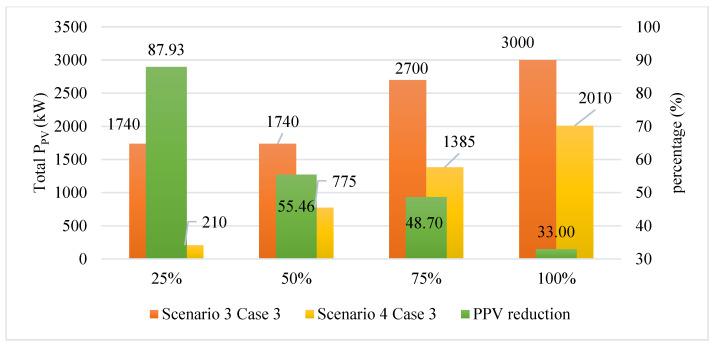
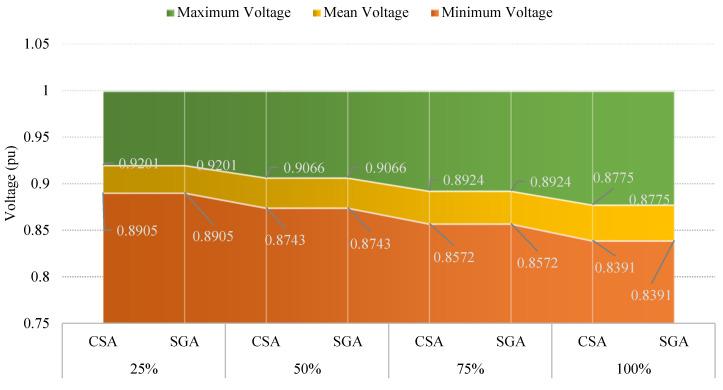
This paper applies the Chameleon Swarm Algorithm (CSA) and Snow Geese Algorithm (SGA) for optimizing the placement of electric vehicle charge stations (EVCSs), renewable energy sources (RESs), and shunt capacitors (SCs). The actual power ranges of the EVCSs of the Vinfast company in Vietnam are used to check the stabilization of the IEEE 85-node distribution power grid by considering four penetration levels of EVCSs, namely 25%, 50%, 75%, and 100%. All penetration levels of EVCSs violate the operating load voltage limits, and the grid cannot work for all the penetration levels. Different scenarios are performed to find the minimum RES penetration level and the most possible SC penetration level to satisfy the operating voltage limits. The use of only SCs cannot satisfy the voltage limits even for the 25% EVCS penetration level. The placement of RESs provides the capability to maintain voltage within the allowed range for 25% and 50% EVCS penetration but not for 75% and 100%. Using both RESs and SCs, the operating voltage limits are satisfied by using RESs with 1385 kW (about 30.44% of loads and EVCSs) and SCs with 2640 kVAr for the 75% EVCS penetration level and using RESs with 2010 kW (about 38.58% of loads and EVCSs) and SCs with 2640 kVAr (100% of loads) for the 100% EVCS penetration level. The study indicates that the installation of EVCSs should be calculated for stable operation of the distribution power grid, and the combination of both RESs and SCs can satisfy the maximum penetration level of EVCSs in the distribution power grids.
本文应用变色龙群算法(CSA)和雪雁算法(SGA)来优化电动汽车充电站(EVCS)、可再生能源(RES)和并联电容器(SC)的布局。利用越南Vinfast公司电动汽车充电站的实际功率范围,通过考虑电动汽车充电站的四个渗透率水平,即25%、50%、75%和100%,来检验IEEE 85节点配电网的稳定性。电动汽车充电站的所有渗透率水平均违反了运行负载电压限制,并且电网在所有渗透率水平下均无法正常运行。执行不同的场景以找到满足运行电压限制的最小可再生能源渗透率水平和最可能的并联电容器渗透率水平。即使对于25%的电动汽车充电站渗透率水平,仅使用并联电容器也无法满足电压限制。可再生能源的布局能够在25%和50%的电动汽车充电站渗透率水平下将电压维持在允许范围内,但在75%和100%的渗透率水平下则不行。同时使用可再生能源和并联电容器时,对于75%的电动汽车充电站渗透率水平,使用1385千瓦(约占负载和电动汽车充电站的30.44%)的可再生能源和2640千乏的并联电容器可满足运行电压限制;对于100%的电动汽车充电站渗透率水平,使用2010千瓦(约占负载和电动汽车充电站的38.58%)的可再生能源和2640千乏(占负载的100%)的并联电容器可满足运行电压限制。该研究表明,应计算电动汽车充电站的安装量以确保配电网的稳定运行,并且可再生能源和并联电容器的组合可以满足配电网中电动汽车充电站的最大渗透率水平。




 Zotero 插件