Wang Hao, Guan Yunqi, Du Huaidong, Dai Pinyuan, Zhong Jieming, Yu Min, Li Na
Department of Non-Communicable Diseases Control and Prevention, Zhejiang Provincial Center for Disease Control and Prevention, Hangzhou 310051, China.
Clinical Trial Service Unit & Epidemiological Studies Unit (CTSU), Nuffield Department of Population Health, University of Oxford, Oxford OX3 7LF, UK.
Nutrients. 2025 Apr 5;17(7):1271. doi: 10.3390/nu17071271.
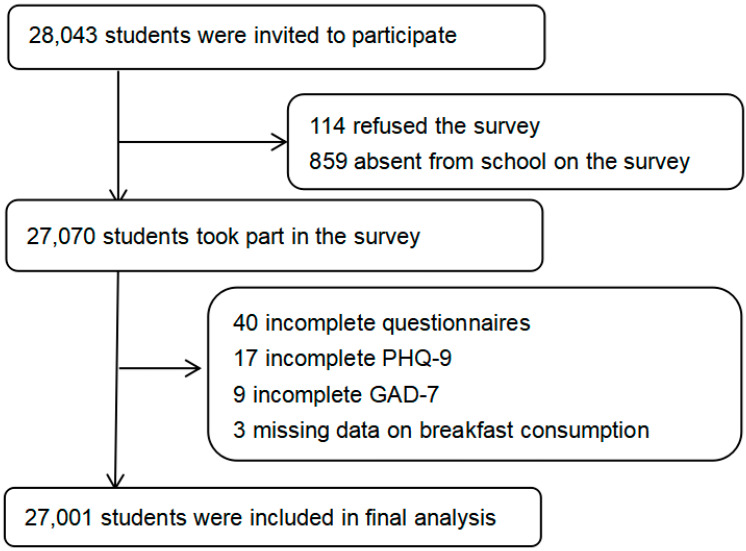
: This study aimed to explore the relationship between breakfast consumption frequency and both depression and anxiety symptoms among middle and high school students in Eastern China. : In this school-based cross-sectional study, 27,001 middle and high school students were investigated in 2022. Multivariable logistic regression models were used to examine the relationship between breakfast consumption frequency and both depression and anxiety symptoms. : The percentages of students who consumed breakfast daily, 6 days/week, 4-5 days/week, and ≤3 days/week were 71.0% (95%CI: 69.9-72.2), 8.3% (95%CI: 7.8-8.6), 11.9% (95%CI: 11.2-12.6), and 8.8% (95%CI: 8.2-9.5), respectively. After adjusting for socio-demographic and lifestyle factors, academic performance, self-reported health, and bullying victimization, compared to those consuming breakfast daily, the odds ratios (95%CI) for depression symptoms were 1.32 (1.15-1.52) for those consuming breakfast 6 days/week, 1.66 (1.49-1.84) for those consuming breakfast 4-5 days/week, and 1.74 (1.54-1.97) for those consuming breakfast ≤3 days/week, respectively ( < 0.001). The corresponding figures for anxiety symptoms were 1.31 (1.14-1.51), 1.35 (1.20-1.52), and 1.43 (1.23-1.66), respectively ( < 0.001). : Breakfast skipping is common among middle and high school students in Eastern China. The frequency of breakfast consumption is inversely associated with both depression symptoms and anxiety symptoms among adolescents.
本研究旨在探讨中国东部地区中学生早餐食用频率与抑郁和焦虑症状之间的关系。在这项基于学校的横断面研究中,2022年对27001名中学生进行了调查。采用多变量逻辑回归模型来检验早餐食用频率与抑郁和焦虑症状之间的关系。每天吃早餐、每周吃6天、每周吃4 - 5天以及每周吃≤3天的学生比例分别为71.0%(95%置信区间:69.9 - 72.2)、8.3%(95%置信区间:7.8 - 8.6)、11.9%(95%置信区间:11.2 - 12.6)和8.8%(95%置信区间:8.2 - 9.5)。在调整了社会人口学和生活方式因素、学业成绩、自我报告的健康状况以及受欺凌情况后,与每天吃早餐的人相比,每周吃6天早餐的人出现抑郁症状的优势比(95%置信区间)为1.32(1.15 - 1.52),每周吃4 - 5天早餐的人为1.66(1.49 - 1.84),每周吃≤3天早餐的人为1.74(1.54 - 1.97)(P < 0.001)。焦虑症状的相应数字分别为1.31(1.14 - 1.51)、1.35(1.20 - 1.52)和1.43(1.23 - 1.66)(P < 0.001)。在中国东部地区的中学生中,不吃早餐的情况很常见。青少年早餐食用频率与抑郁症状和焦虑症状均呈负相关。