Mangini Fabio, Moraschi Marta, Mascali Daniele, Guidi Maria, Fratini Michela, Mangia Silvia, DiNuzzo Mauro, Frezza Fabrizio, Giove Federico
Museo storico della fisica e Centro studi e ricerche Enrico Fermi, Rome, Italy.
Fondazione Santa Lucia IRCCS, Rome, Italy.
J Cereb Blood Flow Metab. 2025 Apr 12:271678X251325413. doi: 10.1177/0271678X251325413.
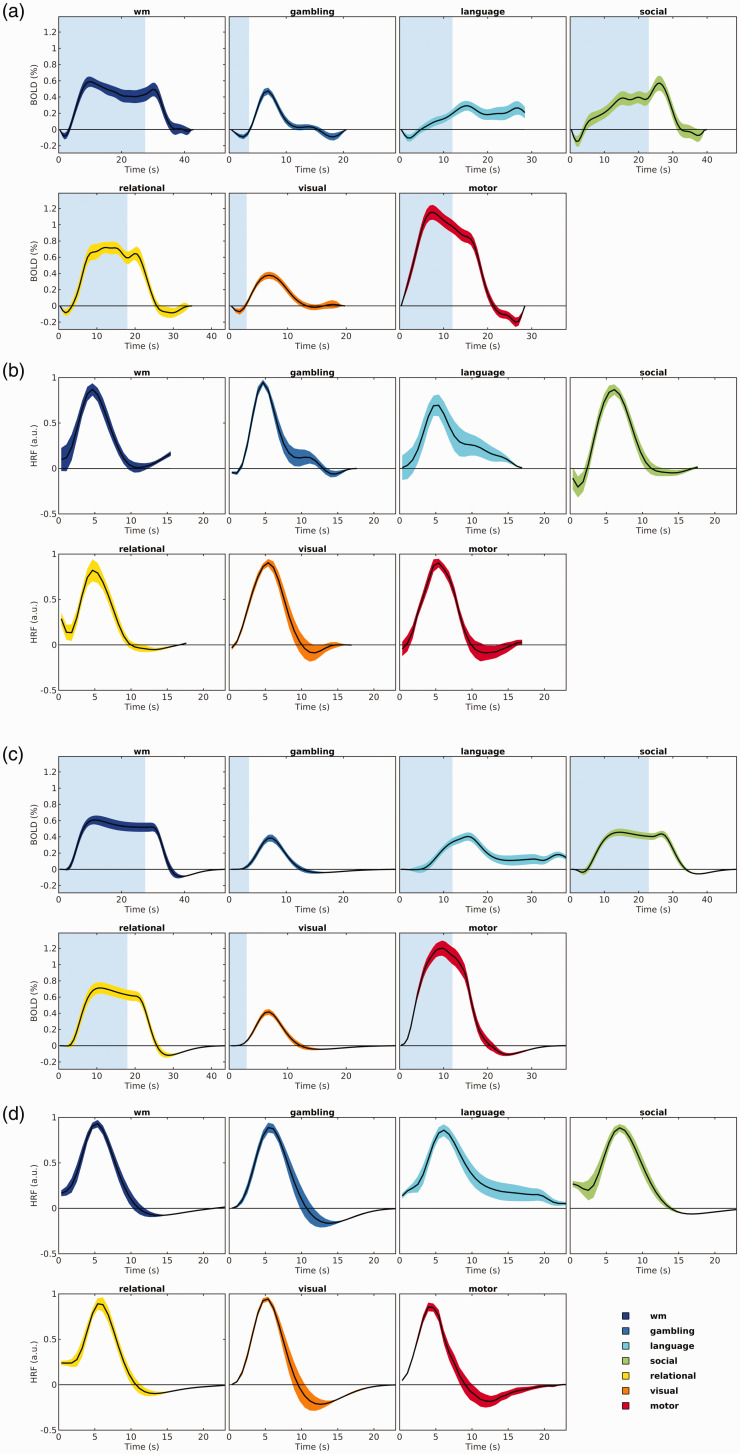
Functional magnetic resonance imaging time-series are conventionally processed by linear modelling the evoked response as the convolution of the experimental conditions with a stereotyped haemodynamic response function (HRF). However, the neural signal in response to a stimulus can vary according to task, brain region, and subject-specific conditions. Moreover, HRF shape has been suggested to carry physiological information. The BOLD signal across a range of sensorial and cognitive tasks was fitted using a sine series expansion, and modelled signals were deconvolved, thus giving rise to a task-specific deconvolved HRF (dHRF), which was characterized in terms of amplitude, latency, time-to-peak and full-width at half maximum for each task. We found that the BOLD response shape changes not only across activated regions and tasks, but also across subjects despite the age homogeneity of the cohort. Largest variabilities were observed in mean amplitude and latency across tasks and regions, while time-to-peak and full width at half maximum were relatively more consistent. Additionally, the dHRF was found to deviate from canonicity in several brain regions. Our results suggest that the choice of a standard, uniform HRF may be not optimal for all fMRI analyses and may lead to model misspecifications and statistical bias.
功能磁共振成像时间序列传统上是通过将诱发反应线性建模为实验条件与定型血流动力学反应函数(HRF)的卷积来处理的。然而,对刺激的神经信号可能会根据任务、脑区和个体特定条件而变化。此外,有人提出HRF形状携带生理信息。使用正弦级数展开对一系列感觉和认知任务中的血氧水平依赖(BOLD)信号进行拟合,并对建模信号进行反卷积,从而产生特定任务的反卷积HRF(dHRF),并针对每个任务根据幅度、潜伏期、峰值时间和半高全宽对其进行表征。我们发现,尽管该队列年龄相同,但BOLD反应形状不仅在激活区域和任务之间变化,而且在个体之间也有所不同。在各任务和区域的平均幅度和潜伏期方面观察到最大的变异性,而峰值时间和半高全宽相对更一致。此外,发现dHRF在几个脑区偏离典型性。我们的结果表明,选择标准、统一的HRF可能并非对所有功能磁共振成像分析都是最佳的,可能会导致模型错误设定和统计偏差。