Lum Jeremy S, Brown Mikayla L, Farrawell Natalie E, Bartlett Rachael, Chisholm Christen G, Gorman Jody, Dosseto Anthony, Dux Florian, McInnes Lachlan E, Ecroyd Heath, McAlary Luke, Crouch Peter J, Donnelly Paul S, Yerbury Justin J
Molecular Horizons and School of Science, University of Wollongong, Wollongong, NSW 2522, Australia; School of Medical, Indigenous and Health Sciences, University of Wollongong, Wollongong, NSW 2522, Australia.
Molecular Horizons and School of Science, University of Wollongong, Wollongong, NSW 2522, Australia.
EBioMedicine. 2025 May;115:105692. doi: 10.1016/j.ebiom.2025.105692. Epub 2025 Apr 12.
SOD1 mutations are a significant contributor of familial amyotrophic lateral sclerosis (ALS) cases. SOD1 mutations increase the propensity for the protein to misfold and aggregate into insoluble proteinaceous deposits within motor neurons and neighbouring cells. The small molecule, CuATSM, has repeatedly shown in mouse models to be a promising therapeutic treatment for SOD1-associated ALS and is currently in Phase II/III clinical trials for the treatment of ALS. We have previously shown CuATSM stabilises various ALS-associated variants of the SOD1 protein, reducing misfolding and toxicity. Two additional FDA-approved small molecules, ebselen and telbivudine, have also been identified to reduce mutant SOD1 toxicity, providing additional potential therapeutic candidates that could be used in combination with CuATSM. Here, we aimed to investigate if CuATSM, ebselen and telbivudine (CET) polytherapy could improve on the therapeutic efficacy of CuATSM monotherapy for the treatment of SOD1-associated ALS.
We utilised a 3D checkerboard approach to investigate whether a matrix of different concentrations CuATSM, ebselen and telbivudine could provide therapeutic improvements on cell survival, SOD1 folding and aggregation in SOD1-transfected NSC-34 cells, compared to CuATSM alone. To progress the preclinical development of CET polytherapy, we evaluated the bioavailability and safety of in vivo polytherapy administration. Furthermore, we assessed and compared the effects of CET- and CuATSM-treatment on disease onset, motor function, survival and neuropathological features in SOD1 mice.
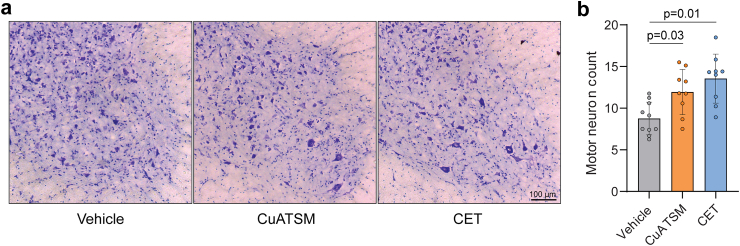
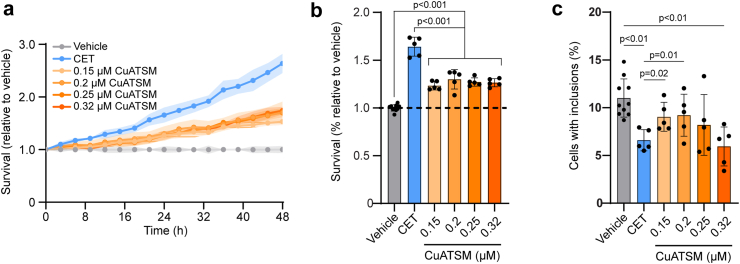
CET polytherapy reduced inclusion formation and increased cell survival of NSC-34 cells overexpressing SOD1 compared to higher concentrations of CuATSM monotherapy. In addition, CET administration was bioavailable and tolerable in mice. CET treatment in SOD1 mice delayed disease onset, reduced motor impairments, and increased survival compared to vehicle- and CuATSM-treated mice. In line with these findings, biochemical analysis of lumbar spinal cords showed CET administration improved SOD1 folding, decreased misfolded SOD1 accumulation, and reduced motor neuron loss.
These findings support CET polytherapy as an advantageous alternative compared to CuATSM monotherapy and highlight the potential of utilising small molecules targeting SOD1 as a polytherapy avenue for the treatment of SOD1-associated ALS.
This work was supported by a FightMND Drug Development Grant, an Australian National Health and Medical Research Council (NHMRC) Investigator Grant (No. 1194872) and a Motor Neuron Disease Research Institute of Australia Bill Gole Postdoctoral Fellowship.
超氧化物歧化酶1(SOD1)突变是家族性肌萎缩侧索硬化症(ALS)病例的一个重要病因。SOD1突变增加了该蛋白错误折叠并聚集形成运动神经元和邻近细胞内不溶性蛋白质沉积物的倾向。小分子化合物铜络合剂(CuATSM)在小鼠模型中反复显示出对SOD1相关ALS具有有前景的治疗效果,目前正处于治疗ALS的II/III期临床试验阶段。我们之前已经表明CuATSM可稳定SOD1蛋白的各种ALS相关变体,减少错误折叠和毒性。另外两种已获美国食品药品监督管理局(FDA)批准的小分子化合物依布硒啉和替比夫定,也已被证实可降低突变型SOD1的毒性,提供了可与CuATSM联合使用的其他潜在治疗候选药物。在此,我们旨在研究CuATSM、依布硒啉和替比夫定(CET)联合治疗是否能提高CuATSM单药治疗SOD1相关ALS的疗效。
我们采用三维棋盘法,研究与单独使用CuATSM相比,不同浓度的CuATSM、依布硒啉和替比夫定组合是否能在SOD1转染的NSC-34细胞中改善细胞存活、SOD1折叠和聚集情况。为推动CET联合治疗的临床前开发,我们评估了体内联合治疗给药的生物利用度和安全性。此外,我们评估并比较了CET和CuATSM治疗对SOD1小鼠疾病发作、运动功能、存活和神经病理学特征的影响。
与较高浓度的CuATSM单药治疗相比,CET联合治疗减少了过表达SOD1的NSC-34细胞中包涵体的形成并提高了细胞存活率。此外,CET给药在小鼠体内具有生物利用度且耐受性良好。与赋形剂和CuATSM治疗的小鼠相比,SOD1小鼠接受CET治疗可延迟疾病发作、减轻运动障碍并延长存活时间。与这些结果一致,腰脊髓的生化分析表明,CET给药改善了SOD1的折叠,减少了错误折叠的SOD1积累,并减少了运动神经元损失。
这些发现支持CET联合治疗是比CuATSM单药治疗更具优势的选择,并突出了利用靶向SOD1的小分子化合物作为联合治疗途径治疗SOD1相关ALS的潜力。
本研究得到了抗击运动神经元病药物开发基金、澳大利亚国家卫生与医学研究委员会(NHMRC)研究员基金(编号1194872)以及澳大利亚运动神经元病研究所比尔·戈尔博士后奖学金的支持。