Dorner László, Csordás Georgina
Department of School Psychology, Istitute of Psychology, Eszterházy Károly Catholic University, Eszterházy tér 1, Eger, 3300 Hungary.
Department of Developmental and Educational Psychology, Eszterházy Károly Catholic University, Eger, Hungary.
Indian J Hematol Blood Transfus. 2025 Apr;41(2):363-369. doi: 10.1007/s12288-024-01867-y. Epub 2024 Sep 6.
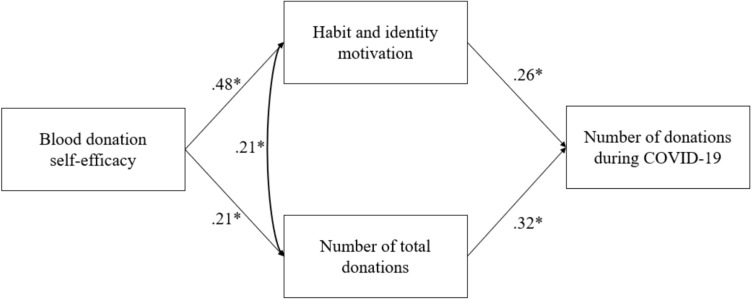
The COVID-19 pandemic had a considerable impact on blood donations worldwide. The present study aims to empirically investigate the determinants of willingness to donate blood during the COVID-19 pandemic in Hungary. Our study was carried out on 418 whole blood donors (286 women, 68.4%) using data collection from the online and paper self-report questionnaire data collection. We evaluated the association between motivation, self-efficacy, and technical and emotional barriers to donation. The correlational analysis showed that the number of donations during the COVID-19 pandemic was positively associated with the total number of donations; habit and identity motivation; and blood donation self-efficacy. In contrast, a negative association has been found with perceived barriers during the pandemic. The path model confirmed that the number of donations during the pandemic can be explained by the donors' habit and identity motivation facilitated by the experienced blood donation self-efficacy. The number of total donations also predicted the donations during COVID-19. These findings suggest that high donor self-efficacy is associated with habitual donation and the need to reinforce donor identity, which may again positively influence the number of donations. These factors contribute to the continued willingness to donate and result in a stable blood supply even during a health crisis or other societal challenges. Our research fits into a series of studies that draw the attention of blood donation professionals to the importance of identifying and maintaining a motivational background, increasing self-efficacy, and removing barriers to blood donation.
The online version contains supplementary material available at 10.1007/s12288-024-01867-y.
新冠疫情对全球献血产生了重大影响。本研究旨在实证调查匈牙利在新冠疫情期间献血意愿的决定因素。我们对418名全血捐献者(286名女性,占68.4%)进行了研究,通过在线和纸质自我报告问卷收集数据。我们评估了动机、自我效能以及献血的技术和情感障碍之间的关联。相关分析表明,新冠疫情期间的献血次数与总献血次数、习惯和身份动机以及献血自我效能呈正相关。相比之下,发现与疫情期间感知到的障碍呈负相关。路径模型证实,疫情期间的献血次数可以由献血者的习惯和身份动机来解释,而这种动机是由献血自我效能促进的。总献血次数也预测了新冠疫情期间的献血情况。这些发现表明,高献血者自我效能与习惯性献血以及强化献血者身份的需求相关,这可能再次对献血次数产生积极影响。这些因素有助于持续的献血意愿,并即使在健康危机或其他社会挑战期间也能确保稳定的血液供应。我们的研究符合一系列研究,这些研究引起了献血专业人员对识别和维持动机背景、提高自我效能以及消除献血障碍的重要性的关注。
在线版本包含可在10.1007/s12288-024-01867-y获取的补充材料。