Jang Hey-Jin, Lee Sun-Mi
College of Nursing, The Catholic University of Korea, Seoul, Republic of Korea.
J Nurs Manag. 2024 May 30;2024:6753210. doi: 10.1155/2024/6753210. eCollection 2024.
This study aimed to analyze the effects of the surgery preparation time on patient outcomes.
Postoperative complications have a decisive effect on postoperative survival. The anesthesia time is a crucial determinant of such complications. Competent operating room nurses can shorten the surgery preparation time, which is the time from when anesthesia is first administered to the making of the surgical incision. The shortening of this preparation time can shorten the anesthesia time and may reduce postoperative complications. However, discussion of this preparation time is insufficient. Therefore, this study analyzed the effect of the surgery preparation time on patient outcomes.
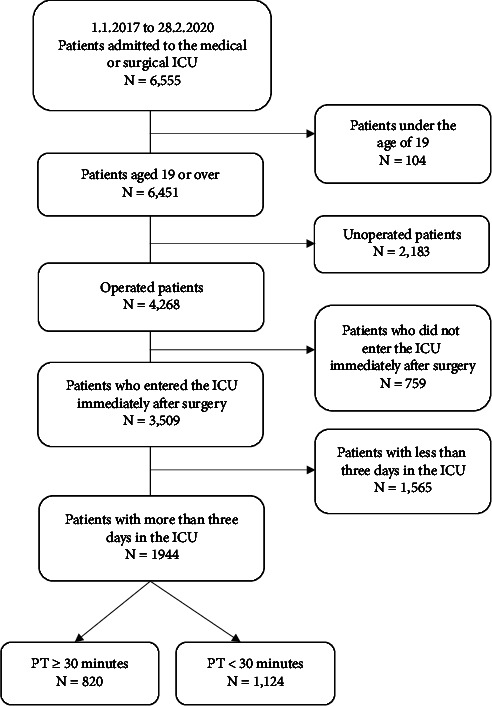
From electronic health records data, this retrospective cohort study used the data of 1,944 patients who had been immediately admitted to the ICU after their surgery between 2017 and 2020. The patients were divided into two groups: ≥30 minutes preparation time and <30 minutes preparation time groups. We performed chi-squared tests and -tests to determine differences in preoperation, intraoperation, and postoperation characteristics of the patients and patient outcomes based on the surgery preparation time. Furthermore, we performed a multiple logistic regression by including 12 adjusted variables to determine the influence of the surgery preparation time on patient outcomes.
Among the 1,944 patients, 820 were in the ≥30 minutes preparation time group and 1,124 in the <30 minutes preparation time group. The multiple logistic regression analysis showed that the surgery preparation time affects alertness (OR = 1.44; 95% CI: [1.09, 1.90]), ventilator application (OR = 1.32; 95% CI: [1.03, 1.70]), and length of stay in the ICU (OR = 1.69; 95% CI [1.16, 2.47]).
The surgery preparation time affects postoperative patient outcomes. The competence of operating room nurses is the most essential aspect of the surgery preparation time. . It is important to analyze operating room nurses' tasks, standardize the tasks, and educate nurses according to their experience level to reduce the surgery preparation time and improve patient outcomes.
本研究旨在分析手术准备时间对患者预后的影响。
术后并发症对术后生存有决定性影响。麻醉时间是此类并发症的关键决定因素。称职的手术室护士可以缩短手术准备时间,即从首次给予麻醉到做出手术切口的时间。缩短这一准备时间可以缩短麻醉时间,并可能减少术后并发症。然而,对此准备时间的讨论并不充分。因此,本研究分析了手术准备时间对患者预后的影响。
本回顾性队列研究从电子健康记录数据中使用了2017年至2020年间手术后立即入住重症监护病房(ICU)的1944例患者的数据。患者分为两组:准备时间≥30分钟组和准备时间<30分钟组。我们进行卡方检验和t检验,以确定基于手术准备时间的患者术前、术中和术后特征及患者预后的差异。此外,我们纳入12个调整变量进行多因素逻辑回归,以确定手术准备时间对患者预后的影响。
在1944例患者中,准备时间≥30分钟组有820例,准备时间<30分钟组有1124例。多因素逻辑回归分析显示,手术准备时间影响警觉性(比值比[OR]=1.44;95%置信区间[CI]:[1.09,1.90])、呼吸机应用(OR=1.32;95%CI:[1.03,1.70])和ICU住院时间(OR=1.69;95%CI[1.16,2.47])。
手术准备时间影响术后患者预后。手术室护士的能力是手术准备时间中最关键的方面。分析手术室护士的任务、规范任务并根据护士的经验水平进行培训,对于减少手术准备时间和改善患者预后非常重要。