Hotwani Jitendra H, Mahadkar Pankaj U, Rao Ankita A
Pharmacology, Topiwala National Medical College and B. Y. L. Nair Charitable Hospital, Mumbai, IND.
Cureus. 2025 Mar 12;17(3):e80450. doi: 10.7759/cureus.80450. eCollection 2025 Mar.
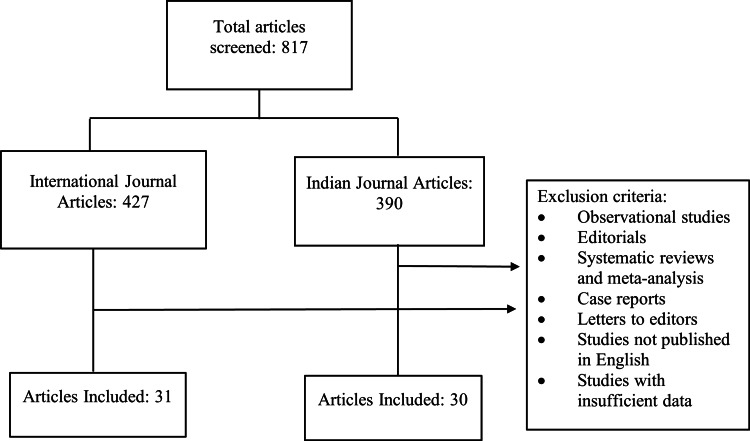
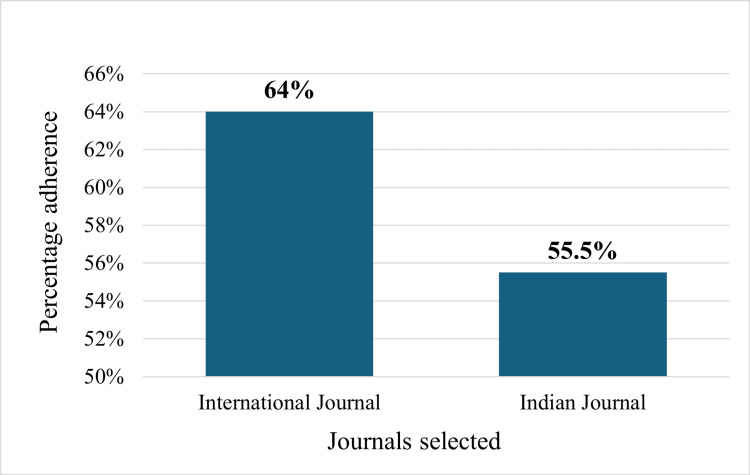
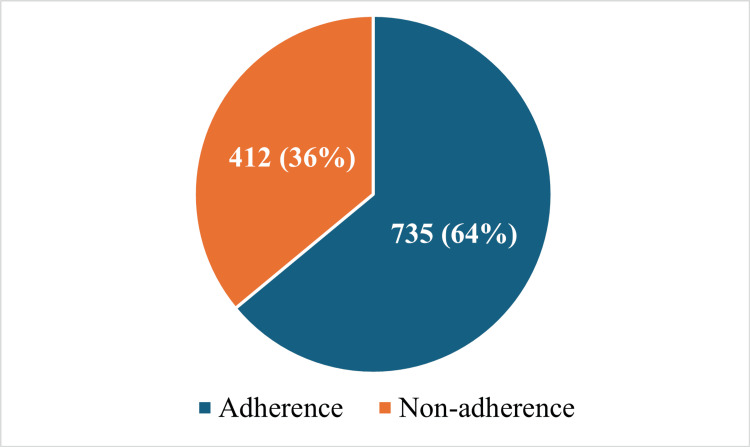
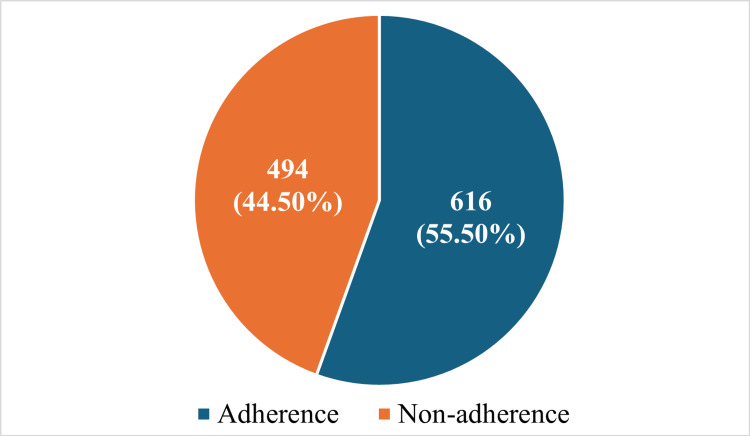
Randomized controlled trials (RCTs) are considered the gold standard in clinical research, providing the highest level of evidence for the effectiveness of healthcare interventions. However, the validity and utility of RCTs depend on the quality of their design, conduct, and reporting. The purpose of this review was to assess the adherence of RCTs published in Indian and international pharmacology journals to the Consolidated Standards of Reporting Trials (CONSORT) statement. RCTs published from 2019 to 2023 from one Indian and one international pharmacology journal were assessed using the CONSORT 2010 checklist, and the items were assigned as "present" or "absent." Data was analyzed using descriptive statistics, and chi-square and Fisher's exact tests were used for categorical data. A total of 61 articles were analyzed, out of which 31 and 30 articles belonged to international and Indian journals, respectively. RCTs published in international journals consistently showed higher adherence rates compared to Indian journals, with statistically significant differences for several checklist items, including trial design description (31, 100%), intervention details (31, 100%), and reporting of harms (27, 87%) (p < 0.05). While Indian journals performed better on points like additional analyses (19, 63.3%) and recruitment dates (23, 76.6%). Overall, the international journal demonstrated significantly higher overall adherence to CONSORT guidelines compared to the Indian journal (p < 0.05). The international journal exhibited greater overall adherence than the Indian journal, with the difference being statistically significant (p < 0.05). The overall reporting was suboptimal. Adherence should be improved further, and the journals should ensure the compliance of authors and reviewers with the standard reporting guidelines.
随机对照试验(RCTs)被认为是临床研究的金标准,为医疗干预措施的有效性提供了最高级别的证据。然而,随机对照试验的有效性和实用性取决于其设计、实施和报告的质量。本综述的目的是评估在印度和国际药理学杂志上发表的随机对照试验对《报告试验的统一标准》(CONSORT)声明的遵守情况。使用CONSORT 2010清单对2019年至2023年在一本印度药理学杂志和一本国际药理学杂志上发表的随机对照试验进行评估,并将各项内容标记为“存在”或“不存在”。使用描述性统计方法分析数据,对分类数据使用卡方检验和费舍尔精确检验。共分析了61篇文章,其中31篇和30篇文章分别来自国际杂志和印度杂志。与印度杂志相比,国际杂志上发表的随机对照试验始终显示出更高的遵守率,在几个清单项目上存在统计学显著差异,包括试验设计描述(31篇,100%)、干预细节(31篇,100%)和危害报告(27篇,87%)(p<0.05)。而印度杂志在额外分析(19篇,63.3%)和招募日期(23篇,76.6%)等方面表现较好。总体而言,与印度杂志相比,国际杂志对CONSORT指南的总体遵守情况显著更高(p<0.05)。国际杂志的总体遵守情况优于印度杂志,差异具有统计学意义(p<0.05)。总体报告情况欠佳。应进一步提高遵守情况,杂志应确保作者和审稿人遵守标准报告指南。