Yang Haokun, Xiong Xueling, Tai Yiping, Xiao Li-Juan, He Dan, Wu Liqin, Zhou Lijun, Ren Lijuan, Wu Qinglong L, Han Bo-Ping
Department of Ecology and Institute of Hydrobiology, Jinan University, Guangzhou, China.
Center for Evolution and Conservation Biology, Southern Marine Sciences and Engineering Guangdong Laboratory (Guangzhou), Guangzhou, China.
Front Microbiol. 2025 Mar 28;16:1554914. doi: 10.3389/fmicb.2025.1554914. eCollection 2025.
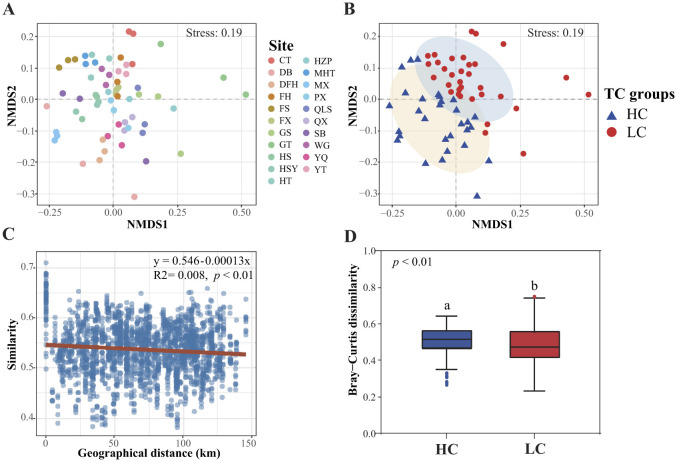
A fundamental goal of reservoir ecosystem management is to understand bacterial biogeographic patterns and the mechanisms shaping them at a regional scale. However, little is known about how eutrophication, a major water quality challenge in reservoirs, influences sediment bacterial biogeographic patterns in subtropical regions. In this study, sediment bacterial communities were sampled from 21 subtropical reservoirs in the Hanjiang river basin, southern China, and spanning trophic states from oligotrophic to eutrophic. Our findings demonstrated that eutrophication-driven changes in total carbon (TC) significantly shaped the regional biogeographic patterns of sediment bacterial communities, weakening the "distance-decay" relationships that typically link bacterial community similarity to geographical distance. TC content exceeding a threshold of 13.2 g·kg resulted in substantial shifts in bacterial community structure. Specifically, high TC levels promoted the dominance of copiotrophic bacteria such as (Deltaproteobacteria), (Firmicutes), and VadinHA17 (Bacteroidetes), while oligotrophic taxa like (Chloroflexi) and Nitrospirota were prevalent in low TC sediments. Additionally, higher TC content was associated with increased regional heterogeneity in bacterial community composition. Reservoirs with elevated TC levels exhibited more complex bacterial interaction networks, characterized by stronger niche segregation and higher competition compared to low TC networks. Overall, these findings underscore the pivotal role of sediment TC in shaping bacterial biogeography at a regional scale. They provide valuable insights for predicting ecosystem responses to eutrophication and offer guidance for mitigating the impacts of anthropogenic activities on freshwater ecosystems.
水库生态系统管理的一个基本目标是了解细菌生物地理模式及其在区域尺度上形成的机制。然而,对于富营养化这一水库主要水质挑战如何影响亚热带地区沉积物细菌生物地理模式,人们知之甚少。在本研究中,从中国南方汉江流域的21个亚热带水库采集了沉积物细菌群落样本,这些水库涵盖了从贫营养到富营养的不同营养状态。我们的研究结果表明,富营养化驱动的总碳(TC)变化显著塑造了沉积物细菌群落的区域生物地理模式,削弱了通常将细菌群落相似性与地理距离联系起来的“距离-衰减”关系。TC含量超过13.2 g·kg的阈值会导致细菌群落结构发生显著变化。具体而言,高TC水平促进了如(δ-变形菌纲)、(厚壁菌门)和VadinHA17(拟杆菌门)等富营养细菌的优势地位,而像(绿弯菌门)和硝化螺旋菌门等贫营养类群在低TC沉积物中更为普遍。此外,较高的TC含量与细菌群落组成的区域异质性增加有关。与低TC水库相比,TC水平升高的水库表现出更复杂的细菌相互作用网络,其特征是生态位分化更强和竞争更高。总体而言,这些发现强调了沉积物TC在区域尺度上塑造细菌生物地理学中的关键作用。它们为预测生态系统对富营养化的反应提供了有价值的见解,并为减轻人为活动对淡水生态系统的影响提供了指导。