Miller Bradley R, Gonzaga-Jauregui Claudia, Brigatti Karlla W, de Jong Job, Breese Robert S, Ko Seung Yeon, Puffenberger Erik G, Van Hout Cristopher, Young Millie, Luna Victor M, Staples Jeffrey, First Michael B, Gregoire Hilledna J, Dwork Andrew J, Pefanis Evangelos, McCarthy Shane, Brydges Susannah, Rojas Jose, Ye Bin, Stahl Eli, Di Gioia Silvio Alessandro, Hen René, Elwood Kevin, Rosoklija Gorazd, Li Dadong, Mellis Scott, Carey David, Croll Susan D, Overton John D, Macdonald Lynn E, Economides Aris N, Shuldiner Alan R, Chuhma Nao, Rayport Stephen, Amin Najaf, Kushner Steven A, Alessandri-Haber Nicole, Markx Sander, Strauss Kevin A
Department of Psychiatry, Columbia University, New York, NY 10032.
Division of Systems Neuroscience, New York State Psychiatric Institute, New York, NY 10032.
Proc Natl Acad Sci U S A. 2025 Apr 22;122(16):e2404754122. doi: 10.1073/pnas.2404754122. Epub 2025 Apr 14.
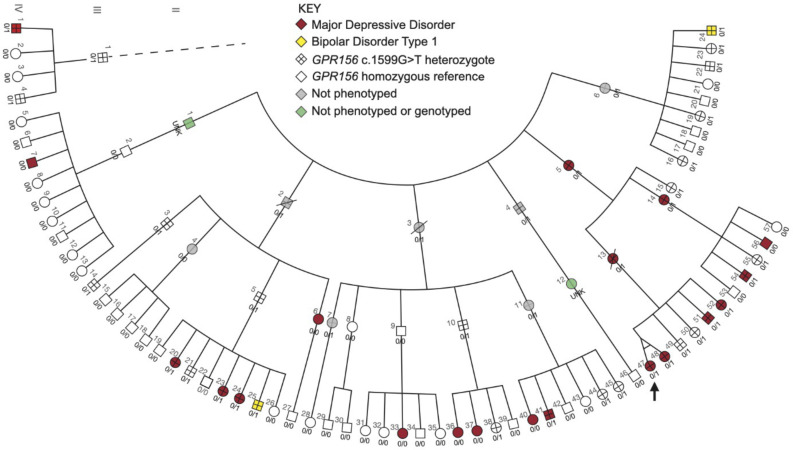
Major depressive disorder (MDD) is a leading cause of disability worldwide. Risk for MDD is heritable, and the genetic structure of founder populations enables investigation of rare susceptibility alleles with large effect. In an extended Old Order Mennonite family cohort, we identified a rare missense variant in (c.1599G>T, p.Glu533Asp) associated with a two-fold increase in the relative risk of MDD. GPR156 is an orphan G protein-coupled receptor localized in the medial habenula, a region implicated in mood regulation. Insertion of a human sequence containing c.1599G>T into the murine locus induced medial habenula hyperactivity and abnormal stress-related behaviors. This work reveals a human variant that is associated with depression, implicates GPR156 as a target for mood regulation, and introduces informative murine models for investigating the pathophysiology and treatment of affective disorders.
重度抑郁症(MDD)是全球致残的主要原因。MDD的风险具有遗传性,创始人群体的基因结构有助于研究具有较大效应的罕见易感等位基因。在一个扩展的旧秩序阿米什人家庭队列中,我们在GPR156中鉴定出一种罕见的错义变体(c.1599G>T,p.Glu533Asp),该变体与MDD相对风险增加两倍相关。GPR156是一种孤儿G蛋白偶联受体,定位于内侧缰核,该区域与情绪调节有关。将包含c.1599G>T的人类序列插入小鼠Gpr156基因座会导致内侧缰核活动亢进和异常的应激相关行为。这项研究揭示了一种与抑郁症相关的人类变体,表明GPR156是情绪调节的一个靶点,并引入了用于研究情感障碍病理生理学和治疗方法的信息丰富的小鼠模型。