Yuan Wenxin, Huang Yi-Chun, LeBlanc Chantal, Poulet Axel, De Luna Vitorino Francisca N, Valsakumar Devisree, Dean Renee, Garcia Benjamin A, van Wolfswinkel Josien C, Voigt Philipp, Jacob Yannick
Department of Molecular, Cellular and Developmental Biology, Faculty of Arts and Sciences, Yale University, New Haven, CT, USA.
Yale Stem Cell Center, Yale School of Medicine, New Haven, CT, USA.
Nat Commun. 2025 Apr 14;16(1):3547. doi: 10.1038/s41467-025-58892-2.
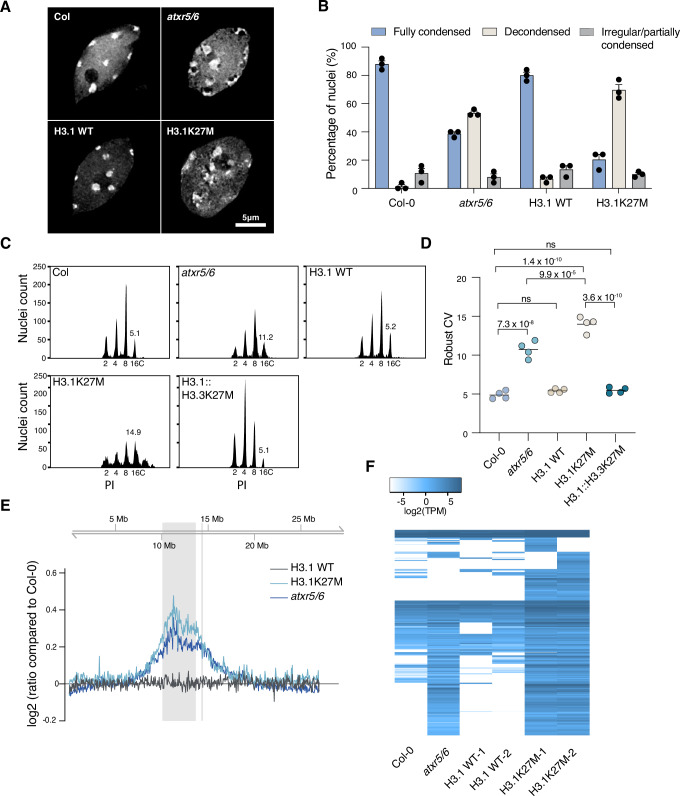
The oncomutation lysine 27-to-methionine in histone H3 (H3K27M) is frequently identified in tumors of patients with diffuse midline glioma-H3K27 altered (DMG-H3K27a). H3K27M inhibits the deposition of the histone mark H3K27me3, which affects the maintenance of transcriptional programs and cell identity. Cells expressing H3K27M are also characterized by defects in genome integrity, but the mechanisms linking expression of the oncohistone to DNA damage remain mostly unknown. In this study, we demonstrate that expression of H3.1K27M in the model plant Arabidopsis thaliana interferes with post-replicative chromatin maturation mediated by the H3.1K27 methyltransferases ATXR5 and ATXR6. As a result, H3.1 variants on nascent chromatin remain unmethylated at K27 (H3.1K27me0), leading to ectopic activity of TONSOKU (TSK/TONSL), which induces DNA damage and genomic alterations. Elimination of TSK activity suppresses the genome stability defects associated with H3.1K27M expression, while inactivation of specific DNA repair pathways prevents survival of H3.1K27M-expressing plants. Overall, our results suggest that H3.1K27M disrupts the chromatin-based mechanisms regulating TSK activity, which causes genomic instability and may contribute to the etiology of DMG-H3K27a.
组蛋白H3赖氨酸27位点向甲硫氨酸的致癌突变(H3K27M)在弥漫性中线胶质瘤-H3K27改变(DMG-H3K27a)患者的肿瘤中经常被发现。H3K27M抑制组蛋白标记H3K27me3的沉积,这会影响转录程序的维持和细胞特性。表达H3K27M的细胞还具有基因组完整性缺陷的特征,但将致癌组蛋白的表达与DNA损伤联系起来的机制大多仍不清楚。在这项研究中,我们证明,在模式植物拟南芥中表达H3.1K27M会干扰由H3.1K27甲基转移酶ATXR5和ATXR6介导的复制后染色质成熟。结果,新生染色质上的H3.1变体在K27位点保持未甲基化状态(H3.1K27me0),导致TONSOKU(TSK/TONSL)的异位激活,从而诱导DNA损伤和基因组改变。消除TSK活性可抑制与H3.1K27M表达相关的基因组稳定性缺陷,而特定DNA修复途径的失活会阻止表达H3.1K27M的植物存活。总体而言,我们的结果表明,H3.1K27M破坏了调节TSK活性的基于染色质的机制,这会导致基因组不稳定,并可能促成DMG-H3K27a的病因。