Wang Jinqiu, Fu Weida, Luo Jin, Wei Mingze, Dai Yongping
Department of Thyroid and Breast Surgery, The First Affiliated Hospital of Ningbo University, No.59 Liuting Street, Haishu District, Ningbo, 315010, Zhejiang, China.
BMC Cancer. 2025 Apr 14;25(1):693. doi: 10.1186/s12885-025-14112-0.
Identifying occult central lymph node metastasis (CLNM) is essential for guiding prophylactic lymph node dissection (PLND) in patients with cN0 stage papillary thyroid microcarcinoma (PTMC). This study aimed to identify molecular prognostic biomarkers associated with PTMC and develop a clinical-molecular prediction model for CLNM.
Differentially expressed genes (DEGs) in PTMC were identified through bioinformatics analysis of the TCGA database. Prognostic DEGs were selected using Cox and LASSO regression analyses, and a risk-scoring model was constructed based on these genes. The prognostic value of the model was validated using Kaplan-Meier survival analysis and ROC curves. DEG expression levels were compared between patients with CLNM and those without (NCLNM). Clinical data and surgical specimens were collected from 404 patients with cN0 stage PTMC treated at the First Affiliated Hospital of Ningbo University in 2022. The cohort was randomly divided into a derivation cohort (n = 323) and a validation cohort (n = 81). DEG expression was quantified using RT-qPCR. Univariate and multivariate logistic regression analyses were conducted in the derivation cohort to identify predictors of CLNM and develop a predictive model. The model's performance was evaluated using the Hosmer-Lemeshow test, ROC curves, calibration curves, and decision curve analysis (DCA).
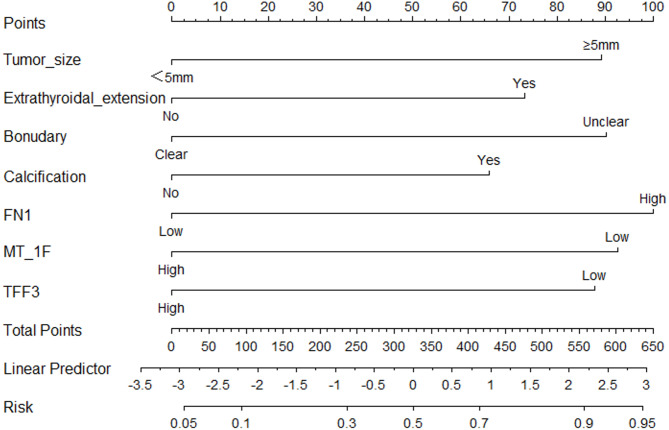
In the TCGA database, FN1, MT-1 F, and TFF3 were identified as prognostic biomarkers. Risk scores based on these genes achieved AUCs of 0.789 (5 years) and 0.674 (10 years) for predicting disease-free survival. Furthermore, FN1, MT-1 F, and TFF3 expression levels were significantly higher in the CLNM group compared to the NCLNM group. Among the 404 PTMC patients, the incidence of CLNM was 42.6% (n = 172). RT-qPCR analysis demonstrated significantly elevated expression of FN1 in both PTMC tissues compared to normal tissues and in the CLNM group relative to the NCLNM group, while MT-1 F and TFF3 exhibited markedly reduced expression levels. In the derivation cohort, FN1, MT-1 F, TFF3, tumor size ≥5 mm, calcification, multifocality, and extrathyroidal extension were independent predictors of CLNM. The prediction model based on these factors showed AUCs of 0.736 (derivation cohort) and 0.813 (validation cohort). Moreover, calibration curves, the Hosmer-Lemeshow test (χ² = 2.411, P = 0.966), and DCA confirmed the model's robust performance and clinical utility.
FN1, MT-1 F, and TFF3 are valuable prognostic biomarkers for PTMC. The clinical-molecular prediction model incorporating these genes provides a basis for personalized PLND decision-making in cN0 stage PTMC patients.
Not applicable.

识别隐匿性中央淋巴结转移(CLNM)对于指导cN0期甲状腺微小乳头状癌(PTMC)患者的预防性淋巴结清扫(PLND)至关重要。本研究旨在识别与PTMC相关的分子预后生物标志物,并建立CLNM的临床-分子预测模型。
通过对TCGA数据库进行生物信息学分析,确定PTMC中的差异表达基因(DEG)。使用Cox和LASSO回归分析选择预后DEG,并基于这些基因构建风险评分模型。使用Kaplan-Meier生存分析和ROC曲线验证该模型的预后价值。比较CLNM患者和无CLNM患者(NCLNM)的DEG表达水平。收集2022年在宁波大学第一附属医院接受治疗的404例cN0期PTMC患者的临床资料和手术标本。该队列被随机分为推导队列(n = 323)和验证队列(n = 81)。使用RT-qPCR对DEG表达进行定量。在推导队列中进行单因素和多因素逻辑回归分析,以识别CLNM的预测因素并建立预测模型。使用Hosmer-Lemeshow检验、ROC曲线、校准曲线和决策曲线分析(DCA)评估模型的性能。
在TCGA数据库中,FN1、MT-1F和TFF3被确定为预后生物标志物。基于这些基因的风险评分在预测无病生存方面,5年AUC为0.789,10年AUC为0.674。此外,与NCLNM组相比,CLNM组中FN1、MT-1F和TFF3的表达水平显著更高。在404例PTMC患者中,CLNM的发生率为42.6%(n = 172)。RT-qPCR分析表明,与正常组织相比,PTMC组织中FN1的表达显著升高,且与NCLNM组相比,CLNM组中FN1的表达也显著升高,而MT-1F和TFF3的表达水平明显降低。在推导队列中,FN1、MT-1F、TFF3、肿瘤大小≥5 mm、钙化、多灶性和甲状腺外侵犯是CLNM的独立预测因素。基于这些因素的预测模型在推导队列中的AUC为0.736,在验证队列中的AUC为0.813。此外,校准曲线、Hosmer-Lemeshow检验(χ² = 2.411,P = 0.966)和DCA证实了该模型的稳健性能和临床实用性。
FN1、MT-1F和TFF3是PTMC有价值的预后生物标志物。纳入这些基因的临床-分子预测模型为cN0期PTMC患者的个性化PLND决策提供了依据。
不适用。