Zhang Fufei, Huang Jingyi, Huang Xinlin, Zhao Xinran, Yang Qinfeng, Wang Jian, Yu Xuegao, Xu Xue
School of Health, Dongguan Polytechnic, Dongguan, Guangdong, 523000, China.
School of Pharmaceutical Sciences, Southern Medical University, Guangzhou, Guangdong, 510515, China.
BMC Womens Health. 2025 Apr 14;25(1):180. doi: 10.1186/s12905-025-03728-w.
To investigate the risk factors associated with postpartum urinary retention after cesarean section (CS) and to determine the associated morbidity rate.
This study was a population-based retrospective case-control study analyzed using National Inpatient Sample (NIS) data from 2010 to 2019. The study classified women according to whether they developed postpartum urinary retention after delivery. Predictors of postpartum urinary retention occurring after CS were identified by multivariate logistic regression analysis, and the corresponding incidence rates were examined after adjusting for basic maternal demographic and clinical characteristics.
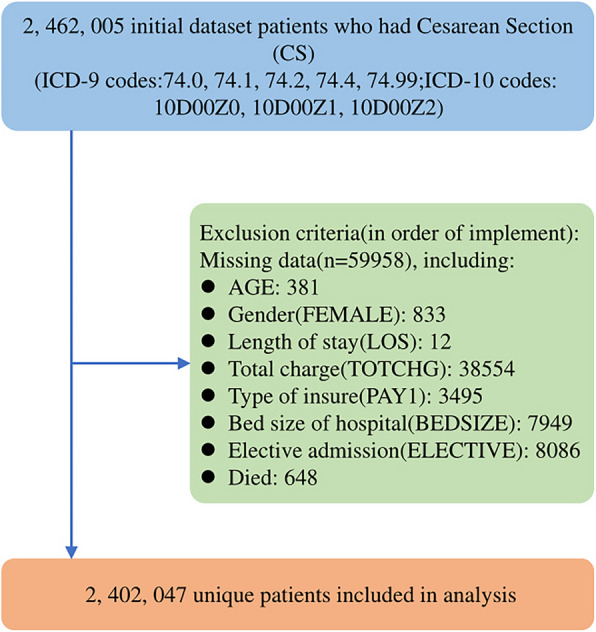
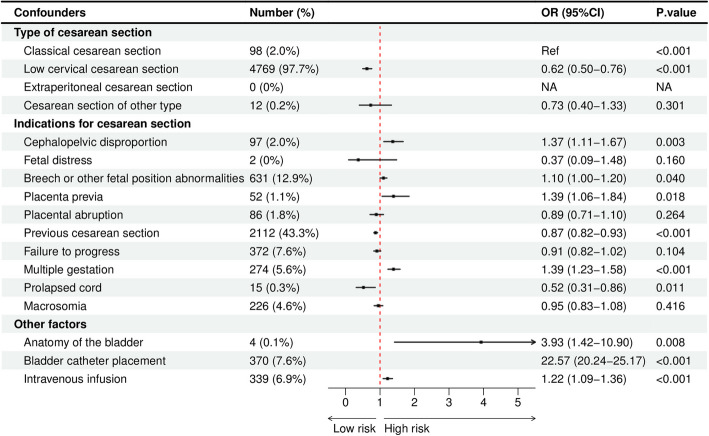
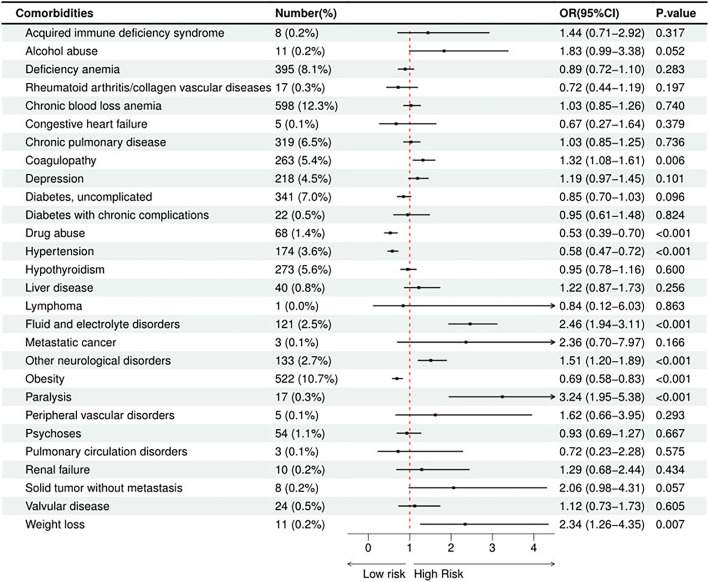
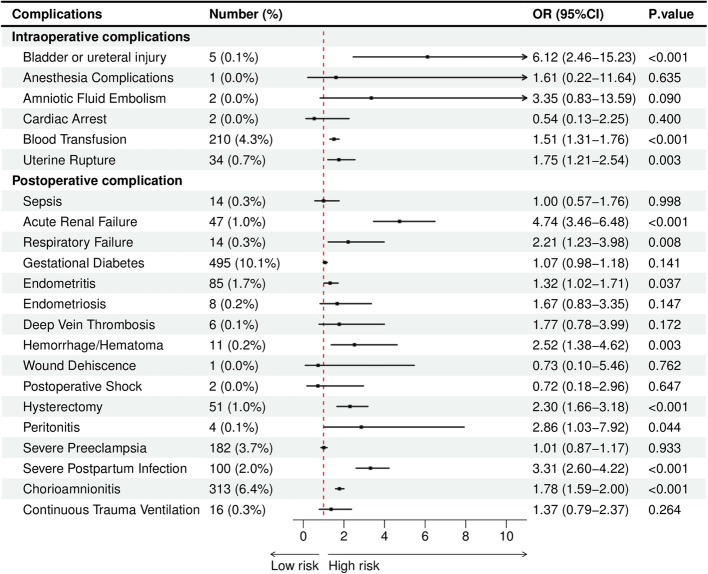
A total of 2,397,168 CSs were extracted from the NIS database. The overall incidence of urinary retention after CS was 0.20%. Patients who experienced urinary retention after CS demonstrated longer length of stay (LOS), higher total costs, and more postoperative complications. The following variables have been identified as potential risk factors for urinary retention: age between 25 and 34 years (OR = 1.27; 95% CI = 1.17-1.38; P < 0.001), 35 years and older (OR = 1.35; 95% CI = 1.22-1.48; P < 0.001), Asian and Pacific Islander (OR = 1.85; 95% CI = 1.68-2.05; P < 0.001), one comorbidity (OR = 1.51; 95% CI = 1.28-1.79; P < 0.001), two comorbidities (OR = 1.51; 95% CI = 1.09-2.08; P = 0.013), three and more comorbidities (OR = 1.79; 95% CI = 1.06-3.04; P = 0.031), large hospitals (OR = 1.16; 95% CI = 1.07-1.26; P < 0.001), teaching hospitals (OR = 1.93; 95% CI = 1.79-2.07; P < 0.001), eastern hospitals (OR = 1.24; 95% CI = 1.14-1.35; P < 0.001), coagulation disorders (OR = 1.32; 95% CI = 1.08-1.61), fluid and electrolyte disorders (OR = 2.46; 95% CI = 1.94-3.11), other neurological disorders (OR = 1.51; 95% CI = 1.20-1.89), paralysis (OR = 3.24; 95% CI = 1.95-5.38), and weight loss (OR = 2.34;95% CI = 1.26-4.35). In addition, urinary retention was associated with postoperative complications related to bladder or ureteral injury (OR = 6.12; 95% CI = 2.46-15.23), blood transfusion (OR = 1.51; 95% CI = 1.31-1.76), acute renal failure (OR = 4.74; 95% CI = 3.46-6.48), respiratory failure (OR = 2.21; 95% CI = 1.23-3.98), endometritis (OR = 1.32; 95% CI = 1.02-1.71), hemorrhage/hematoma ( OR = 2.52; 95% CI = 1.38-4.62), uterine rupture (OR = 1.75; 95% CI = 1.21-2.54), hysterectomy (OR = 2.30; 95% CI = 1.66-3.18), peritonitis (OR = 2.86; 95% CI = 1.03-7.92), severe puerperal infections (OR = 3.31; 95% CI = 2.60- 4.22), chorioamnionitis (OR = 1.78; 95% CI = 1.59-2.00). Notably, the presence of cephalopelvic disproportion (OR = 1.37; 95% CI = 1.11-1.67), breech or other fetal position abnormalities (OR = 1.10; 95% CI = 1.00-1.20), placenta previa (OR = 1.39; 95% CI = 1.06-1.84), multiple gestation (OR = 1.39; 95% CI = 1.23-1.58), anatomy of the bladder (OR = 3.93; 95% CI = 1.42-10.90), bladder catheter placement (OR = 22.57; 95% CI = 20.24-25.17) and intravenous infusion (OR = 1.22; 95% CI = 1.09-1.36) was associated with a significantly increased risk of urinary retention, while low cervical CS (OR = 0.62; 95% CI = 0.50-0.76), previous CS (OR = 0.87; 95% CI = 0.82-0.93) and prolapsed cord (OR = 0.52; 95% CI = 0.31-0.86) conferred some protective effect against it.
In this study, we identified an overall prevalence of 0.20% for urinary retention after CS and several risk factors, including advanced maternal age, Asian and Pacific Islander background, comorbidities, and delivery in large or teaching hospitals, particularly in the Eastern region. Protective factors included hospitals in the southern region, urban hospitals, obesity, and hypertension. Urinary retention was associated with increased postoperative complications, longer LOS, and higher healthcare costs. Several confounders also significantly influenced the incidence of urinary retention. To mitigate these risks, healthcare professionals should prioritize antenatal screening, manage comorbidities, and closely monitor high-risk patients during the postpartum period to reduce adverse outcomes.
探讨剖宫产术后产后尿潴留的相关危险因素,并确定其相关发病率。
本研究是一项基于人群的回顾性病例对照研究,使用2010年至2019年的国家住院样本(NIS)数据进行分析。该研究根据女性产后是否发生尿潴留进行分类。通过多因素逻辑回归分析确定剖宫产术后发生产后尿潴留的预测因素,并在调整基本产妇人口统计学和临床特征后检查相应的发病率。
从NIS数据库中提取了总共2397168例剖宫产病例。剖宫产术后尿潴留的总体发生率为0.20%。剖宫产术后发生尿潴留的患者住院时间更长、总费用更高且术后并发症更多。以下变量已被确定为尿潴留的潜在危险因素:25至34岁(OR = 1.27;95% CI = 1.17 - 1.38;P < 0.001)、35岁及以上(OR = 1.35;95% CI = 1.22 - 1.48;P < 0.001)、亚裔和太平洋岛民(OR = 1.85;95% CI = 1.68 - 2.05;P < 0.001)、一种合并症(OR = 1.51;95% CI = 1.28 - 1.79;P < 0.001)、两种合并症(OR = 1.51;95% CI = 1.09 - 2.08;P = 0.013)、三种及以上合并症(OR = 1.79;95% CI = 1.06 - 3.04;P = 0.031)、大型医院(OR = 1.16;95% CI = 1.07 - 1.26;P < 0.001)、教学医院(OR = 1.93;95% CI = 1.79 - 2.07;P < 0.001)、东部医院(OR = 1.24;95% CI = 1.14 - 1.35;P < 0.001)、凝血障碍(OR = 1.32;95% CI = 1.08 - 1.61)、液体和电解质紊乱(OR = 2.46;95% CI = 1.94 - 3.11)、其他神经系统疾病(OR = 1.51;95% CI = 1.20 - 1.89)、瘫痪(OR = 3.24;95% CI = 1.95 - 5.38)和体重减轻(OR = 2.34;95% CI = 1.26 - 4.35)。此外,尿潴留与膀胱或输尿管损伤相关的术后并发症(OR = 6.12;95% CI = 2.46 - 15.23)、输血(OR = 1.51;95% CI = 1.31 - 1.76)、急性肾衰竭(OR = 4.74;95% CI = 3.46 - 6.48)、呼吸衰竭(OR = 2.21;95% CI = 1.23 - 3.98)、子宫内膜炎(OR = 1.32;95% CI = 1.02 - 1.71)、出血/血肿(OR = 2.52;95% CI = 1.38 - 4.62)、子宫破裂(OR = 1.75;95% CI = 1.21 - 2.54)、子宫切除术(OR = 2.30;95% CI = 1.66 - 3.18)、腹膜炎(OR = 2.86;95% CI = 1.03 - 7.92)、严重产褥感染(OR = 3.31;95% CI = 2.60 - 4.22)、绒毛膜羊膜炎(OR = 1.78;95% CI = 1.59 - 2.00)有关。值得注意的是,头盆不称(OR = 1.37;95% CI = 1.11 - 1.67)、臀位或其他胎位异常(OR = 1.10;95% CI = 1.00 - 1.20)、前置胎盘(OR = 1.39;95% CI = 1.06 - 1.84)、多胎妊娠(OR = 1.39;95% CI = 1.23 - 1.58)、膀胱解剖结构(OR = 3.93;95% CI = 1.42 - 10.90)、膀胱导管放置(OR = 22.57;95% CI = 20.24 - 25.17)和静脉输液(OR = 1.22;95% CI = 1.09 - 1.36)与尿潴留风险显著增加相关,而低位宫颈剖宫产(OR = 0.62;95% CI = 0.50 - 0.76)、既往剖宫产(OR = 0.87;95% CI = 0.82 - 0.93)和脐带脱垂(OR = 0.52;95% CI = 0.31 - 0.86)对其有一定的保护作用。
在本研究中,我们确定剖宫产术后尿潴留的总体患病率为0.20%,并确定了几个危险因素,包括产妇年龄较大、亚裔和太平洋岛民背景、合并症以及在大型或教学医院分娩,特别是在东部地区。保护因素包括南部地区的医院、城市医院、肥胖和高血压。尿潴留与术后并发症增加、住院时间延长和医疗费用增加相关。几个混杂因素也显著影响尿潴留的发生率。为降低这些风险,医护人员应优先进行产前筛查、管理合并症,并在产后密切监测高危患者以减少不良结局。