Wang Neng, Zheng Yu, Tao Shuai, Chen Liang
Department of Liver Disease, Shanghai Public Health Clinical Center, Fudan University, Shanghai, China.
Center of Infectious Disease, West China Hospital, Sichuan University, Chengdu, Sichuan, 610041, P.R. China.
BMC Pulm Med. 2025 Apr 14;25(1):178. doi: 10.1186/s12890-025-03628-7.
To identify risk factors for pulmonary infection in patients with hepatitis B virus (HBV)-related acute-on-chronic liver failure (ACLF), assess its impact on prognosis, and develop a prognostic prediction model.
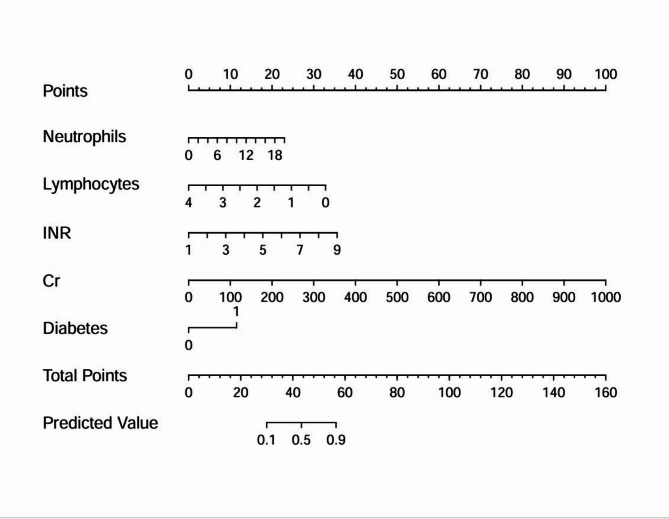
We retrospectively analyzed the clinical data of 393 patients with HBV-ACLF. Logistic regression was used to analyze the risk factors for lung infection in ACLF patients, as well as the factors affecting the prognosis of those who were infected. Additionally, a prognostic prediction model was established using the Nomogram method.
The incidence of pulmonary infections in patients with ACLF was 38.7%, and patients with ACLF combined with pulmonary infections had a higher short-term mortality rate than those without infections (65.71% vs. 35.02%). Multivariate logistic regression analysis indicated that independent risk factors for pulmonary infection included TBIL, CRP, invasive procedures, peritoneal effusion, and hepatic encephalopathy. Additionally, creatinine, INR, comorbid diabetes mellitus, neutrophil counts, and lymphocyte counts were identified as independent risk factors affecting 30-day mortality in patients with pulmonary infection. Incorporating these risk factors, a new predictive model was established, with an area under the receiver operating characteristic curve of 0.832 (95% CI, 0.765-0.900). This model demonstrated higher discriminatory performance compared to traditional prognostic models such as CTP, MELD, and MELD-Na, with statistically significant differences (P < 0.05).
HBV-ACLF patients are susceptible to pulmonary infection, with fungal infection posing a significant threat. Pulmonary infection is associated with worse prognosis in HBV-ACLF patients. Early identification of risk factors and prognostic assessment can facilitate timely intervention and improve prognosis.
确定乙型肝炎病毒(HBV)相关慢加急性肝衰竭(ACLF)患者肺部感染的危险因素,评估其对预后的影响,并建立预后预测模型。
我们回顾性分析了393例HBV-ACLF患者的临床资料。采用逻辑回归分析ACLF患者肺部感染的危险因素以及感染患者的预后影响因素。此外,使用列线图法建立预后预测模型。
ACLF患者肺部感染发生率为38.7%,合并肺部感染的ACLF患者短期死亡率高于未感染者(65.71%对35.02%)。多因素逻辑回归分析表明,肺部感染的独立危险因素包括总胆红素(TBIL)、C反应蛋白(CRP)、侵入性操作、腹腔积液和肝性脑病。此外,肌酐、国际标准化比值(INR)、合并糖尿病、中性粒细胞计数和淋巴细胞计数被确定为影响肺部感染患者30天死亡率的独立危险因素。纳入这些危险因素后,建立了一个新的预测模型,受试者工作特征曲线下面积为0.832(95%可信区间,0.765-0.900)。与传统预后模型如CTP、MELD和MELD-Na相比,该模型具有更高的辨别性能,差异有统计学意义(P<0.05)。
HBV-ACLF患者易发生肺部感染,真菌感染构成重大威胁。肺部感染与HBV-ACLF患者预后较差相关。早期识别危险因素和进行预后评估有助于及时干预并改善预后。