Ali Aizaz, Ali Muhammad Abdullah, Khattak Asad Iqbal, Khattak Fazia, Afridi Abdullah, Azeem Touba, Shabbar Banatwala Umme Salma, Alam Umama, Khan Ayesha, Jalal Urbe, Moeez Abdul, Khan Malik W Z, Collins Peter, Ahmed Raheel
Khyber Medical College, Peshawar, Pakistan.
Bacha Khan Medical College, Pakistan.
Int J Cardiol Heart Vasc. 2025 Mar 28;58:101651. doi: 10.1016/j.ijcha.2025.101651. eCollection 2025 Jun.
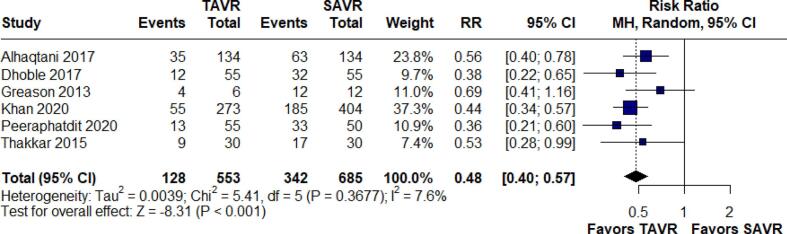
Aortic valve stenosis in patients with chronic liver diseases, particularly liver cirrhosis and End-Stage Liver Disease, poses significant management challenges due to the interplay between cardiovascular and hepatic dysfunction. This systematic review and meta-analysis compared the safety and efficacy of Transcatheter Aortic Valve Replacement (TAVR) and Surgical Aortic Valve Replacement in this high-risk population. An extensive search of PubMed, Embase, and Web of Science (inception to January 5, 2025) identified 11 retrospective studies comprising 19,097 patients. Risk ratios for dichotomous outcomes and mean differences (MD) for continuous outcomes, each with 95% confidence intervals, were calculated using random-effects models. The analysis revealed that TAVR significantly reduced hospital mortality (RR 0.36, 95 % CI: 0.30-0.42; I = 7.6 %), acute kidney injury (RR 0.51, 95 % CI: 0.33-0.78; I = 57.2 %), bleeding (RR 0.33, 95 % CI: 0.28-0.39; I = 0.0 %), stroke (RR 0.35, 95 % CI: 0.23-0.51; I = 6.1 %), and blood transfusion (RR 0.48, 95 % CI: 0.40-0.57; I = 7.6 %). TAVR was also associated with shorter hospital stays (MD -6.77 days, 95 % CI: -9.17 to -4.38; I = 97.5 %). No significant differences were observed in vascular complications requiring surgery or hospital charges and post-operative infections. These findings suggest TAVR offers significant advantages over SAVR in reducing complications such as mortality, acute kidney injury, and bleeding in patients with liver disease. However, further randomized trials are necessary to confirm long-term outcomes and establish optimal treatment strategies for this high-risk population.
慢性肝病患者,尤其是肝硬化和终末期肝病患者的主动脉瓣狭窄,由于心血管功能障碍和肝功能障碍之间的相互作用,给治疗带来了重大挑战。本系统评价和荟萃分析比较了经导管主动脉瓣置换术(TAVR)和外科主动脉瓣置换术在这一高危人群中的安全性和有效性。通过广泛检索PubMed、Embase和Web of Science(从创刊到2025年1月5日),确定了11项回顾性研究,共纳入19,097例患者。使用随机效应模型计算二分结果的风险比和连续结果的平均差(MD),并给出95%置信区间。分析显示,TAVR显著降低了住院死亡率(RR 0.36,95%CI:0.30 - 0.42;I² = 7.6%)、急性肾损伤(RR 0.51,95%CI:0.33 - 0.78;I² = 57.2%)、出血(RR 0.33,95%CI:0.28 - 0.39;I² = 0.0%)、中风(RR 0.35,95%CI:0.23 - 0.51;I² = 6.1%)和输血(RR 0.48,95%CI:0.40 - 0.57;I² = 7.6%)。TAVR还与缩短住院时间相关(MD -6.77天,95%CI:-9.17至-4.38;I² = 97.5%)。在需要手术的血管并发症、住院费用和术后感染方面未观察到显著差异。这些发现表明,在降低肝病患者的死亡率、急性肾损伤和出血等并发症方面,TAVR比SAVR具有显著优势。然而,需要进一步的随机试验来确认长期结果,并为这一高危人群制定最佳治疗策略。