Fu Liang, Kim Su Hyun, Garcia Deanna Dolores, Lambert Marcus, Rivera Lurheinna Rosado, Hayward Matt, Vieira Candice, Parikh Alexander, Yu Ping, Song Lixin
School of Nursing, The University of Texas Health Science Center at San Antonio (UTHSCSA), San Antonio, TX, 78229, USA.
College of Nursing, Research Institute of Nursing Science, Kyungpook National University, Daegu, 41944, Republic of Korea.
J Gastrointest Cancer. 2025 Apr 16;56(1):98. doi: 10.1007/s12029-025-01218-8.
This scoping review aims to provide a comprehensive literature review regarding supportive care needs and related interventions for patients with pancreatic cancer and/or their informal caregivers.
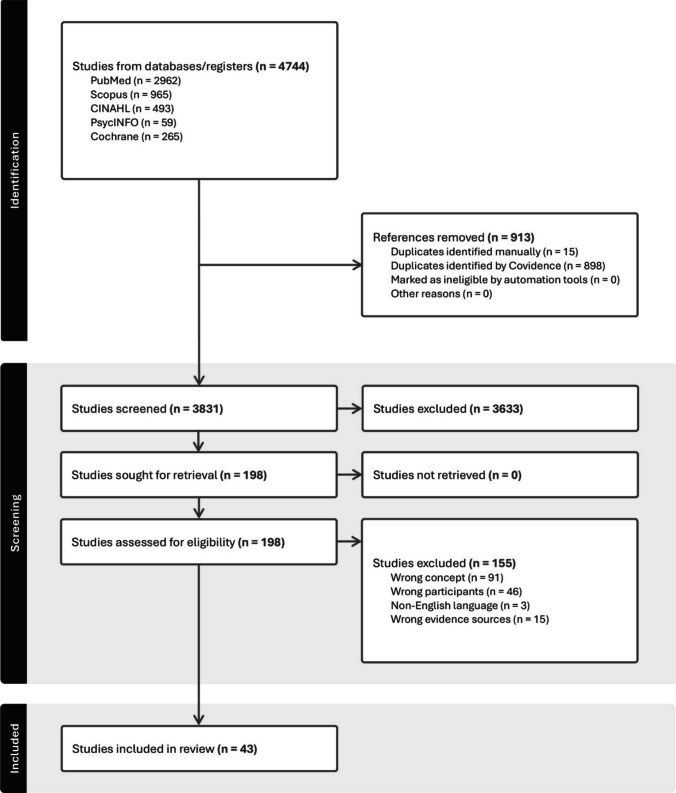
Following the Joanna Briggs Institute Manual for Evidence Synthesis, we conducted this review. In January 2025, we searched five English databases using the keywords "pancreatic cancer," "patients/caregivers," "supportive care," and "needs." We summarized the data employing the Supportive Care Framework.
Of the 4752 references identified, 43 articles were included in the review. Among the 33 descriptive studies, informational needs emerged as the most frequently reported supportive care need, identified in studies involving both patients and informal caregivers (n = 6), patients only (n = 13), and informal caregivers only (n = 5). These were followed by emotional needs (n = 4) for both patients and informal caregivers, physical needs (n = 8) for patients only, and emotional (n = 4) and practical needs (n = 4) for informal caregivers only. Psycho-educational interventions were the most frequently reported approach for addressing the needs of both patients and informal caregivers, while pain/symptom management interventions were the most frequently used to support patients alone. Four studies demonstrated statistically significant improvements in outcomes for intervention groups compared to control groups.
Patients with pancreatic cancer and their informal caregivers experienced a spectrum of supportive care needs, particularly informational needs. Intervention strategies have been developed to address their supportive care needs, but only a few studies demonstrated statistically significant improvements in outcomes. These findings advance our understanding of the supportive care needs and related interventions for patients with pancreatic cancer and/or their informal caregivers, providing a foundation for future research and targeted interventions to better address these needs.
本范围综述旨在全面回顾有关胰腺癌患者和/或其非正式照护者的支持性护理需求及相关干预措施的文献。
按照乔安娜·布里格斯循证综合手册进行本综述。2025年1月,我们使用关键词“胰腺癌”“患者/照护者”“支持性护理”和“需求”检索了五个英文数据库。我们采用支持性护理框架对数据进行了总结。
在检索到的4752篇参考文献中,有43篇文章纳入了本综述。在33项描述性研究中,信息需求是最常被报告的支持性护理需求,在涉及患者和非正式照护者的研究(n = 6)、仅涉及患者的研究(n = 13)以及仅涉及非正式照护者的研究(n = 5)中均有发现。其次是患者和非正式照护者的情感需求(n = 4)、仅患者的身体需求(n = 8)以及仅非正式照护者的情感需求(n = 4)和实际需求(n = 4)。心理教育干预是最常被报告的满足患者和非正式照护者需求的方法,而疼痛/症状管理干预是最常用于单独支持患者的方法。四项研究表明,与对照组相比,干预组的结局有统计学显著改善。
胰腺癌患者及其非正式照护者有一系列支持性护理需求,尤其是信息需求。已制定干预策略来满足他们的支持性护理需求,但只有少数研究表明结局有统计学显著改善。这些发现增进了我们对胰腺癌患者和/或其非正式照护者的支持性护理需求及相关干预措施的理解,为未来研究和针对性干预以更好地满足这些需求奠定了基础。