Gong Qineng, Zhu Tianyu, Zhang Linlin, Wu Hui, Miao Yang, Hu Ye
Medical Research Center, Affiliated Hospital 2, Nantong University, Nantong, 226001, People's Republic of China.
Jiangsu Provincial Medical Key Discipline (Laboratory) Cultivation Unit, Medical Research Center, Nantong First People's Hospital, Nantong, 226001, People's Republic of China.
Discov Oncol. 2025 Apr 16;16(1):538. doi: 10.1007/s12672-025-02332-6.
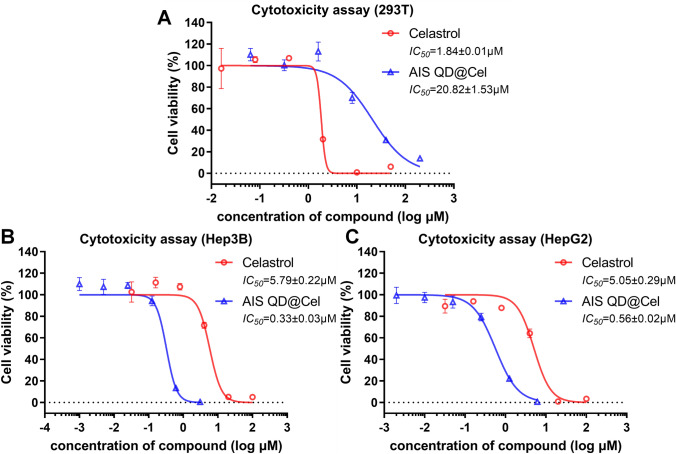
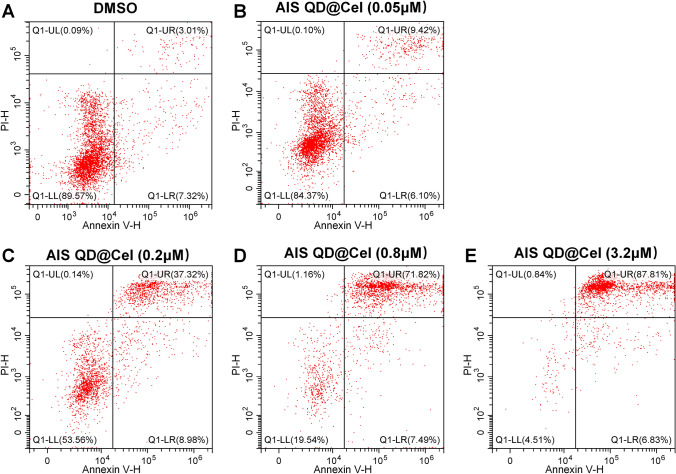
Hepatocellular carcinoma (HCC) is a predominant form of liver cancer and one of the leading causes of cancer-related death globally. Therefore, there is an urgent need for innovative therapeutic strategies that target the molecular mechanisms underlying HCC progression and metastasis, aiming to improve treatment efficacy and patient survival. The natural product celastrol (Cel) has demonstrated inhibitory effects in various cancer cell lines. However, its clinical application has been hindered by high toxicity and a low safety threshold. Metal-free quantum dots (QDs), AgInS (AIS QDs) not only eliminate toxic risks associated with heavy metals but also exhibit high biocompatibility in the biomedical field. By developing AIS QD@Cel, an AIS QDs nano-delivery system for Cel, the cell selectivity and inhibitory effects of Cel on HCC were enhanced. Fourier-transform infrared spectroscopy (FTIR) analysis revealed that AIS QDs can interact with Cel via amide bonds. The encapsulation rate of AIS QDs to Cel reached 27.5%. AIS QD@Cel eliminated toxicity on 293T and enhanced inhibition on HCC cells by over 10 times. Furthermore, the western blotting and flow cytometry experiments showed that AIS QD@Cel promoted apoptosis and autophagy signal pathway. Finally, transcriptome sequencing revealed that AIS QD@Cel effect on HCC by regulating gene expression involved in critical signaling pathways that are implicated in the progression of cancer. This strategy holds the potential to increase safety threshold and clinical applicability of Cel, offering significant clinical value for the treatment of HCC patients.
肝细胞癌(HCC)是肝癌的主要形式,也是全球癌症相关死亡的主要原因之一。因此,迫切需要创新的治疗策略,以针对HCC进展和转移的分子机制,旨在提高治疗效果和患者生存率。天然产物雷公藤红素(Cel)已在多种癌细胞系中显示出抑制作用。然而,其临床应用受到高毒性和低安全阈值的阻碍。无金属量子点(QDs),即AgInS(AIS QDs)不仅消除了与重金属相关的毒性风险,而且在生物医学领域表现出高生物相容性。通过开发AIS QD@Cel,一种用于Cel的AIS QDs纳米递送系统,增强了Cel对HCC的细胞选择性和抑制作用。傅里叶变换红外光谱(FTIR)分析表明,AIS QDs可以通过酰胺键与Cel相互作用。AIS QDs对Cel的包封率达到27.5%。AIS QD@Cel消除了对293T细胞的毒性,并将对HCC细胞的抑制作用提高了10倍以上。此外,蛋白质印迹和流式细胞术实验表明,AIS QD@Cel促进了凋亡和自噬信号通路。最后,转录组测序显示,AIS QD@Cel通过调节参与癌症进展的关键信号通路的基因表达来影响HCC。该策略有可能提高Cel的安全阈值和临床适用性,为HCC患者的治疗提供重要的临床价值。