Kamberi Ariana, Weitz Benjamin, Flahive Julie, Eve Julianna, Najjar Reem, Liaghat Tara, Ford Daniel, Lindenauer Peter, Person Sharina, Houston Thomas K, Gauvey-Kern Megan E, Lobien Jackie, Sadasivam Rajani S
Division of Health Informatics and Implementation Science, Department of Population and Quantitative Health Sciences, UMass Chan Medical School, Worcester, MA, United States.
Division of Biostatistics and Health Services Research, Department of Population and Quantitative Health Sciences, UMass Chan Medical School, Worcester, MA, United States.
JMIR Res Protoc. 2025 Apr 16;14:e63693. doi: 10.2196/63693.
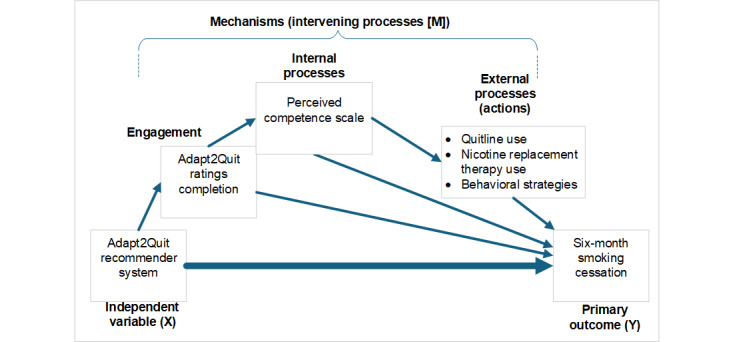
Individuals who are socioeconomically disadvantaged have high smoking rates and face barriers to participating in smoking cessation interventions. Computer-tailored health communication, which is focused on finding the most relevant messages for an individual, has been shown to promote behavior change. We developed a machine learning approach (the Adapt2Quit recommender system), and our pilot work demonstrated the potential to increase message relevance and smoking cessation effectiveness among individuals who are socioeconomically disadvantaged.
This study protocol describes our randomized controlled trial to test whether the Adapt2Quit recommender system will increase smoking cessation among individuals from socioeconomically disadvantaged backgrounds who smoke.
Individuals from socioeconomically disadvantaged backgrounds who smoke were identified based on insurance tied to low income or from clinical settings (eg, community health centers) that provide care for low-income patients. They received text messages from the Adapt2Quit recommender system for 6 months. Participants received daily text messages for the first 30 days and every 14 days until the end of the study. Intervention participants also received biweekly texting facilitation messages, that is, text messages asking participants to respond (yes or no) if they were interested in being referred to the quitline. Interested participants were then actively referred to the quitline by study staff. Intervention participants also received biweekly text messages assessing their current smoking status. Control participants did not receive the recommender messages but received the biweekly texting facilitation and smoking status assessment messages. Our primary outcome is the 7-day point-prevalence smoking cessation at 6 months, verified by carbon monoxide testing. We will use an inverse probability weighting approach to test our primary outcome. This involves using a logistic regression model to predict nonmissingness, calculating the inverse probability of nonmissingness, and using it as a weight in a logistic regression model to compare cessation rates between the two groups.
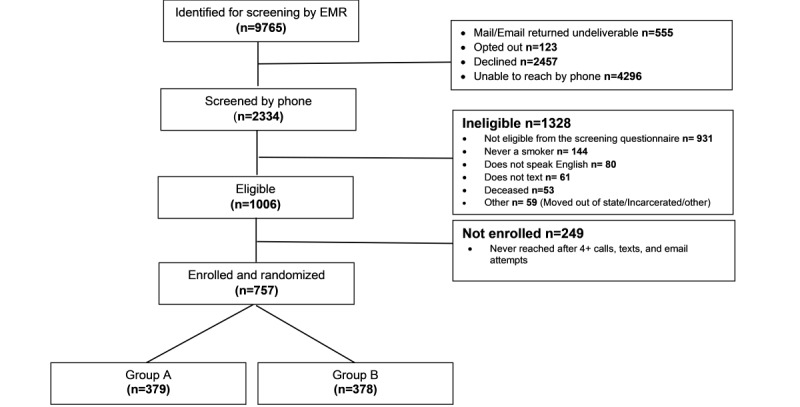
The Adapt2Quit study was funded in April 2020 and is still ongoing. We have completed the recruitment of individuals (N=757 participants). The 6-month follow-up of all participants was completed in November 2024. The sample consists of 64% (486/757) female participants, 35% (265/757) Black or African American individuals, 51.1% (387/757) White individuals, and 16% (121/757) Hispanic or Latino individuals. In total, 52.6% (398/757) of participants reported having a high school education or being a high school graduate; 70% (529/757) smoked their first cigarette within 30 minutes of waking, and half (379/757, 50%) had stopped smoking for at least one day in the past year. Moreover, 16.6% (126/757) had called the quitline before study participation.
We have recruited a diverse sample of individuals who are socioeconomically disadvantaged and designed a rigorous protocol to evaluate the Adapt2Quit recommender system. Future papers will present our main analysis of the trial.
ClinicalTrials.gov NCT04720625; https://clinicaltrials.gov/study/NCT04720625.
INTERNATIONAL REGISTERED REPORT IDENTIFIER (IRRID): DERR1-10.2196/63693.
社会经济地位不利的人群吸烟率较高,且在参与戒烟干预措施时面临障碍。计算机定制的健康沟通方式专注于为个体找到最相关的信息,已被证明能促进行为改变。我们开发了一种机器学习方法(Adapt2Quit推荐系统),我们的试点工作表明该系统有潜力提高社会经济地位不利个体所接收信息的相关性以及戒烟效果。
本研究方案描述了我们的随机对照试验,以测试Adapt2Quit推荐系统是否会提高来自社会经济地位不利背景的吸烟个体的戒烟率。
根据与低收入相关的保险或从为低收入患者提供护理的临床机构(如社区健康中心)来确定社会经济地位不利背景的吸烟个体。他们在6个月内收到来自Adapt2Quit推荐系统的短信。参与者在开始的30天内每天收到短信,之后每14天收到一次,直至研究结束。干预组参与者还会每两周收到一次短信促进信息,即询问参与者是否有兴趣被转介到戒烟热线并请其回复(是或否)的短信。有兴趣的参与者随后会由研究人员积极转介到戒烟热线。干预组参与者还会每两周收到评估其当前吸烟状况的短信。对照组参与者不接收推荐信息,但会收到每两周一次的短信促进信息和吸烟状况评估信息。我们的主要结局指标是6个月时经一氧化碳检测验证的7天点患病率戒烟率。我们将使用逆概率加权法来检验我们的主要结局指标。这包括使用逻辑回归模型预测数据非缺失情况,计算非缺失的逆概率,并将其用作逻辑回归模型中的权重,以比较两组之间的戒烟率。
Adapt2Quit研究于2020年4月获得资助,目前仍在进行中。我们已完成个体招募(N = 757名参与者)。所有参与者的6个月随访已于2024年11月完成。样本包括64%(486/757)的女性参与者、35%(265/757)的黑人或非裔美国人、51.1%(387/757)的白人以及16%(121/757)的西班牙裔或拉丁裔个体。总体而言,52.6%(398/757)的参与者报告拥有高中教育程度或为高中毕业生;70%(529/757)的人在醒来后30分钟内吸了第一支烟,一半(379/757,50%)的人在过去一年中至少戒烟一天。此外,16.6%(126/757)的人在参与研究前曾拨打过戒烟热线。
我们招募了社会经济地位不利的多样化个体样本,并设计了一个严谨的方案来评估Adapt2Quit推荐系统。未来的论文将展示我们对该试验的主要分析。
ClinicalTrials.gov NCT04720625;https://clinicaltrials.gov/study/NCT04720625。
国际注册报告标识符(IRRID):DERR1-10.2196/63693。