Schmidt Anna, Fuchs Jana, Dedden Mark, Kocher Katharina, Schülein Christine, Hübner Julian, Vieira Antão Ana, Irrgang Pascal, Oltmanns Friederike, Viherlehto Vera, Leicht Natascha, Rieker Ralf Joachim, Geppert Carol, Appelt Uwe, Zundler Sebastian, Schober Kilian, Lapuente Dennis, Tenbusch Matthias
Friedrich-Alexander-Universität Erlangen-Nürnberg, University Hospital Erlangen, Institute of Clinical and Molecular Virology, Erlangen, Germany.
Department of Medicine 1, University Hospital Erlangen and Friedrich-Alexander-Universität Erlangen-Nürnberg, Erlangen, Germany.
Nat Commun. 2025 Apr 16;16(1):3612. doi: 10.1038/s41467-025-58931-y.
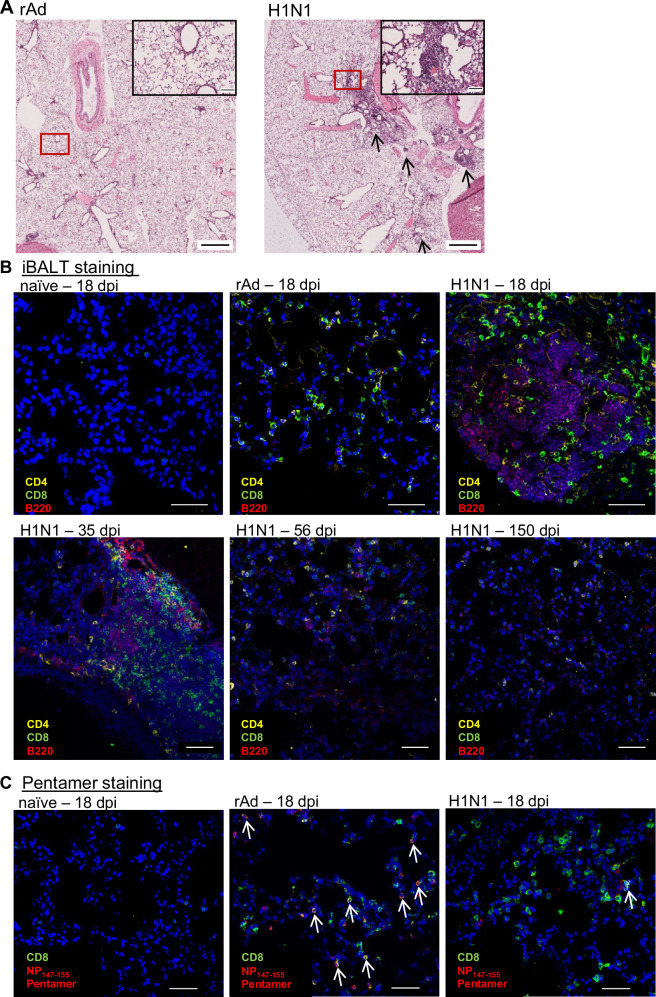
Lung tissue-resident memory T cells (T) are critical for the local control of respiratory tract infections caused by influenza A viruses (IAV). Here we compare T populations induced by intranasal adenoviral vector vaccines encoding hemagglutinin and nucleoprotein (NP) with those induced by an H1N1 infection in BALB/c mice. While vaccine-induced T express high levels of CD103 and persist longer in the lung parenchyma, short-lived, H1N1-induced T have a transcriptome associated with higher cytotoxic potential and distinct transcriptional profile as shown by single-cell RNA sequencing. In both the vaccine and H1N1 groups, NP-specific CD8 T cells expand during heterologous influenza virus infection and protect the mice from disease. Meanwhile, lung inflammation in response to an infection with unrelated respiratory syncytial virus do not influence the fate of pre-existing T. Our preclinical work thus confirms that inflammatory conditions in the tissue shape the phenotypic and functional characteristics of T to serve relevant informations for optimizing mucosal vaccines.
肺组织驻留记忆T细胞(T细胞)对于甲型流感病毒(IAV)引起的呼吸道感染的局部控制至关重要。在这里,我们比较了在BALB/c小鼠中,由编码血凝素和核蛋白(NP)的鼻内腺病毒载体疫苗诱导产生的T细胞群体与由H1N1感染诱导产生的T细胞群体。虽然疫苗诱导的T细胞高表达CD103并在肺实质中持续更长时间,但H1N1诱导产生的短暂性T细胞具有与更高细胞毒性潜力相关的转录组以及如单细胞RNA测序所示的独特转录谱。在疫苗组和H1N1组中,NP特异性CD8 T细胞在异源流感病毒感染期间都会扩增,并保护小鼠免受疾病侵害。同时,对无关的呼吸道合胞病毒感染产生的肺部炎症不会影响预先存在的T细胞的命运。因此,我们的临床前研究工作证实,组织中的炎症状况塑造了T细胞的表型和功能特征可为优化黏膜疫苗提供相关信息。