Lv Man, Wang Yue, Yuan Ziyin, Zhai Lina, Iqbal Haroon, Ur-Rehman Uzair, Ning Xin, Wei Huiying, Xin Jun, Jin Zihui, Yi Zhou, Wang Baichuan, Chen Wangkai, Xiao Run
School of Life Science, Tianjin University, Tianjin, 300072, China.
Zhejiang Cancer Hospital, Hangzhou Institute of Medicine, Chinese Academy of Sciences, Hangzhou, 310022, Zhejiang, China.
Sci Rep. 2025 Apr 16;15(1):13119. doi: 10.1038/s41598-025-95741-0.
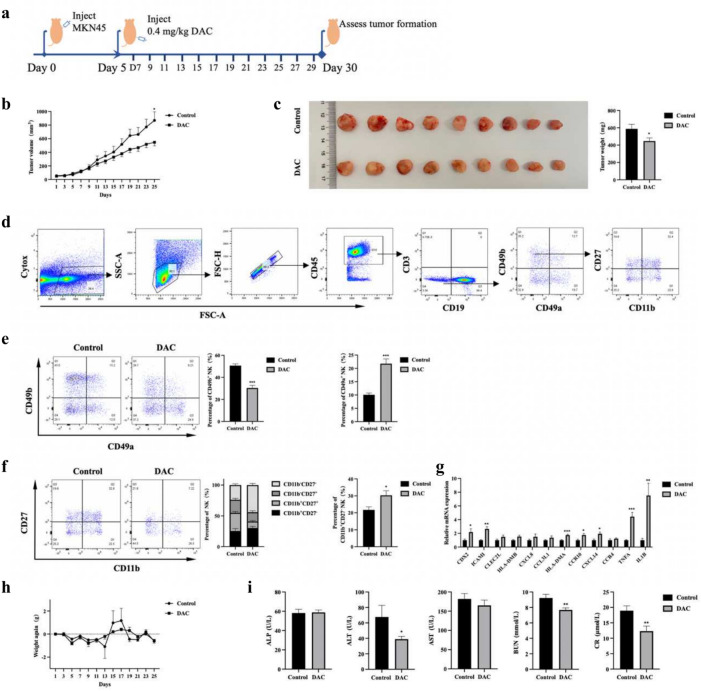
Poorly differentiated gastric cancer (PDGC) is characterized by high invasiveness, rapid progression, and poor prognosis for patients. Differentiation therapy has long been a promising approach by manipulating the differentiation state of tumor cells to inhibit tumor growth, offering fewer side effects. Decitabine (DAC), is known as an inhibitor of DNA methylation, thus reactivating the transcription of previously methylated silenced genes associated with differentiation to induce a more differentiated state. This study used the differentiation-inducing agents DAC to treat two PDGC cell lines, MKN45 and NUGC4, and explored the impact of DAC on cell proliferation and influence of their sensitivity to Natural Killer cells (NK cells) mediated cytotoxicity. The results demonstrated a significant reduction in cell proliferation, migration, and invasion without affecting cell viability after DAC treatment. Additionally, transcriptomic analysis revealed that DAC-treated PDGC cells upregulated multiple immune-related genes, including the gene encoding for tumor necrosis factor alpha (TNF-α). Co-culture study of NK cells and PDGC cells showed that DAC treatment enhanced the sensitivity of these cancer cells to NK cell-mediated cytotoxicity, and TNF-α played a crucial role in promoting NK cell cytotoxicity. Following the subcutaneous implantation of tumors in nude mice, DAC administration significantly inhibited the growth of PDGC tumors and induced the upregulation of differentiation related genes. In summary, DAC effectively reduces the malignant characteristics of the PDGC cells by promoting their transition towards a higher state of differentiation and enhancing their sensitivity to NK cell-mediated killing, providing new insights for the mechanisms of the antitumor effects of DAC.
低分化胃癌(PDGC)具有侵袭性高、进展迅速以及患者预后差的特点。长期以来,分化疗法一直是一种很有前景的方法,通过操纵肿瘤细胞的分化状态来抑制肿瘤生长,且副作用较少。地西他滨(DAC)是一种已知的DNA甲基化抑制剂,可重新激活与分化相关的先前甲基化沉默基因的转录,从而诱导更分化的状态。本研究使用分化诱导剂DAC处理两种PDGC细胞系MKN45和NUGC4,并探讨DAC对细胞增殖的影响及其对自然杀伤细胞(NK细胞)介导的细胞毒性敏感性的影响。结果表明,DAC处理后细胞增殖、迁移和侵袭显著减少,而不影响细胞活力。此外,转录组分析显示,经DAC处理的PDGC细胞上调了多个免疫相关基因,包括编码肿瘤坏死因子α(TNF-α)的基因。NK细胞与PDGC细胞的共培养研究表明,DAC处理增强了这些癌细胞对NK细胞介导的细胞毒性的敏感性,且TNF-α在促进NK细胞细胞毒性中起关键作用。在裸鼠皮下植入肿瘤后,给予DAC显著抑制了PDGC肿瘤的生长,并诱导了分化相关基因的上调。总之,DAC通过促进PDGC细胞向更高分化状态转变并增强其对NK细胞介导杀伤的敏感性,有效降低了PDGC细胞的恶性特征,为DAC抗肿瘤作用机制提供了新的见解。