Yang Yuhua, Gong Yali, Zhang Naan, Peng Huagang, Shang Weilong, Yang Yi, Rao Yifan, Hu Zhen, Tan Li, Wang Yuting, Liu Lu, Liu He, Huang Xiaonan, Zhang Yulin, Hu Qiwen, Yuan Zhiqiang, Rao Xiancai
Department of Microbiology, College of Basic Medical Sciences, Key Laboratory of Microbial Engineering under the Educational Committee in Chongqing, Army Medical University, Chongqing, China.
Institute of Burn Research, State Key Laboratory of Trauma and Chemical Poisoning, Southwest Hospital, Army Medical University, Chongqing, China.
Microbiol Spectr. 2025 Jun 3;13(6):e0257724. doi: 10.1128/spectrum.02577-24. Epub 2025 Apr 17.
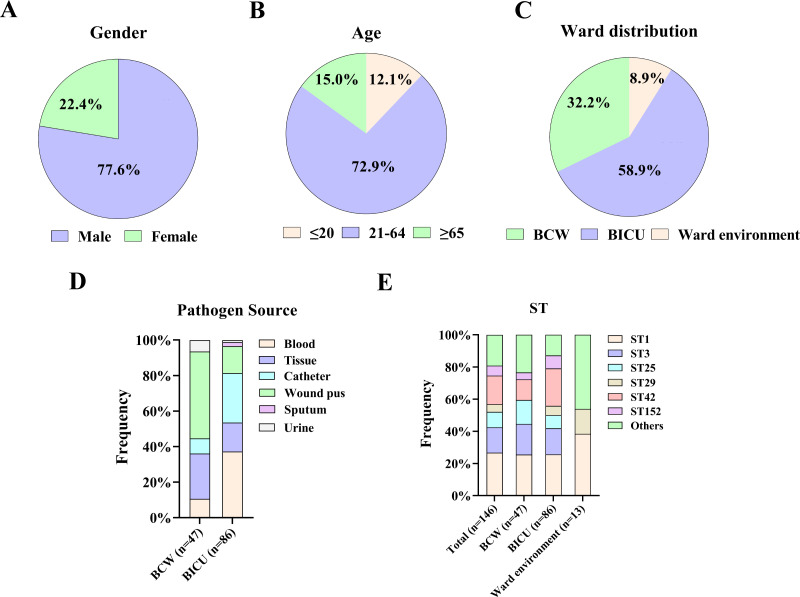
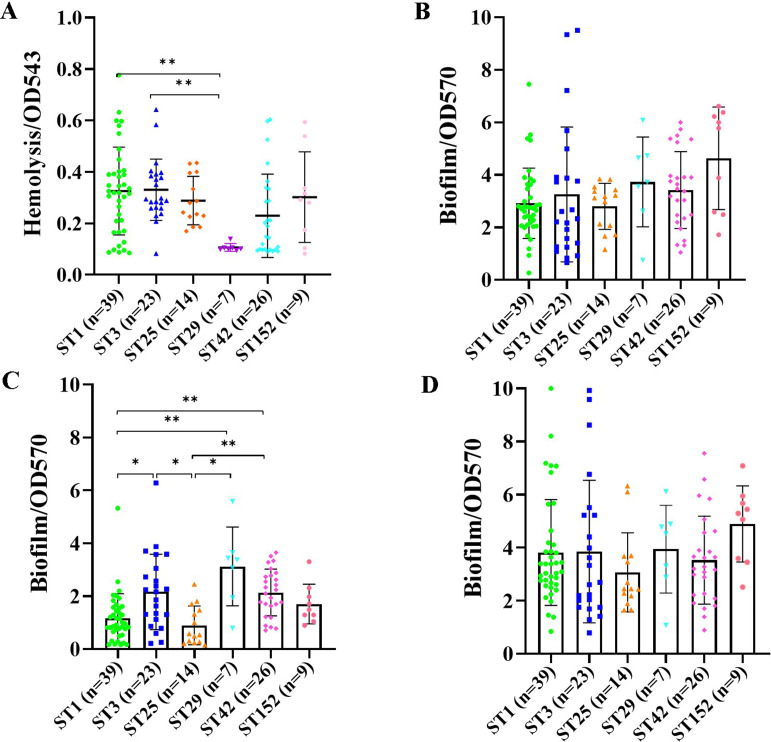
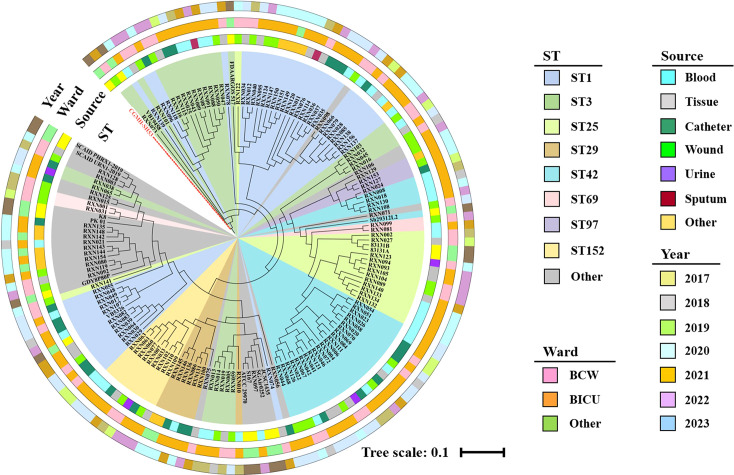
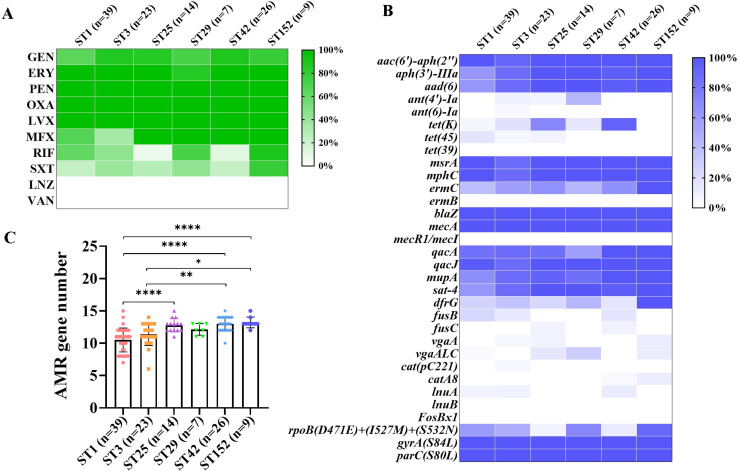
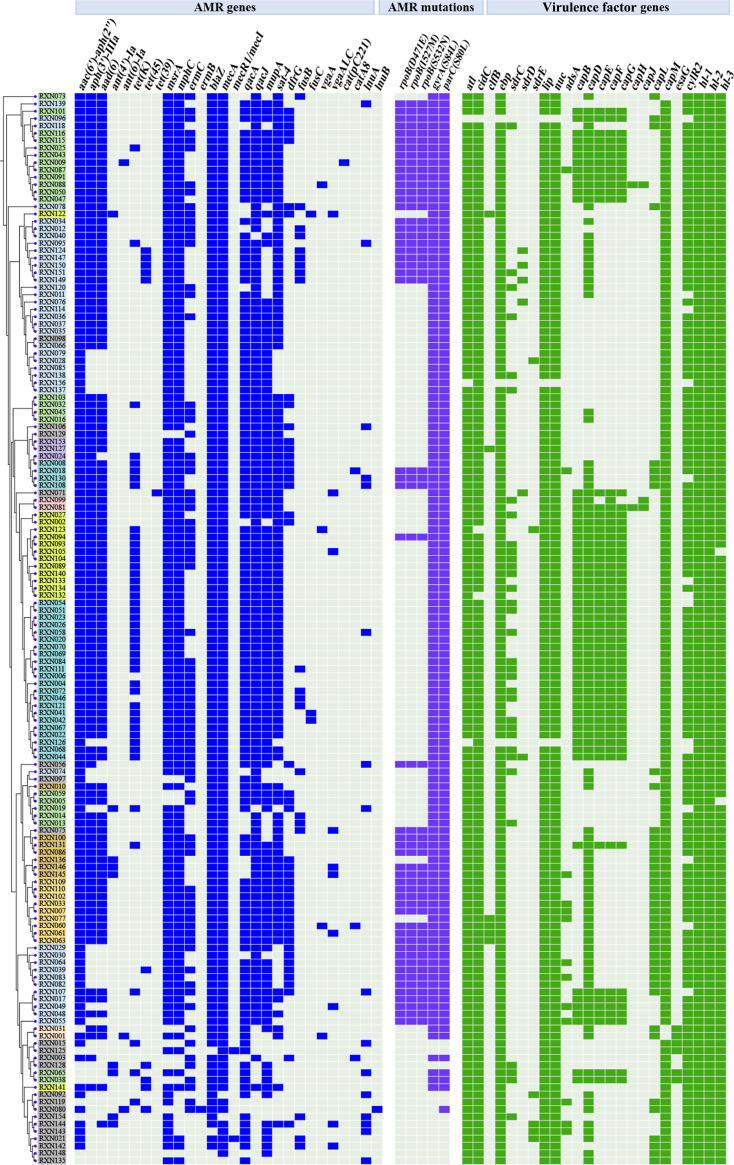
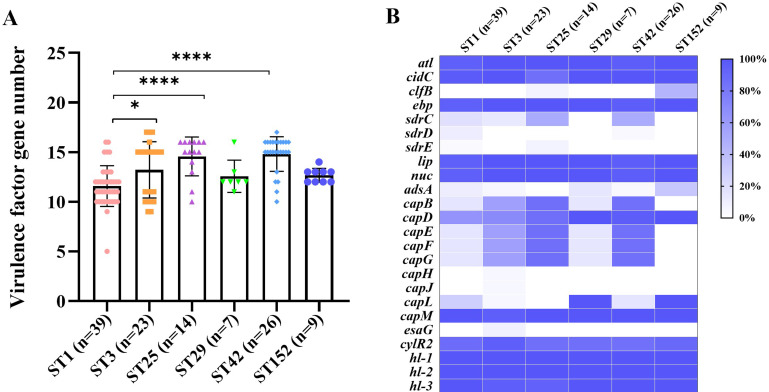
is one of the frequently isolated nosocomial pathogens in immunocompromised patients; however, its genotypic and phenotypic characteristics in burn patients remain largely unknown. In this study, 146 . strains were collected from the burn unit of a tertiary hospital in Chongqing, southwestern China. Whole genome sequencing was applied to determine the molecular characteristics of these isolates. Results showed that sequence type 1 (ST1; 26.7%, 39/146) was the most prevalent lineage, followed by clones ST42 (17.8%, 25/146), ST3 (15.8%, 23/146), ST25 (9.6%, 14/146), ST29 (4.8%, 7/146), and newly emerged ST152 (6.2%, 9/146). In terms of phenotypes, 90.4% (132/146) of the isolates were multidrug-resistant (MDR), and more than 90% strains exhibited resistance to penicillin, erythromycin, oxacillin, and levofloxacin. A total of 145 out of 146 . isolates harbored at least 10 virulence factor genes. The tested strains with ST1, ST3, ST25, and ST42 presented similar hemolytic activities and biofilm formation capabilities. All detected ST152 isolates were MDR, corresponding to the number of their antimicrobial resistance genes being the largest among all tested STs. Moreover, ST152 isolates had increased hemolytic capacity and biofilm formation capability compared with their counterpart ST29 strains, the parent lineage of ST152 with a single locus variation. Overall, this study showed the genomic and phenotypic characteristics of 146 . strains isolated in Chongqing and found the newly emerged ST152 MDR lineage with hypervirulence, which may call attention to the control of infections caused by MDR strains in hospitals.IMPORTANCE is a common opportunistic pathogen with multidrug resistance in clinical infections. In this study, we analyzed the molecular epidemiological characteristics of 146 . strains isolated from the burn patients of a tertiary hospital in Chongqing between 2017 and 2023. The results demonstrated that the phylogenetic evolution of strains was diverse and plastic. The majority of the isolates were multidrug-resistant (MDR). The virulence genes, resistance elements, and phenotypes, such as hemolysis and biofilm formation, were determined. A new lineage (ST152) that harbored the highest number of resistance genes was characterized to be 100% (9/9) MDR. The prevalence of ST152 strains suggests a new health threat in terms of control and treatment of coagulase-negative staphylococcal infections in Chongqing. This study provides information for clinical control of dissemination and infection in hospitals.
是免疫功能低下患者中经常分离出的医院感染病原体之一;然而,其在烧伤患者中的基因型和表型特征仍 largely 未知。在本研究中,从中国西南部重庆一家三级医院的烧伤科收集了146株菌株。应用全基因组测序来确定这些分离株的分子特征。结果显示,序列类型1(ST1;26.7%,39/146)是最常见的谱系,其次是克隆ST42(17.8%,25/146)、ST3(15.8%,23/146)、ST25(9.6%,14/146)、ST29(4.8%,7/146)和新出现的ST152(6.2%,9/146)。在表型方面,90.4%(132/146)的分离株为多重耐药(MDR),超过90%的菌株对青霉素、红霉素、苯唑西林和左氧氟沙星耐药。146株分离株中共有145株至少携带10个毒力因子基因。测试的ST1、ST3、ST25和ST42菌株表现出相似的溶血活性和生物膜形成能力。所有检测到的ST152分离株均为MDR,其抗菌耐药基因数量在所有测试的序列类型中最多。此外,与ST152的单基因座变异的亲本谱系ST29菌株相比,ST152分离株的溶血能力和生物膜形成能力增强。总体而言,本研究显示了在重庆分离的146株菌株的基因组和表型特征,并发现了新出现的具有高毒力的ST152 MDR谱系,这可能需要关注医院中由MDR菌株引起的感染的控制。重要性是临床感染中具有多重耐药性的常见机会性病原体。在本研究中,我们分析了2017年至2023年期间从重庆一家三级医院的烧伤患者中分离出的146株菌株的分子流行病学特征。结果表明,菌株的系统发育进化是多样的且具有可塑性。大多数分离株为多重耐药(MDR)。确定了毒力基因、耐药元件以及溶血和生物膜形成等表型。一个携带最多耐药基因的新谱系(ST152)被鉴定为100%(9/9)MDR。ST152菌株的流行对重庆凝固酶阴性葡萄球菌感染的控制和治疗构成了新的健康威胁。本研究为医院中菌株传播和感染的临床控制提供了信息。