Lei Hillmin, Shawki Ali, Santos Alina N, Canale Vinicius, Manz Salomon, Crawford Meli'sa S, Chatterjee Pritha, Spalinger Marianne R, Scharl Michael, McCole Declan F
School of Medicine, Division of Biomedical Sciences, University of California, Riverside, CA 92521, USA.
Department of Gastroenterology & Hepatology, University Hospital Zurich, 8091 Zurich, Switzerland.
Int J Mol Sci. 2025 Apr 3;26(7):3356. doi: 10.3390/ijms26073356.
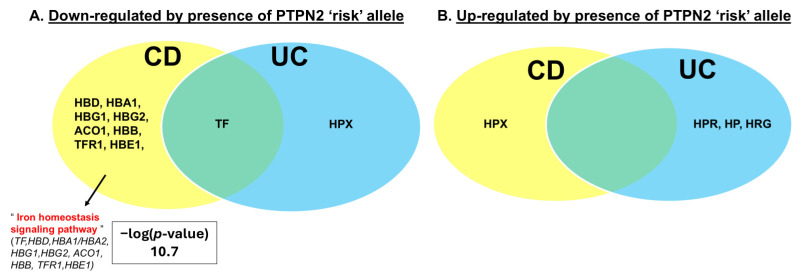
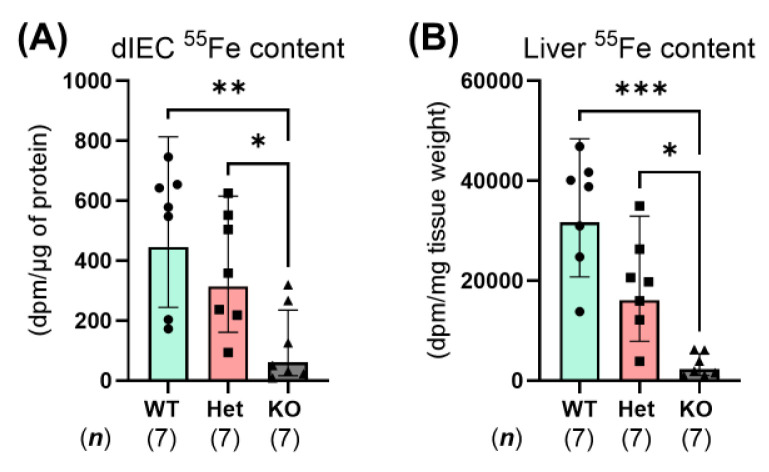
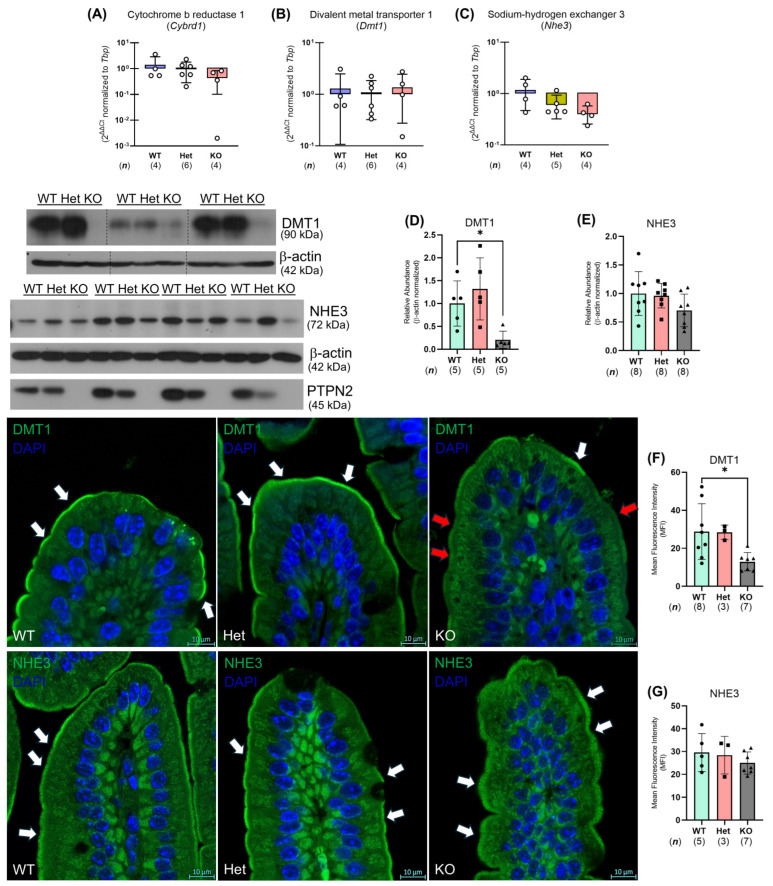
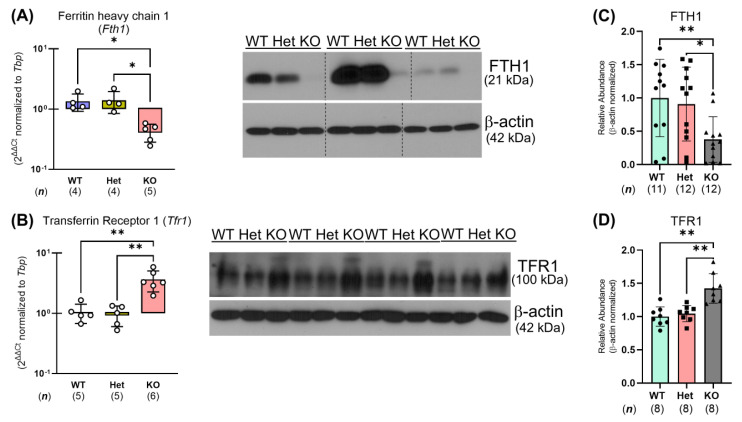
Anemia is the most common extraintestinal manifestation of inflammatory bowel disease (IBD). Iron deficiency is the most frequent cause of anemia in IBD; however, the mechanisms involved are still poorly understood. Here, we investigated the role of the IBD risk gene, protein tyrosine phosphatase non-receptor type 2 (), in regulating iron homeostasis. Proteomic analyses were performed on serum from IBD patients genotyped for the IBD-associated loss-of-function rs1893217 variant. Constitutive wild type (WT), heterozygous (Het), and knockout (KO) mice were analyzed for iron content, blood parameters, and expression of iron handling proteins. Iron absorption was assessed through radiotracer assays. Serum proteomic analyses revealed that the "iron homeostasis signaling pathway" was the main pathway downregulated in Crohn's disease (CD) patients carrying the risk allele, independent of disease activity. -KO mice showed characteristics of anemia, including reduced hemoglobin concentrations along with serum and tissue iron deficiency and elevated serum hepcidin levels vs. -WT and Het mice. Fe absorption via oral gavage was significantly impaired in -KO mice. Correspondingly, -KO mice showed reduced apical membrane expression of the iron transporter DMT1. CD patients with the loss-of-function rs1893217 variant display alterations in serum iron handling proteins. Loss of in mice caused features of anemia, including iron deficiency associated with reduced apical membrane expression of DMT1. These findings identify an important role for in regulating systemic iron homeostasis.
贫血是炎症性肠病(IBD)最常见的肠外表现。缺铁是IBD中贫血最常见的原因;然而,其涉及的机制仍知之甚少。在此,我们研究了IBD风险基因蛋白酪氨酸磷酸酶非受体2型()在调节铁稳态中的作用。对IBD相关功能丧失rs1893217变体基因分型的IBD患者血清进行了蛋白质组学分析。分析了组成型野生型(WT)、杂合子(Het)和敲除(KO)小鼠的铁含量、血液参数以及铁处理蛋白的表达。通过放射性示踪分析评估铁吸收。血清蛋白质组学分析显示,“铁稳态信号通路”是携带风险等位基因的克罗恩病(CD)患者中下调的主要通路,与疾病活动无关。与-WT和Het小鼠相比,-KO小鼠表现出贫血特征,包括血红蛋白浓度降低、血清和组织缺铁以及血清铁调素水平升高。-KO小鼠经口灌胃的铁吸收明显受损。相应地,-KO小鼠的铁转运蛋白DMT1顶端膜表达降低。具有功能丧失rs1893217变体的CD患者血清铁处理蛋白出现改变。小鼠中缺失导致贫血特征,包括与DMT1顶端膜表达降低相关的缺铁。这些发现确定了在调节全身铁稳态中的重要作用。