Ruan Baiye, Paulson Robert F
Pathobiology Graduate Program, Penn State University, University Park, PA, United States.
Center for Molecular Immunology and Infectious Disease, Department of Veterinary and Biomedical Sciences, Penn State University, University Park, PA, United States.
Front Physiol. 2023 Jan 5;13:1063294. doi: 10.3389/fphys.2022.1063294. eCollection 2022.
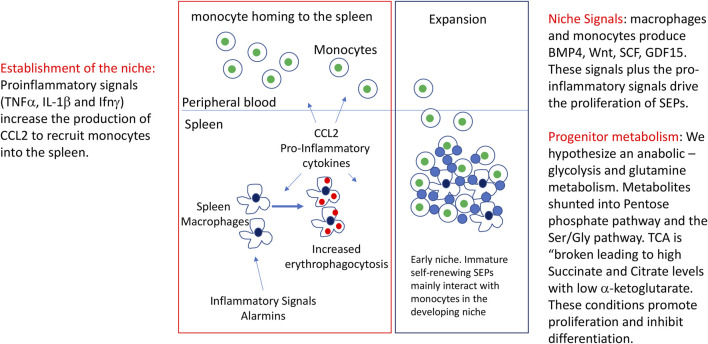
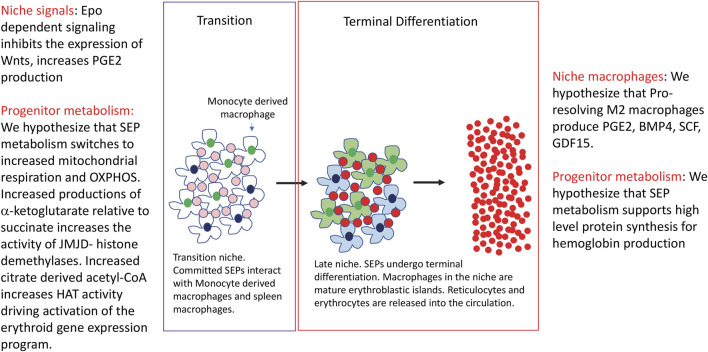
Steady state erythropoiesis produces new erythrocytes at a constant rate to replace the senescent cells that are removed by macrophages in the liver and spleen. However, infection and tissue damage disrupt the production of erythrocytes by steady state erythropoiesis. During these times, stress erythropoiesis is induced to compensate for the loss of erythroid output. The strategy of stress erythropoiesis is different than steady state erythropoiesis. Stress erythropoiesis generates a wave of new erythrocytes to maintain homeostasis until steady state conditions are resumed. Stress erythropoiesis relies on the rapid proliferation of immature progenitor cells that do not differentiate until the increase in serum Erythropoietin (Epo) promotes the transition to committed progenitors that enables their synchronous differentiation. Emerging evidence has revealed a central role for cell metabolism in regulating the proliferation and differentiation of stress erythroid progenitors. During the initial expansion stage, the immature progenitors are supported by extensive metabolic changes which are designed to direct the use of glucose and glutamine to increase the biosynthesis of macromolecules necessary for cell growth and division. At the same time, these metabolic changes act to suppress the expression of genes involved in erythroid differentiation. In the subsequent transition stage, changes in niche signals alter progenitor metabolism which in turn removes the inhibition of erythroid differentiation generating a bolus of new erythrocytes to alleviate anemia. This review summarizes what is known about the metabolic regulation of stress erythropoiesis and discusses potential mechanisms for metabolic regulation of proliferation and differentiation.
稳态红细胞生成以恒定速率产生新的红细胞,以替代被肝脏和脾脏中的巨噬细胞清除的衰老细胞。然而,感染和组织损伤会破坏稳态红细胞生成对红细胞的产生。在这些时期,会诱导应激红细胞生成以补偿红细胞生成量的损失。应激红细胞生成的策略与稳态红细胞生成不同。应激红细胞生成会产生一波新的红细胞以维持体内平衡,直到恢复稳态条件。应激红细胞生成依赖于未成熟祖细胞的快速增殖,这些祖细胞在血清促红细胞生成素(Epo)增加促进向定向祖细胞转变并使其同步分化之前不会分化。新出现的证据表明细胞代谢在调节应激红细胞祖细胞的增殖和分化中起核心作用。在初始扩增阶段,未成熟祖细胞通过广泛的代谢变化得到支持,这些变化旨在引导葡萄糖和谷氨酰胺的利用,以增加细胞生长和分裂所需的大分子的生物合成。同时,这些代谢变化会抑制参与红细胞分化的基因的表达。在随后的转变阶段,生态位信号的变化会改变祖细胞代谢,进而消除对红细胞分化的抑制,产生大量新的红细胞以缓解贫血。本综述总结了关于应激红细胞生成的代谢调节的已知信息,并讨论了增殖和分化的代谢调节的潜在机制。