Bujaldón Roger, Fons Arnau, Garcia-Amorós Jaume, Vaca Cristina, Nogués Josep, Esplandiu Maria José, Gómez Elvira, Sepúlveda Borja, Serrà Albert
Grup d'Electrodeposició de Capes Primes i Nanoestructures (GE-CPN), Departament de Ciència de Materials i Química Física, Universitat de Barcelona, Martí i Franquès, 1, Barcelona, Catalonia, E-08028, Spain.
Institute of Nanoscience and Nanotechnology (IN2UB), Universitat de Barcelona, Barcelona, Catalonia, Spain.
Adv Sci (Weinh). 2025 Jun;12(21):e2416153. doi: 10.1002/advs.202416153. Epub 2025 Apr 17.
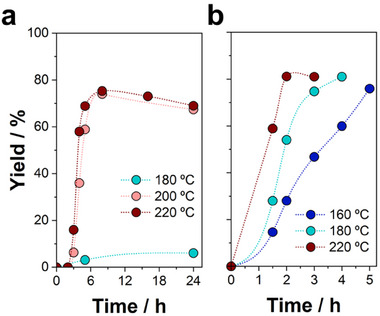
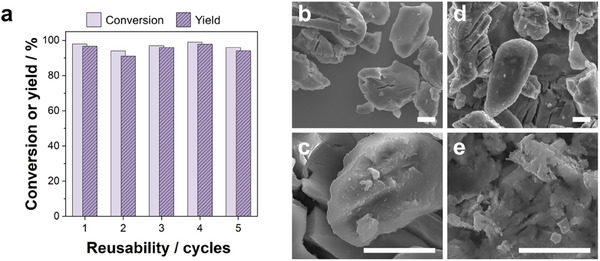
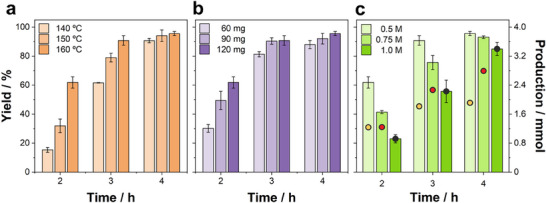
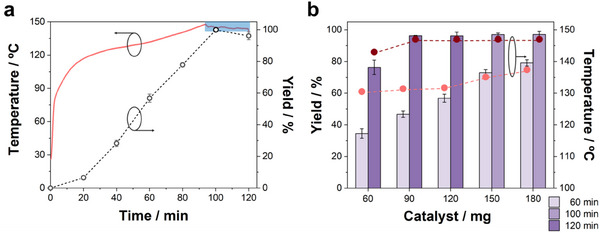
The valorization of lignocellulosic wastes emerges as a prime strategy to mitigate the global carbon footprint. Among the multiple biomass derivatives, γ-valerolactone is particularly attractive as precursor of high-value chemicals, biofuel, green solvent or perfumery. γ-Valerolactone can be synthesized through a hydrogenation reaction from levulinic acid, obtained from cellulose. However, the high energy requirements of this synthetic pathway have hindered its industrial viability. To drastically reduce the reaction energy requirements, here a novel synthetic strategy, based on solvothermal-photothermal processes using cost-effective Raney-Ni as photothermal catalyst, is proposed. First, the use of hydrogen gas is avoided by selecting isopropanol as a safer and greener H-source. Second, a photothermocatalytic process is used to minimize the reaction temperature and time with respect to conventional reactions. This approach exploits the broadband optical absorption of the Raney®-Ni, due to its highly damped plasmonic behavior, to achieve fast and efficient catalyst heating inside the reactor. The photothermal reaction required less than 2 h and just 132 °C to reach over 95% conversion, thereby drastically reducing the reaction time and energy consumption compared to conventional reactions. Importantly, these conditions granted high catalyst reusability. This solvothermal-photothermal approach could offer a sustainable alternative for the industrial production of γ-valerolactone.
木质纤维素废料的增值成为减轻全球碳足迹的首要策略。在多种生物质衍生物中,γ-戊内酯作为高价值化学品、生物燃料、绿色溶剂或香料的前体特别具有吸引力。γ-戊内酯可通过纤维素制得的乙酰丙酸经氢化反应合成。然而,这种合成途径的高能量需求阻碍了其工业可行性。为大幅降低反应能量需求,本文提出一种基于使用具有成本效益的雷尼镍作为光热催化剂的溶剂热-光热过程的新型合成策略。首先,通过选择异丙醇作为更安全、更环保的氢源避免使用氢气。其次,使用光热催化过程相对于传统反应将反应温度和时间降至最低。这种方法利用雷尼镍由于其高度阻尼的等离子体行为而具有的宽带光吸收,在反应器内实现快速高效的催化剂加热。光热反应只需不到2小时且仅在132°C就能达到超过95%的转化率,从而与传统反应相比大幅减少了反应时间和能耗。重要的是,这些条件赋予了催化剂高可重复使用性。这种溶剂热-光热方法可为γ-戊内酯的工业生产提供一种可持续的替代方案。