Schmidt Ryan E, Pohodich Amy E, Birch David, Jones Kaylie, Lam Byron L, Jung Emily H, Jain Nieraj, Georgiou Michalis, Mahroo Omar A, Webster Andrew R, Michaelides Michel, Bakall Benjamin, Iannaccone Alessandro, Vincent Ajoy, Parameswarappa Deepika C, Heon Elise, Scholl Hendrik P N, Janeschitz-Kriegl Lucas, Traboulsi Elias I, Zein Wadih, Brooks Brian P, Cukras Catherine, Hufnagel Robert, Aleman Tomas S, Sylla Mohamed M, Tsang Stephen H, Alabek Michelle, Sahel Jose, Gorin Michael B, van Genderen Maria M, Stingl Katarina, Reith Milda, Kohl Susanne, Amaral Rebeca Azevedo Souza, Sallum Juliana Maria Ferraz, Vincent Andrea L, Hull Sarah, Duncan Jacque L, Hanson James V M, Tedeus Matthias, Maggi Jordi, Graf Urs, Koller Samuel, Berger Wolfgang, Gerth-Kahlert Christina, Marra Molly, Everett Lesley A, Yang Paul, Pennesi Mark E
Casey Eye Institute, Oregon Health Science University, Portland, OR, USA.
Retina Foundation of the Southwest, Dallas, TX, USA.
NPJ Genom Med. 2025 Apr 17;10(1):32. doi: 10.1038/s41525-025-00489-1.
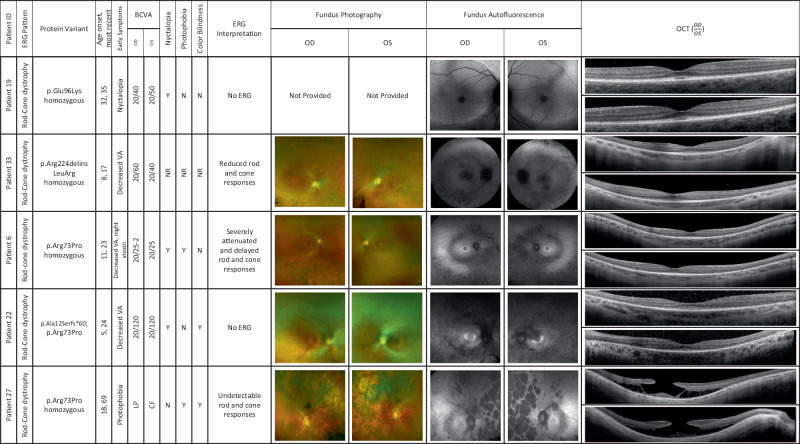
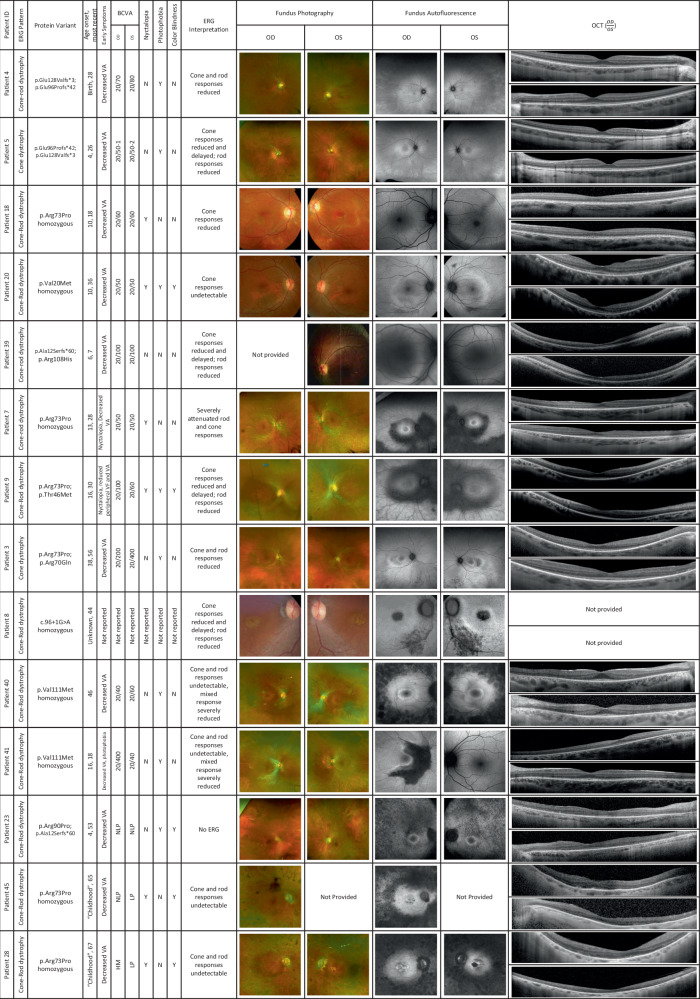
Ciliopathies are associated with a range of phenotypes including retinal degeneration and skeletal abnormalities. We present a retrospective study of 49 patients with variants in Cilia and Flagella Associated Protein 410 (CFAP410) from multiple ophthalmic centers across the world. Common clinical features included early-onset reduced visual acuity, photophobia, and delayed light-to-dark adaptation. A cone-rod dystrophy pattern was observed roughly two times more commonly than rod-cone dystrophy. A minority of patients (22.4%) presented with skeletal abnormalities consistent with axial spondylometaphyseal dysplasia (SMDAX). Patients with the most severe ophthalmic and skeletal phenotypes had disease-associated variants within conserved leucine-rich regions of CFAP410, and the structural effects of these variants were modelled using ChimeraX. This report furthers our understanding of CFAP410-associated clinical phenotypes such as retinal dystrophy and skeletal dysplasia.
纤毛病与一系列表型相关,包括视网膜变性和骨骼异常。我们对来自世界各地多个眼科中心的49例纤毛和鞭毛相关蛋白410(CFAP410)变异患者进行了一项回顾性研究。常见临床特征包括早发性视力下降、畏光和明暗适应延迟。锥杆营养不良模式的观察频率约为杆锥营养不良的两倍。少数患者(22.4%)出现与轴性脊椎干骺端发育异常(SMDAX)一致的骨骼异常。具有最严重眼科和骨骼表型的患者在CFAP410保守的富含亮氨酸区域内存在疾病相关变异,并使用ChimeraX对这些变异的结构效应进行了建模。本报告加深了我们对CFAP410相关临床表型(如视网膜营养不良和骨骼发育异常)的理解。