Liang Yu, Wei Shixiong, Zhang Anling
The Third Operation Room, The First Hospital of Jilin University, Changchun, 130021, China.
Department of Hepatobiliary and Pancreatic Surgery, General Surgery Center, The First Hospital of Jilin University, Changchun, 130021, China.
Regen Ther. 2025 Apr 9;29:364-380. doi: 10.1016/j.reth.2025.03.016. eCollection 2025 Jun.
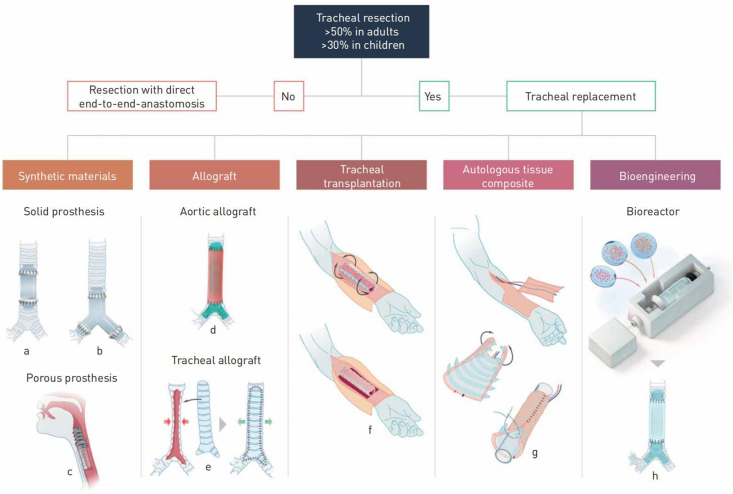
Tracheal reconstruction remains a formidable clinical challenge due to the complex structural, biomechanical, and physiological requirements of the airway. Traditional approaches, including autologous grafts, allografts, and synthetic prostheses, suffer from limitations such as donor site morbidity, immune rejection, and mechanical instability. Tissue-engineered tracheal grafts have emerged as a promising alternative, integrating advanced biomaterials, cellular therapies, and biofabrication techniques to create functional airway replacements. Synthetic polymers, such as polycaprolactone and polylactic acid, provide mechanical stability and tunable degradation properties, while extracellular matrix - derived biomaterials enhance biocompatibility and support cellular integration. Recent advances in stem cell biology, particularly the application of mesenchymal stem cells, induced pluripotent stem cells, and adipose-derived stem cells, have facilitated cartilage regeneration, epithelialization, and immune modulation within engineered constructs. However, achieving adequate vascularization remains a major bottleneck, necessitating the development of pre-vascularized scaffolds, growth factor delivery systems, and in vivo bioreactor strategies. Emerging technologies, including 3D bioprinting, electrospinning, and AI-driven scaffold design, are transforming the landscape of tracheal tissue engineering by enabling precise control over scaffold architecture, cellular distribution, and functional integration. Despite these advances, challenges such as mechanical failure, chronic inflammation, and regulatory hurdles must be addressed to ensure clinical translation. This review critically examines the latest advancements, persisting challenges, and future perspectives in artificial trachea engineering, providing a comprehensive roadmap for its development and clinical implementation.
由于气道在结构、生物力学和生理方面的复杂要求,气管重建仍然是一项艰巨的临床挑战。传统方法,包括自体移植物、同种异体移植物和合成假体,存在供体部位发病、免疫排斥和机械不稳定等局限性。组织工程气管移植物作为一种有前途的替代方案应运而生,它整合了先进的生物材料、细胞疗法和生物制造技术,以制造功能性气道替代物。合成聚合物,如聚己内酯和聚乳酸,提供机械稳定性和可调降解特性,而细胞外基质衍生的生物材料则增强生物相容性并支持细胞整合。干细胞生物学的最新进展,特别是间充质干细胞、诱导多能干细胞和脂肪来源干细胞的应用,促进了工程构建体内的软骨再生、上皮化和免疫调节。然而,实现足够的血管化仍然是一个主要瓶颈,需要开发预血管化支架、生长因子递送系统和体内生物反应器策略。包括3D生物打印、静电纺丝和人工智能驱动的支架设计在内的新兴技术,通过实现对支架结构、细胞分布和功能整合的精确控制,正在改变气管组织工程的格局。尽管取得了这些进展,但必须解决机械故障、慢性炎症和监管障碍等挑战,以确保临床转化。本综述批判性地审视了人工气管工程的最新进展、持续存在的挑战和未来前景,为其发展和临床应用提供了全面的路线图。