Gewert Klara, Topi Geriolda, Planck Tereza, Calissendorff Jan
Department of Clinical Sciences, Lund University, Malmö, Sweden.
Department of Endocrinology, Skåne University Hospital, Malmö, Sweden.
Front Endocrinol (Lausanne). 2025 Apr 4;16:1517283. doi: 10.3389/fendo.2025.1517283. eCollection 2025.
Graves´ disease (GD) is the predominant cause of hyperthyroidism. Treatment options include antithyroid drugs (ATD), surgery, and radioactive iodine ablation (RI). Although thyroid peroxidase antibodies (anti-TPO) are prevalent in patients with GD, their role in driving relapse or hypothyroidism after treatment in patients with GD remains unclear. This study aimed to determine if patients with anti-TPO at GD diagnosis are more likely to relapse after ATD or RI treatment, and if patients with anti-TPO are at increased risk of developing hypothyroidism post-ATD treatment.
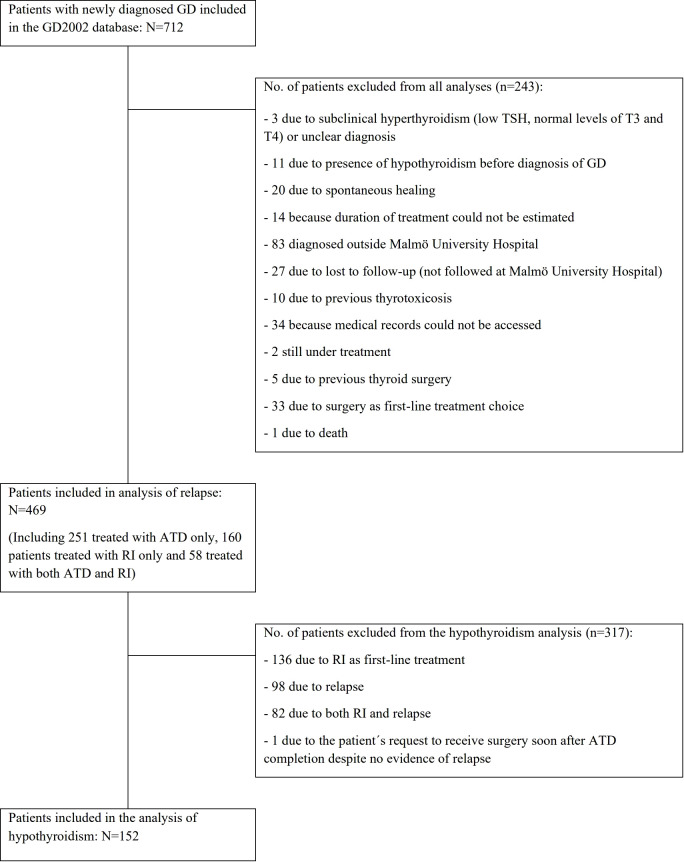
This was an observational, non-interventional retrospective registry study, which included 712 patients treated for GD at a single center in Sweden during 2002-2018.
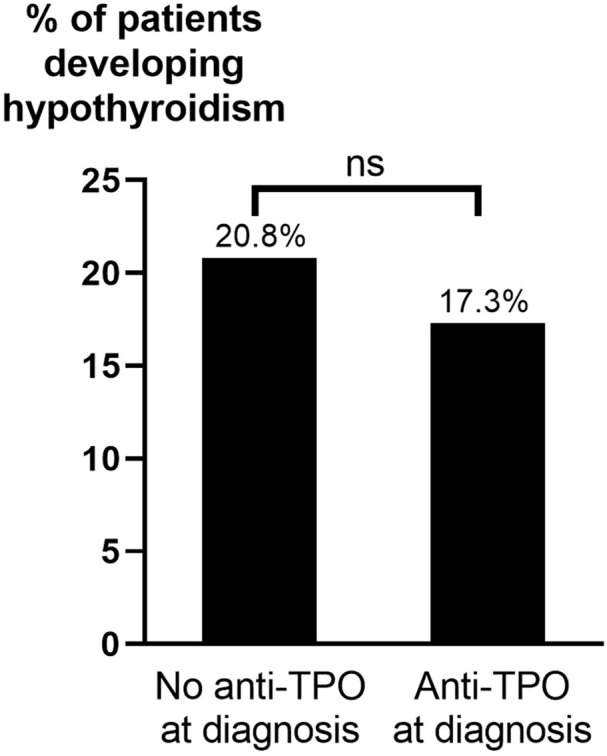
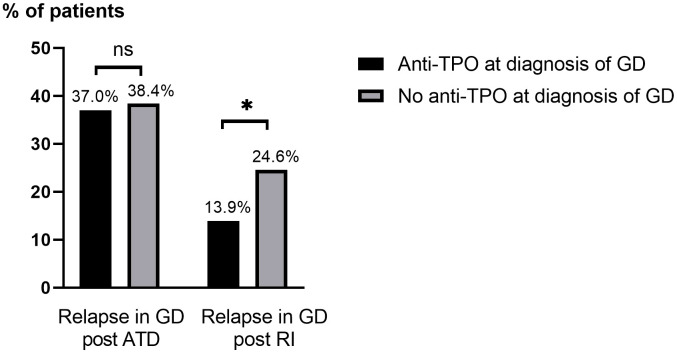
After therapy with ATD, there was no difference in relapse rate between patients with (37.0%) or without (38.4%) anti-TPO at GD diagnosis. Age <40 years was a risk factor for relapse after ATD (p<0.0001). Presence of anti-TPO at diagnosis was associated with reduced relapse rate after RI (13.9% vs. 24.6%; p=0.049). Development of hypothyroidism after discontinuation of ATD did not correlate with anti-TPO status at diagnosis (with anti-TPO: 17.3%; without anti-TPO: 20.8%). Increased risk of hypothyroidism was seen with ATD treatment for >2 years, p<0.05.
Anti-TPO positivity at diagnosis of GD did not affect the relapse rate after ATD treatment but could be associated with a better long-term effect of RI. Anti-TPO did not increase the risk of hypothyroidism post-ATD therapy. Understanding risk factors of relapse or hypothyroidism can facilitate treatment choices and help physicians individualize management and follow-up strategies for patients with GD.
格雷夫斯病(GD)是甲状腺功能亢进症的主要病因。治疗方案包括抗甲状腺药物(ATD)、手术和放射性碘消融(RI)。虽然甲状腺过氧化物酶抗体(抗-TPO)在GD患者中普遍存在,但其在GD患者治疗后导致复发或甲状腺功能减退中的作用仍不清楚。本研究旨在确定GD诊断时抗-TPO阳性的患者在接受ATD或RI治疗后是否更易复发,以及抗-TPO阳性的患者在ATD治疗后发生甲状腺功能减退的风险是否增加。
这是一项观察性、非干预性回顾性注册研究,纳入了2002年至2018年期间在瑞典单中心接受GD治疗的712例患者。
接受ATD治疗后,GD诊断时抗-TPO阳性(37.0%)和阴性(38.4%)的患者复发率无差异。年龄<40岁是ATD治疗后复发的危险因素(p<0.0001)。诊断时抗-TPO的存在与RI治疗后复发率降低相关(13.9%对24.6%;p=0.049)。停用ATD后甲状腺功能减退的发生与诊断时抗-TPO状态无关(抗-TPO阳性:17.3%;抗-TPO阴性:20.8%)。ATD治疗>2年时甲状腺功能减退风险增加,p<0.05。
GD诊断时抗-TPO阳性不影响ATD治疗后的复发率,但可能与RI的长期效果较好有关。抗-TPO不会增加ATD治疗后甲状腺功能减退的风险。了解复发或甲状腺功能减退的危险因素有助于指导治疗选择,并帮助医生为GD患者制定个性化的管理和随访策略。