Adamecz Dóra Izabella, Veres Éva, Papp Csaba, Árva Hédi, Rónavári Andrea, Marton Annamária, Vizler Csaba, Gácser Attila, Kónya Zoltán, Igaz Nóra, Kiricsi Mónika
Department of Biochemistry and Molecular Biology, University of Szeged, Szeged, Hungary.
Doctoral School of Biology, University of Szeged, Szeged, Hungary.
Int J Nanomedicine. 2025 Apr 15;20:4777-4802. doi: 10.2147/IJN.S508171. eCollection 2025.
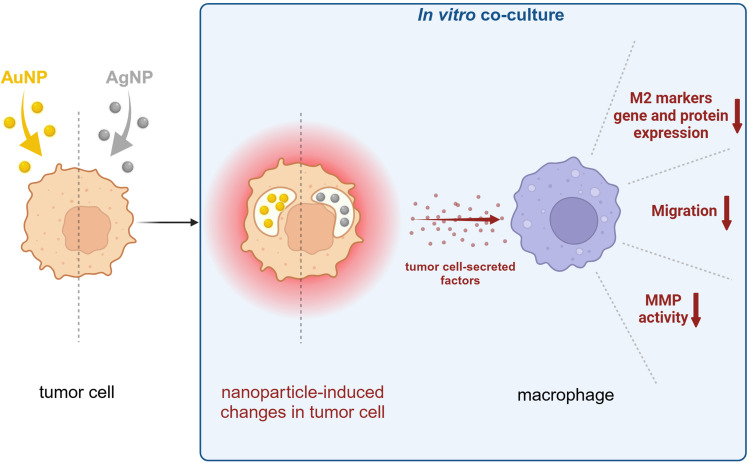
Macrophages, polarized into pro-inflammatory M1 or anti-inflammatory M2 states, are essential cellular elements of innate immunity. In the tumor microenvironment, owing to a paracrine manipulative program by cancerous cells, tumor-associated macrophages (TAMs) evolve, which can shift between M1-like and M2-like phenotypes. Since it is fairly unknown how the promising anticancer agents, silver (AgNPs) and gold nanoparticles (AuNPs) affect the bidirectional communication and reprogramming in the tumor stroma, we examined the behavior, the tumor-supporting functions, and the expression of polarization and functional marker genes of TAMs to reveal how these are modulated upon interaction with nanoparticle-exposed cancer cells.
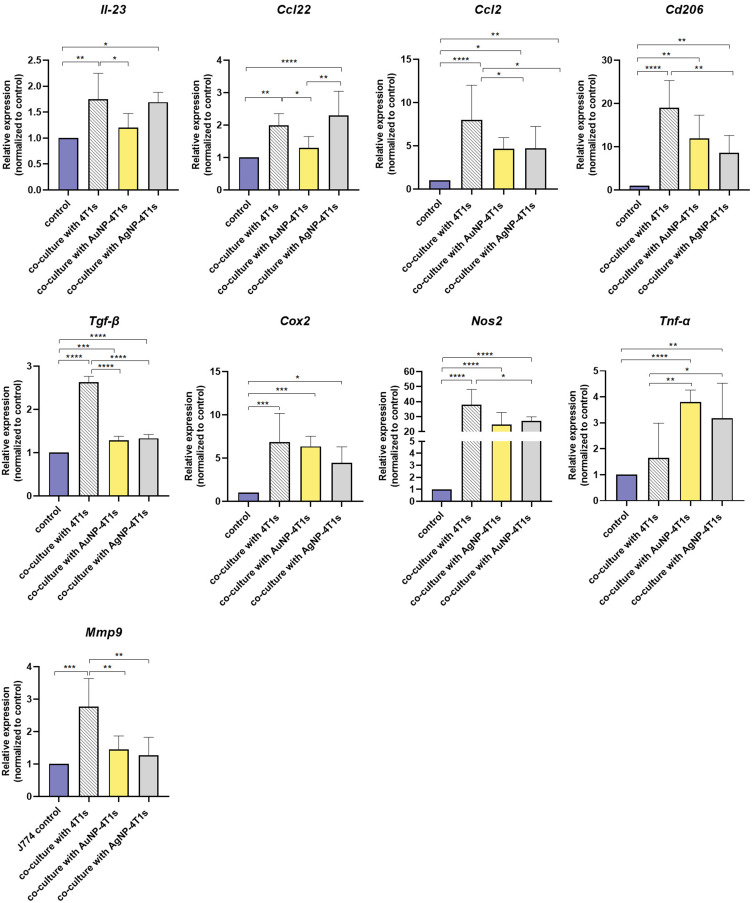
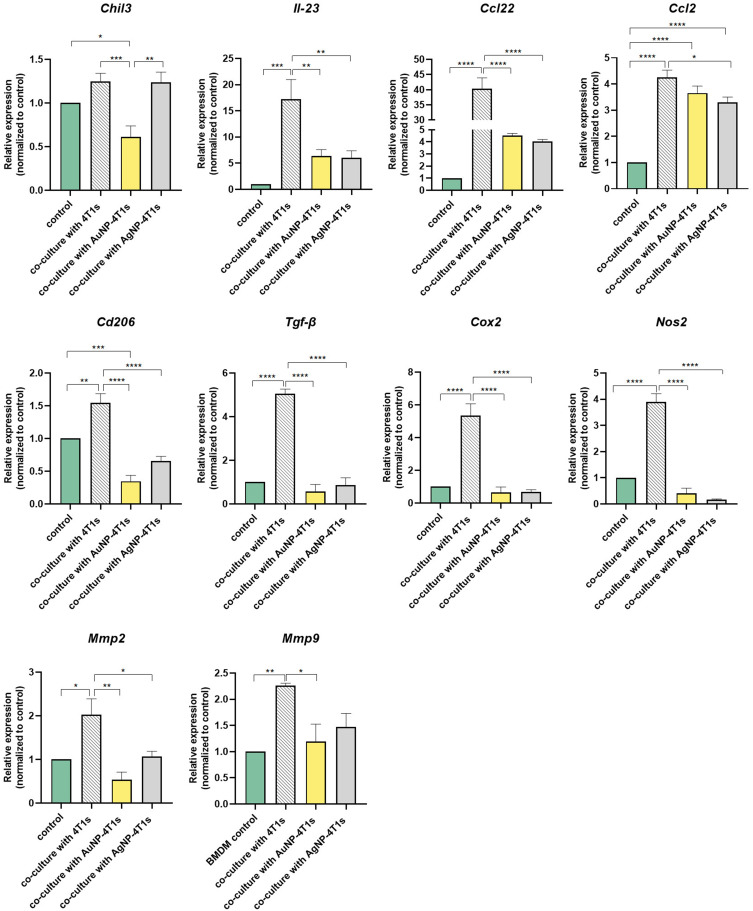
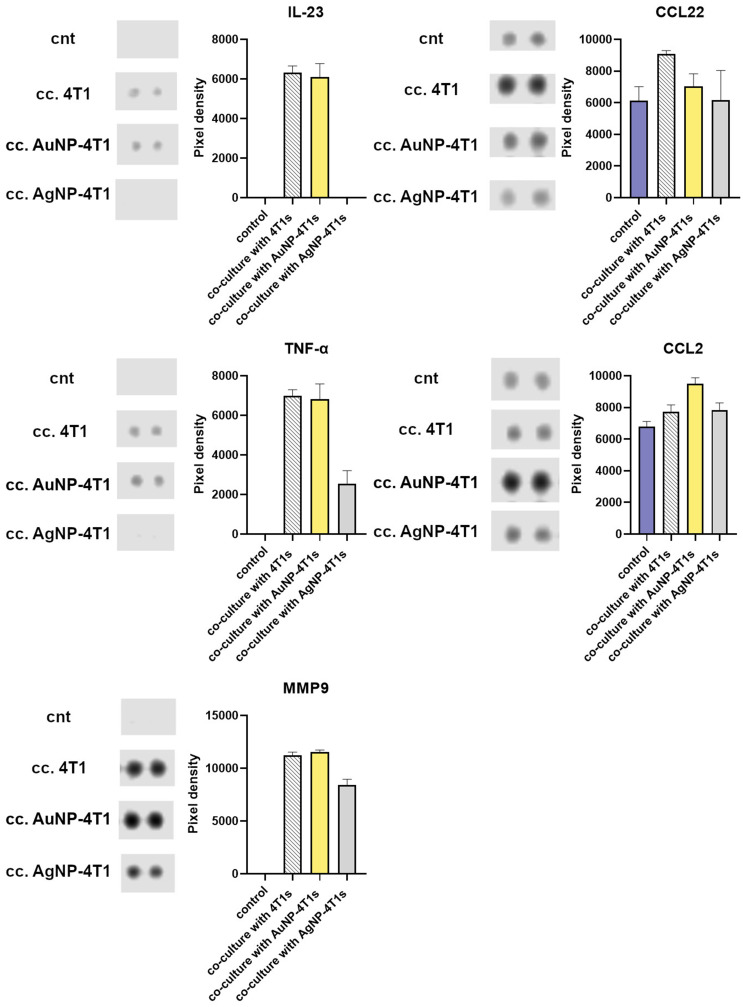
We established co-cultures of murine immortalized J774 or primary bone marrow-derived macrophages with 4T1 breast cancer cells treated with AuNPs or AgNPs or with none of the nanoparticles. We assessed the expression of macrophage polarization and functional markers using RT-qPCR and Proteome Profiler Array and evaluated macrophage migration and matrix metalloproteinase activity by specific assays.
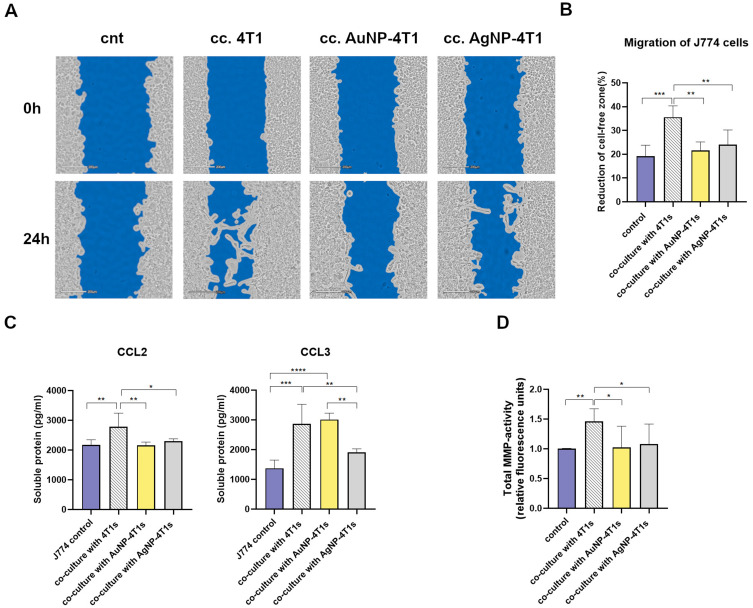
Protein and mRNA levels of most examined factors - except tumor necrosis factor-alpha - such as C-C-motif chemokine ligands 2 and 22, interleukin-23, inducible nitric oxide synthase, cyclooxygenase-2, the macrophage mannose receptor CD206, transforming growth factor-beta, and chitinase-like-3 protein decreased, and the expression of polarization markers revealed a shift towards M1-like phenotype in macrophages co-cultured with AgNP- or AuNP-treated 4T1 cells. Both nanoparticle treatments reduced the levels and activity of cell migration-related factors, such as C-C motif chemokine ligand 3, matrix metalloproteinases, and suppressed macrophage migration.
Both AuNPs and AgNPs showed a remarkable ability to influence macrophage-cancer cell communication, suppressed indirectly M2-like TAM polarization, and perturbed the migration behavior of TAMs that is critical for tumor invasion, indicating modulated immunological functions and debilitated cancer-promoting capabilities of TAMs in this microenvironment.
巨噬细胞可极化为促炎性M1或抗炎性M2状态,是先天性免疫的重要细胞成分。在肿瘤微环境中,由于癌细胞的旁分泌操纵程序,肿瘤相关巨噬细胞(TAM)发生演变,其可在M1样和M2样表型之间转变。由于目前对有前景的抗癌剂银纳米颗粒(AgNP)和金纳米颗粒(AuNP)如何影响肿瘤基质中的双向通讯和重编程知之甚少,我们研究了TAM的行为、肿瘤支持功能以及极化和功能标记基因的表达,以揭示与暴露于纳米颗粒的癌细胞相互作用后这些因素是如何被调节的。
我们建立了永生化小鼠J774或原代骨髓来源的巨噬细胞与经AuNP或AgNP处理或未处理纳米颗粒的4T1乳腺癌细胞的共培养体系。我们使用RT-qPCR和蛋白质组分析阵列评估巨噬细胞极化和功能标记物的表达,并通过特定测定法评估巨噬细胞迁移和基质金属蛋白酶活性。
除肿瘤坏死因子-α外,大多数检测因子的蛋白质和mRNA水平,如C-C基序趋化因子配体2和22、白细胞介素-23、诱导型一氧化氮合酶、环氧化酶-2、巨噬细胞甘露糖受体CD206、转化生长因子-β和几丁质酶样3蛋白均降低,并且在与经AgNP或AuNP处理的4T1细胞共培养的巨噬细胞中,极化标记物的表达显示向M1样表型转变。两种纳米颗粒处理均降低了细胞迁移相关因子的水平和活性,如C-C基序趋化因子配体3、基质金属蛋白酶,并抑制了巨噬细胞迁移。
AuNP和AgNP均显示出显著影响巨噬细胞-癌细胞通讯的能力,间接抑制M2样TAM极化,并扰乱对肿瘤侵袭至关重要的TAM迁移行为,表明在这种微环境中TAM的免疫功能受到调节且促进癌症的能力减弱。