Chen Xuanling, Qin Xuewei, Li Zhengqian, Wang Shengpei, Liang Zhenhu, Zhang Hua, Yao Lan, Li Xiaoli, Duan Ran, Wang Rong, Guo Xiangyang
Department of Anesthesiology, Peking University Third Hospital, Beijing, China.
Department of Anesthesiology, Peking University International Hospital, Beijing, China.
CNS Neurosci Ther. 2025 Apr;31(4):e70358. doi: 10.1111/cns.70358.
To analyze the effects of intravenous propofol combined with remifentanil on whole-brain functional networks in patients with ischemic moyamoya disease (IMMD) and intraspinal space-occupying lesions (SOLs) using resting-state functional magnetic resonance imaging (rs-fMRI).
Ten patients with IMMD and 10 sex- and age-matched patients with lumbar SOL (normal cerebrovascular findings on preoperative MRI) were recruited. General anesthesia was administered using propofol and remifentanil. rs-fMRI imaging was performed in both awake and anesthetized states. Whole-brain functional network in different states was constructed based on graph theory tools.
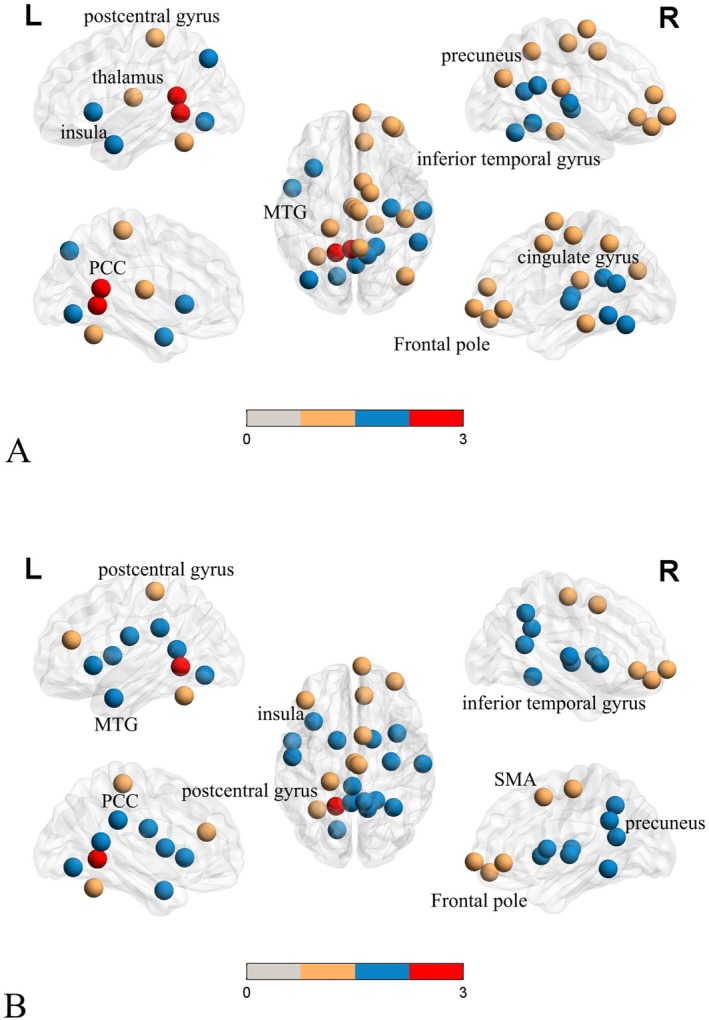
In awake patients with IMMD, significant reductions in nodal strength (NS) were observed in the default mode network (DMN), sensorimotor network, and frontoparietal control network (FPN), compared to patients with SOL. Nodal efficiency (NE) showed further significant network declines. Under anesthesia, patients with IMMD: (1) exhibited disease-specific decreases in NS and NE across several networks, potentially reflecting underlying cerebral pathology. (2) Propofol's effects also contributed to significant NS and NE reductions in several brain regions. Changes before and after anesthesia in patients with IMMD were significantly decreased in specific regions (discussed in detail) per analysis of NS versus NE. DMN connectivity correlated moderately with Montreal Cognitive Assessment scores.
Reduced whole-brain functional connectivity in patients with IMMD before anesthesia was similar to the alterations caused by systemic intravenous drugs administered after anesthesia.
ChiCTR2300075268.
使用静息态功能磁共振成像(rs-fMRI)分析静脉注射丙泊酚联合瑞芬太尼对缺血性烟雾病(IMMD)和脊髓占位性病变(SOL)患者全脑功能网络的影响。
招募10例IMMD患者和10例性别及年龄匹配的腰椎SOL患者(术前MRI脑血管检查正常)。使用丙泊酚和瑞芬太尼进行全身麻醉。在清醒和麻醉状态下均进行rs-fMRI成像。基于图论工具构建不同状态下的全脑功能网络。
与SOL患者相比,清醒的IMMD患者在默认模式网络(DMN)、感觉运动网络和额顶叶控制网络(FPN)中观察到节点强度(NS)显著降低。节点效率(NE)显示网络进一步显著下降。在麻醉状态下,IMMD患者:(1)在多个网络中表现出特定疾病的NS和NE降低,这可能反映了潜在的脑病理学。(2)丙泊酚的作用也导致几个脑区的NS和NE显著降低。根据NS与NE的分析,IMMD患者麻醉前后特定区域的变化显著降低(详细讨论)。DMN连通性与蒙特利尔认知评估得分中度相关。
麻醉前IMMD患者全脑功能连接性降低与麻醉后静脉注射全身性药物引起的改变相似。
ChiCTR2300075268。