Li Hang, Jin Zhenghua, Xiong Bo, Wang Xun, Sun Guochao, Tan Lundong, Wang Tie, Deng Lijun, Liao Ling, He Siya, Wang Zhihui
College of Horticulture, Sichuan Agricultural University, Chengdu, 611130, China.
Anyue Lemon Industry Development Center, Ziyang, China.
BMC Plant Biol. 2025 Apr 21;25(1):500. doi: 10.1186/s12870-025-06519-5.
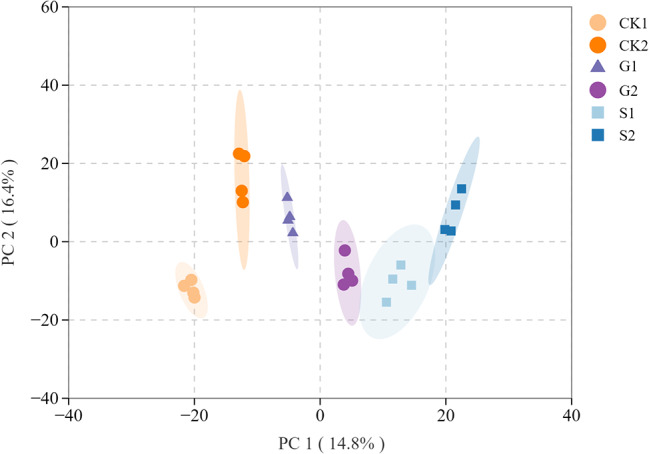
Citrus is the world's largest fruit category, yet it is frequently damaged by weeds during cultivation and management. As a green cultivation measure, covering crops in orchards effectively controls weeds and enhances soil quality. At present, the research on covering crops is mostly focused on soil, but there is still a lack of research on how crops affect citrus trees. This study aims to provide theoretical support for the widespread adoption of the green management practices. The previous research of us found that rattail fescue and vicia villosa had notably enhanced the organic matter and alkali-hydrolyzable nitrogen levels in orchard soils. Consequently, this study treated citrus orchards with sowing rattail fescue and vicia villosa between rows, with manual tillage serving as the control, to investigate the impact of two-year grass cultivation on N metabolism in citrus roots. Results indicated that both types of grass significantly enhanced amino acid metabolism in citrus roots at depths of 0-20 cm, significantly increasing activities of nitrate reductase, nitrite reductase, glutamine synthetase, NADH-glutamate synthetase, and NADPH-glutamate dehydrogenase, as well as expression levels of NR and NiR. Rattail fescue demonstrated superior effects. There was no discernible pattern in amino acid levels at depths of 20-40 cm, with both grass types significantly increasing NR, NADH-GOGAT enzyme activity, and also increasing gene expression levels for NiR, GDH1, and GDH2. Both types of grass significantly promoted N metabolism in citrus roots at depths of 0-20 cm, with rattail fescue outperforming vicia villosa.
柑橘是世界上最大的水果种类,但在栽培管理过程中经常受到杂草的侵害。作为一种绿色栽培措施,果园覆盖作物能有效控制杂草并提高土壤质量。目前,关于覆盖作物的研究大多集中在土壤方面,但对于作物如何影响柑橘树仍缺乏研究。本研究旨在为绿色管理措施的广泛应用提供理论支持。我们之前的研究发现,鼠尾草和野豌豆显著提高了果园土壤中的有机质和碱解氮水平。因此,本研究对柑橘园进行行间播种鼠尾草和野豌豆处理,以人工翻耕作为对照,来研究两年种草对柑橘根系氮代谢的影响。结果表明,两种草均显著增强了0 - 20厘米深度柑橘根系的氨基酸代谢,显著提高了硝酸还原酶、亚硝酸还原酶、谷氨酰胺合成酶、NADH - 谷氨酸合成酶和NADPH - 谷氨酸脱氢酶的活性,以及NR和NiR的表达水平。鼠尾草的效果更佳。在20 - 40厘米深度,氨基酸水平没有明显规律,两种草均显著提高了NR、NADH - GOGAT酶活性,同时也提高了NiR、GDH1和GDH2的基因表达水平。两种草均显著促进了0 - 20厘米深度柑橘根系的氮代谢,鼠尾草的效果优于野豌豆。