
杂交ddRAD测序和表型分析阐明了具有天空岛分布的高山物种的系统地理结构和进化。
Hybridization ddRAD-sequencing and phenotypic analysis clarify the phylogeographic structure and evolution of an alpine species with a sky island distribution.
作者信息
Hu Xue-Ying, Lu Wen-Xun, Wang Zi-Zhao, Rao Guang-Yuan
机构信息
State Key Laboratory of Protein and Plant Gene Research, School of Life Sciences, Peking University, Beijing, China.
Key Laboratory of Biodiversity Science and Ecological Engineering of the Ministry of Education, College of Life Sciences, Beijing Normal University, Beijing, China.
出版信息
Front Plant Sci. 2025 Apr 7;16:1563127. doi: 10.3389/fpls.2025.1563127. eCollection 2025.
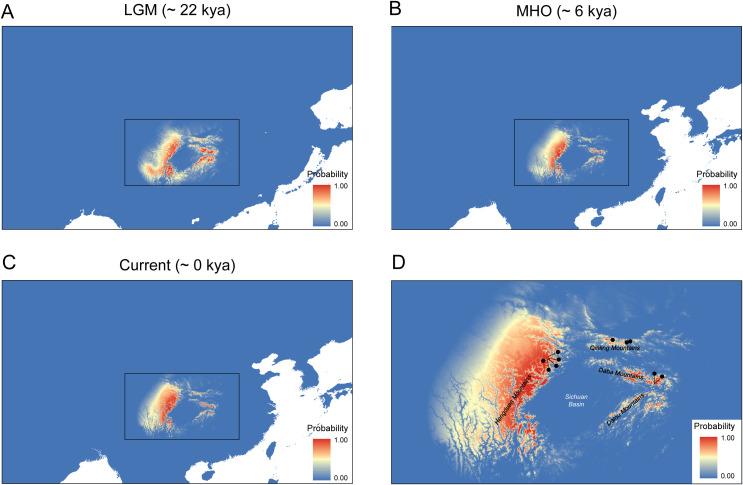
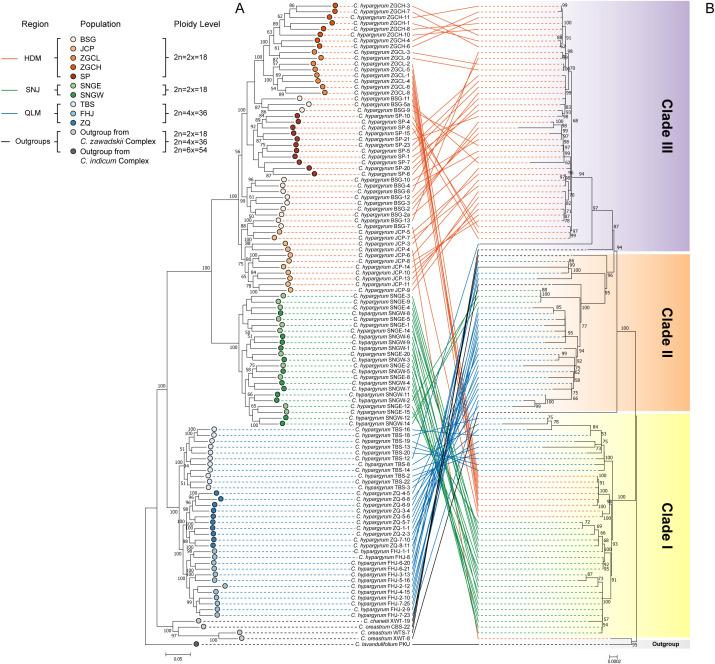
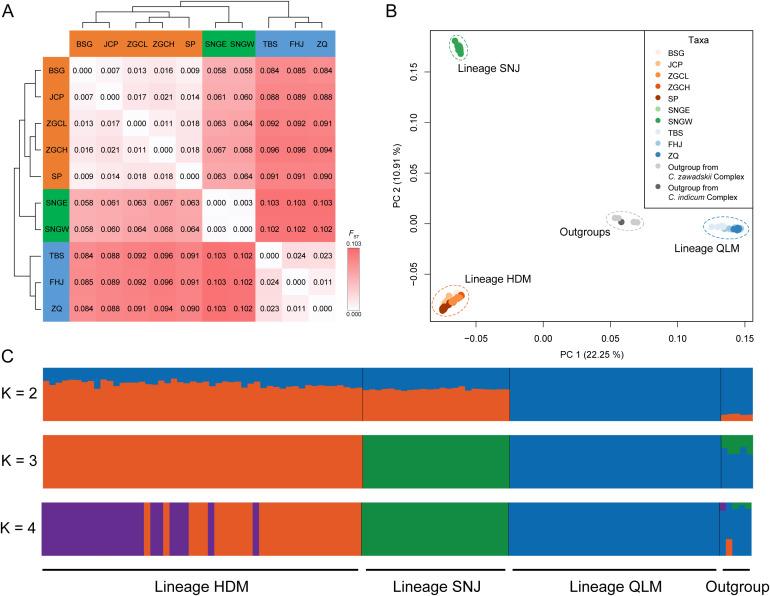
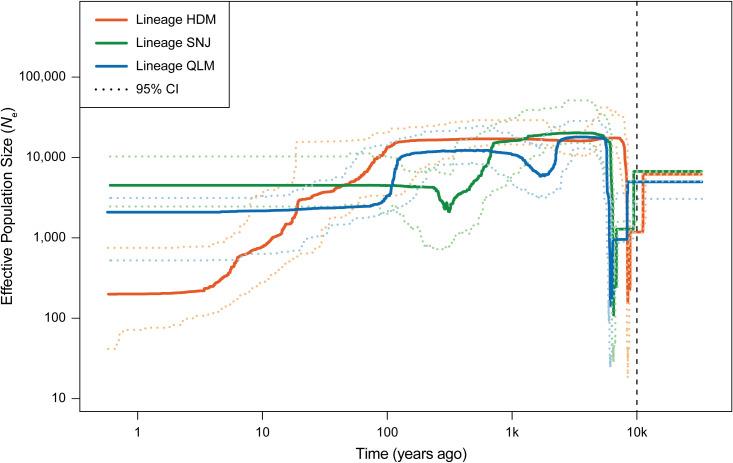
The phylogeographic structure of a species is the result of historical intraspecific differentiation and influences the pace and trajectory of speciation. Therefore, study of the phylogeographic structure of species and the mechanisms underlying its formation can shed light on the evolutionary history and speciation of species, as well as enhance our understanding of the generation and maintenance of species diversity. is an alpine species endemic to central China. It is restrictively distributed to three isolated mountain ranges, and its populations exhibit a sky island distribution and some morphological variation to different environments. In this study, we investigated the morphogenetic divergence, phylogeographic structure, and evolutionary history of this species through hybridization ddRAD-sequencing, phenotypic analysis, and species distribution modeling. Our results indicate that originated in the Daba Mountains and has since diverged into three lineages. The phylogeographic structure and distribution of this species are mainly attributed to geographic isolation, the founder effect and Quaternary climate oscillations as its range expanded. The divergence of its three major lineages coincided with Pliocene mountain uplifts and Pleistocene climatic fluctuations. The current sky island distribution has also promoted the diversification and phylogeographic structure of .
一个物种的系统发育地理结构是种内历史分化的结果,并影响物种形成的速度和轨迹。因此,研究物种的系统发育地理结构及其形成机制可以揭示物种的进化历史和物种形成过程,同时增进我们对物种多样性的产生和维持的理解。 是中国中部特有的高山物种。它局限分布于三个孤立的山脉,其种群呈现出天空岛分布,并对不同环境表现出一些形态变异。在本研究中,我们通过杂交ddRAD测序、表型分析和物种分布建模,研究了该物种的形态发生分歧、系统发育地理结构和进化历史。我们的结果表明, 起源于大巴山,此后分化为三个谱系。该物种的系统发育地理结构和分布主要归因于地理隔离、奠基者效应以及其分布范围扩大时的第四纪气候振荡。其三个主要谱系的分歧与上新世的山脉隆升和更新世的气候波动相吻合。当前的天空岛分布也促进了 的多样化和系统发育地理结构的形成。



 Zotero 插件