Huang Xi Lun, Jin Rui, Tang Ting Ting, Liang E, Zhang Lai
College of Life Science, Guizhou Normal University, Guiyang, China.
Innovation Center for Efficient Agricultural of Guizhou Mountain Characteristics, Anshun University, Guiyang, China.
Sci Rep. 2025 Apr 22;15(1):13950. doi: 10.1038/s41598-025-89508-w.
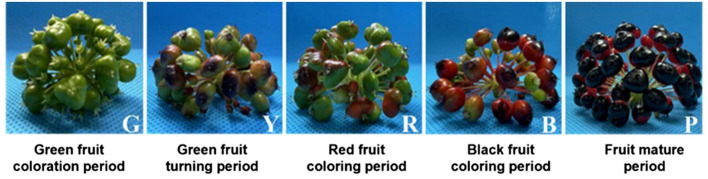
Panax japonicus C. A. Mey. is a rare and endangered Class II important protected wild medicinal plant in China with a wide range of pharmacological activities. The development of the fruit is special, only the apical capitulum can develop into fruit normally, and the color trait changes during the maturation process showed a pattern from green to red and from red to purple-black. In order to reveal the phenomenon of color trait changes during fruit development, this paper analyzed the correlation between color trait changes and pigment contents (chlorophyll, carotenoids) and secondary metabolite contents (anthocyanin, flavonoids, and total phenols) of the fruits, and used transcriptome sequencing to explore the correlation between color trait changes and synthetic genes, and then verified the fluorescence quantification with qRT-PCR. The results showed that chlorophyll was gradually converted and carotenoids began to appear in the pericarp when the fruit entered the color change stage from the green fruit stage; the content of anthocyanin, flavonoids and total phenolic substances gradually increased during fruit ripening. Transcriptome sequencing obtained transcriptome data of 15 samples from five periods of color trait changes in Panax japonicus fruits 93.94 Gbp, with 462,117 functionally annotated Total Unigenes; the total number of DETs generated by intercomparison of the five periods (G, Y, R, B, P) was 17,895 (up-regulated 9435 and down-regulated 8460). Weighted gene co-expression network analysis (WGCNA) indicated that 448 were hub differential genes (DETs) associated with common involvement in the color changes (carotenoids, anthocyanins, flavonoids, total phenols) in the fruits of Duchess. GO and KEGG were enriched to participate in the photosynthesis-antenna protein pathway 19; involved in flavonoid biosynthesis a total of 205. The results of qRT-PCR fluorescence quantitative validation showed that chlorophyll degradation related 6 candidate genes PjCAB and fruit color change flavonoid biosynthesis 6 candidate genes PjF3'H, PjCHI, PjCHS, PjDFR, PjANS, and PjC3'H at five periods were consistent with the transcriptome sequencing results.
竹节参是中国国家重点二级保护野生药用植物,珍稀濒危,具有广泛的药理活性。其果实发育特殊,仅顶端头状花序能正常发育成果实,果实成熟过程中的颜色性状变化呈现出从绿色到红色、再从红色到紫黑色的规律。为揭示果实发育过程中颜色性状变化的现象,本文分析了果实颜色性状变化与色素含量(叶绿素、类胡萝卜素)以及次生代谢产物含量(花青素、黄酮类化合物和总酚)之间的相关性,并利用转录组测序探究颜色性状变化与合成基因之间的相关性,随后通过qRT-PCR进行荧光定量验证。结果表明,当果实从绿色果期进入变色期时,叶绿素逐渐转化,果皮中开始出现类胡萝卜素;果实成熟过程中,花青素、黄酮类化合物和总酚类物质的含量逐渐增加。转录组测序获得了竹节参果实颜色性状变化五个时期15个样本的转录组数据93.94 Gbp,共有462,117个功能注释的总单基因;五个时期(G、Y、R、B、P)相互比较产生的差异表达基因(DET)总数为17,895个(上调9435个,下调8460个)。加权基因共表达网络分析(WGCNA)表明,有448个是与公爵夫人果实颜色变化(类胡萝卜素、花青素、黄酮类化合物、总酚)共同参与相关的枢纽差异基因(DET)。GO和KEGG富集分析显示,参与光合作用天线蛋白途径的有19个;参与黄酮类生物合成的共有205个。qRT-PCR荧光定量验证结果表明,五个时期叶绿素降解相关的6个候选基因PjCAB以及果实颜色变化黄酮类生物合成的6个候选基因PjF3'H、PjCHI、PjCHS、PjDFR、PjANS和PjC3'H与转录组测序结果一致。