Lee Amy S G, Kirkland Kelly, Stanley Samantha K, Robinson Abby, Leviston Zoe, Walker Iain
Melbourne School of Psychological Sciences, University of Melbourne, Melbourne, Australia.
School of Psychology, University of Queensland, Brisbane, Australia.
Sci Rep. 2025 Apr 22;15(1):12989. doi: 10.1038/s41598-025-96714-z.
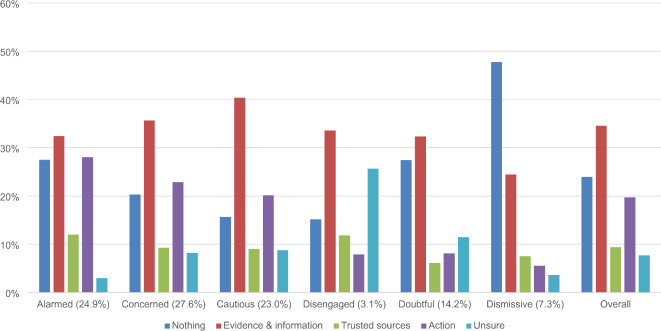
What do Australians believe would change their current opinions about climate change? In this study, we used audience segmentation analysis through the Six Americas Short Survey to identify groups of climate opinion holders within a representative sample of Australians. We had 4857 participants tell us what it would take to change their current opinions about climate change and leveraged OpenAI's Generative Pre-Trained Transformer (GPT) to identify the presence or absence of themes (Nothing, Evidence and Information, Trusted Sources, Action, and Unsure) and subthemes in their responses. GPT performed at near-human levels, proving to be a highly useful tool for thematic analysis. Our analyses revealed that strong climate denialists and believers tended to display greater dogmatism, with increased likelihood of stating that nothing would change their mind and lower likelihood of being unsure. Results also highlighted the need for diverse forms of evidence and information and the importance of trusted sources of information across audience segments. These findings provide support for GPT's utility in managing large datasets in the social sciences and offer participant-informed insights into climate opinion change.
澳大利亚人认为什么会改变他们目前对气候变化的看法?在这项研究中,我们通过“六个美国人简短调查”进行受众细分分析,以在具有代表性的澳大利亚样本中识别气候观点持有者群体。我们让4857名参与者告诉我们需要什么才能改变他们目前对气候变化的看法,并利用OpenAI的生成式预训练变换器(GPT)来识别他们回答中主题(无、证据与信息、可信来源、行动和不确定)和子主题的存在与否。GPT的表现接近人类水平,证明是用于主题分析的非常有用的工具。我们的分析表明,强烈的气候怀疑论者和相信者往往表现出更大的教条主义,他们更有可能表示没有什么能改变他们的想法,而不太可能不确定。结果还强调了需要多种形式的证据和信息,以及跨受众群体的可信信息来源的重要性。这些发现支持了GPT在管理社会科学大型数据集中的效用,并提供了基于参与者的气候观点变化见解。