Xu Chuanhai, Chen Jieyao, Li Yuehui, Huang Dongyu, Xue Yuan
Department of Operational Management, Provincial Hospital Affiliated to Fuzhou University, Dong Jie Street, Fuzhou, Fujian, 350001, China.
Department of Operational Management, Fujian Provincial Hospital, Fuzhou, Fujian, 350001, China.
BMC Health Serv Res. 2025 Apr 22;25(1):578. doi: 10.1186/s12913-025-12767-w.
Social healthcare expenditure is a crucial component of global healthcare expenditure. Assessing the relative efficiency, dynamic changes, and influencing factors of province-level social investment in China would facilitate the continued and stable development of healthcare services.
Based on the Malmquist Data Envelopment Analysis and Tobit regression model, this study pursued panel data from 2012 to 2020 for a set of 31 provinces and cities in China to estimate the efficiency of social health expenditure and explore the factors that influence the efficiency.
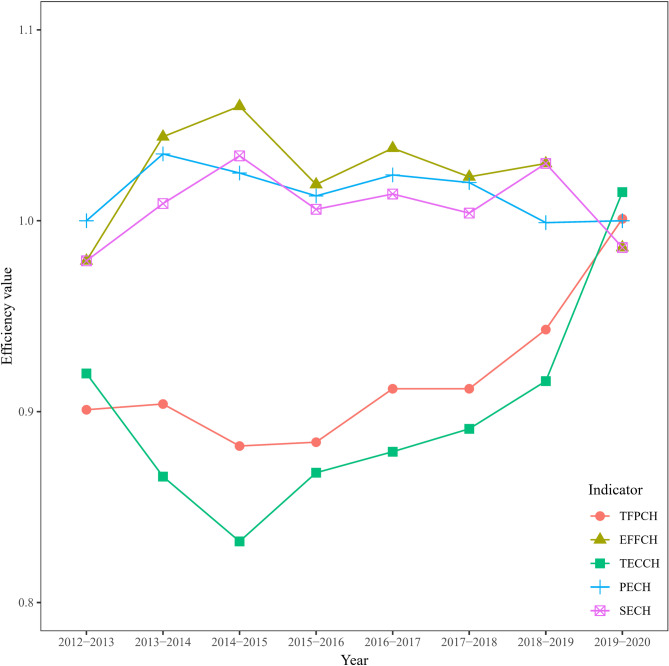
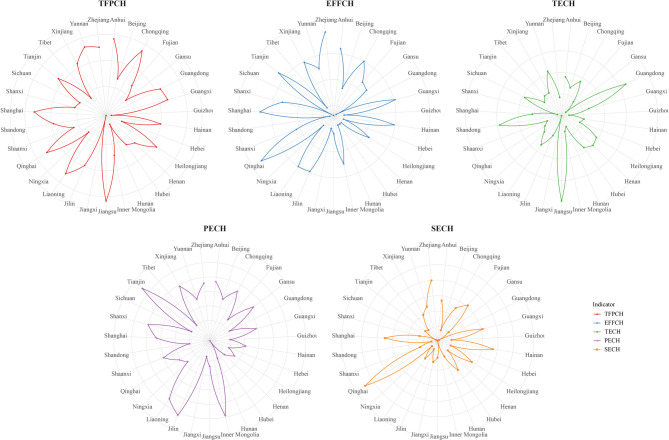
All provinces experience a decline in the total factor productivity change index in the period 2012-2020. The average value is 0.917, which implies a deterioration of 8.3% per year. Most provinces show increased efficiency change but experience declines in technical progress, except Sichuan, Guangdong, and Shandong. Although efficiency change shows an upward trend, the positive impact is offset by technological regression, leading to a decline in overall productivity. Population density and urbanization level are found to be associated with expenditure efficiency in opposite directions. Higher levels of urbanization are associated with higher efficiency scores and the opposite impact is observed for population density.
This study shows that there is still much room for improving the efficiency of province-level social health expenditure and reinforcing the imperatives to increase investment in technological progress in health to foster the efficiency of social healthcare expenditure. Policy reforms and adjustments tailored to the specific conditions of different regions may be necessary for better alignment.
社会医疗支出是全球医疗支出的重要组成部分。评估中国省级社会医疗投资的相对效率、动态变化及影响因素,将有助于医疗服务的持续稳定发展。
基于曼奎斯特数据包络分析和托比特回归模型,本研究采用了中国31个省市2012年至2020年的面板数据,以估算社会医疗支出的效率,并探究影响效率的因素。
2012年至2020年期间,所有省份的全要素生产率变化指数均出现下降。平均值为0.917,这意味着每年下降8.3%。除四川、广东和山东外,大多数省份的效率变化有所提高,但技术进步出现下降。尽管效率变化呈上升趋势,但正向影响被技术退步所抵消,导致整体生产率下降。研究发现,人口密度和城市化水平与支出效率呈相反方向的关联。较高的城市化水平与较高的效率得分相关,而人口密度则呈现相反的影响。
本研究表明,省级社会医疗支出的效率仍有很大提升空间,必须加强对卫生技术进步的投资,以提高社会医疗支出的效率。为实现更好的匹配,可能需要针对不同地区的具体情况进行政策改革和调整。