Wang Xiao, Shi Jingwei, Liu Zhengcheng
Department of Thoracic Surgery, Nanjing Drum Tower Hospital Clinical College of Nanjing Medical University, Nanjing, 211166, China.
Department of Thoracic Surgery, Nanjing Drum Tower Hospital, The Affiliated Hospital of Nanjing University Medical School, Nanjing, 210008, China.
J Cardiothorac Surg. 2025 Apr 23;20(1):218. doi: 10.1186/s13019-025-03441-7.
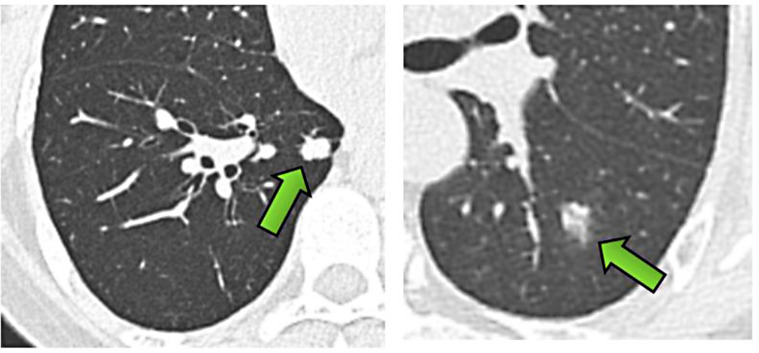
To construct and validate a nomogram risk prediction model based on clinical characteristics and radiological features to predict spread through air spaces (STAS) of stage IA sub-centimeter non-small cell lung cancer.
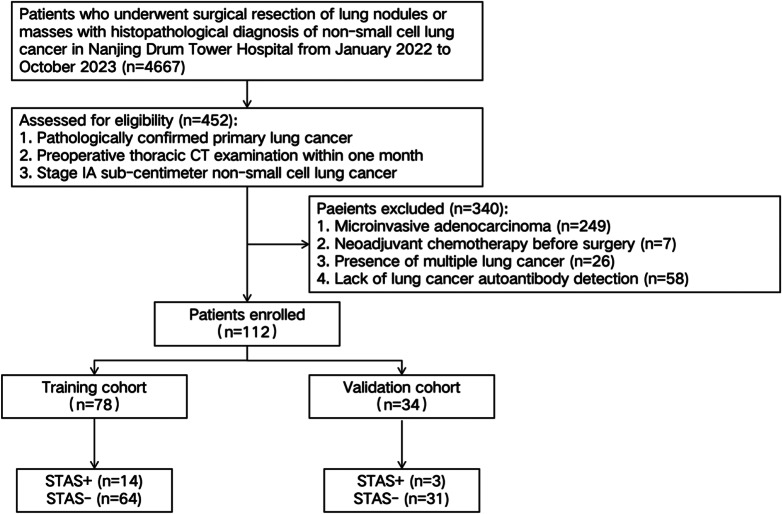
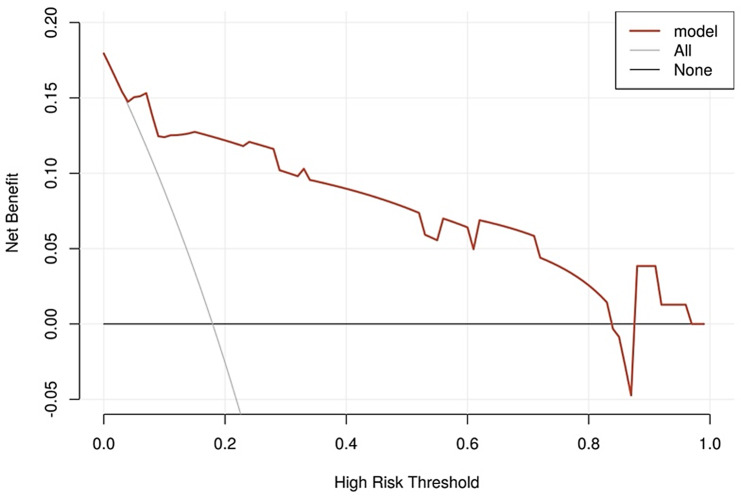
112 patients who underwent surgical treatment in Nanjing Drum Tower Hospital with pathologically diagnosed stage IA sub-centimeter non-small cell lung cancer were retrospectively collected. The training cohort and the validation cohort were chosen in a 7:3 ratio. Based on the presence or absence of STAS in pathology results, they were divided into STAS positive and STAS negative groups. The independent risk predictors of STAS in clinical characteristics and radiological features were selected by univariate and multivariate logistic regression analysis and then used to construct a nomogram. The sensitivity and specificity were calculated based on the Youden index, area under the curve (AUC), calibration curves and decision curve analysis (DCA) were used to evaluate the performance of the model.
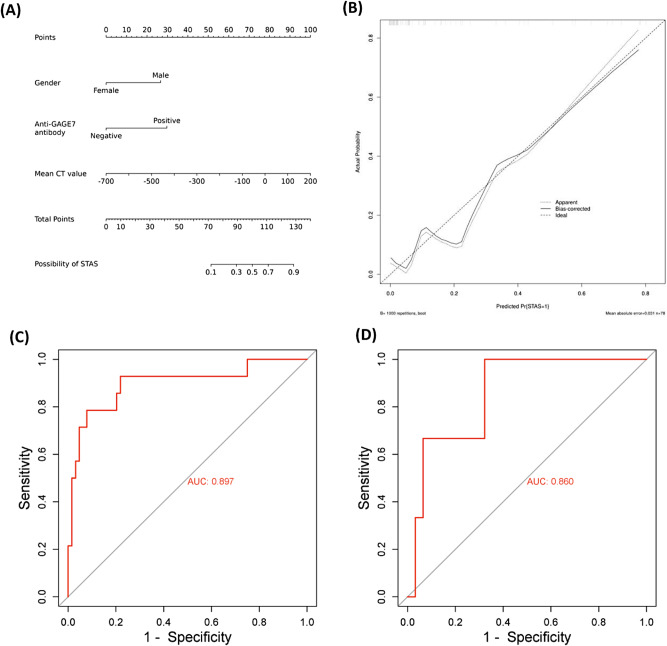
The incidence of STAS in the training cohort was 17.9%. Univariate logistic regression analysis showed that male, anti-GAGE7 antibody positive and mean CT value were associated with the occurrence of STAS; multivariate logistic regression analysis showed that male (OR = 7.900, 95%CI: 1.502-41.545), anti-GAGE7 antibody positive (OR = 10.065, 95%CI: 1.256-80.659) and mean CT value (OR = 1.009, 95%CI: 1.004-1.014) were independent predictors for STAS. The nomogram based on the above factors achieved good predictive performance for STAS with AUC was 0.897 (sensitivity was 0.929, specificity was 0.781) in the training cohort and 0.860 in the validation cohort. The calibration curve and DCA validated the good performance of the model.
The nomogram model established in this study had good predictive performance for STAS status of sub-centimeter lung cancer, and provide reference significance for preoperative planning of patients.
构建并验证基于临床特征和放射学特征的列线图风险预测模型,以预测IA期亚厘米级非小细胞肺癌的气腔播散(STAS)情况。
回顾性收集在南京鼓楼医院接受手术治疗且病理诊断为IA期亚厘米级非小细胞肺癌的112例患者。按7:3的比例选取训练队列和验证队列。根据病理结果中是否存在STAS,将患者分为STAS阳性组和STAS阴性组。通过单因素和多因素逻辑回归分析筛选出临床特征和放射学特征中STAS的独立风险预测因素,进而构建列线图。基于约登指数计算敏感性和特异性,采用曲线下面积(AUC)、校准曲线和决策曲线分析(DCA)评估模型性能。
训练队列中STAS的发生率为17.9%。单因素逻辑回归分析显示,男性、抗GAGE7抗体阳性和平均CT值与STAS的发生有关;多因素逻辑回归分析显示,男性(OR = 7.900,95%CI:1.502 - 41.545)、抗GAGE7抗体阳性(OR = 10.065,95%CI:1.256 - 80.659)和平均CT值(OR = 1.009,95%CI:1.004 - 1.014)是STAS的独立预测因素。基于上述因素构建的列线图对STAS具有良好的预测性能,训练队列中的AUC为0.897(敏感性为0.929,特异性为0.781),验证队列中的AUC为0.860。校准曲线和DCA验证了模型的良好性能。
本研究建立的列线图模型对亚厘米级肺癌的STAS状态具有良好的预测性能,为患者的术前规划提供参考意义。