Zhang Xianmei, Sun Qinguo, Xie Xie, Luo Meng, Zan Junjie, Cong Zewei
Department of Traditional Chinese Medicine, Wuhan Third Hospital, Wuhan, 430000, China.
J Orthop Surg Res. 2025 Apr 22;20(1):403. doi: 10.1186/s13018-025-05685-4.
Diabetes is a common disease contributing to osteoporosis. Epimedin B (EB), a major ingredient of Herba Epimedii, has been found to be effective in preventing osteoporosis in mice. However, the potential of EB to ameliorate diabetic osteoporosis (DOP) remains elusive. In this study, our goal is to investigate the functions and underlying mechanisms of EB in the progression of DOP.
A DOP rat model was established via a high-fat diet combined with intraperitoneal injection of streptozotocin (STZ). DOP rats were daily administered with EB or vehicle via intragastric administration for 8 weeks. Body weights and blood glucose levels were measured every 4 weeks during the drug administration period. Blood samples and femoral tissues were collected for further analysis. Bone parameters and bone histopathological changes were detected. Bone formation and resorption markers as well as inflammatory factors were detected using enzyme-linked immunosorbent assay kits. Reverse-transcription quantitative polymerase chain reaction and western blotting were conducted to measure the expression of osteoprotegerin (OPG) and Rev-Erbα, receptor activator of NF-κB ligand (RANKL).
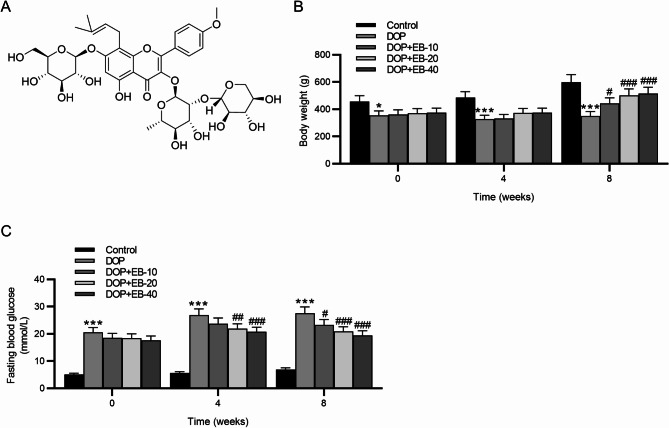
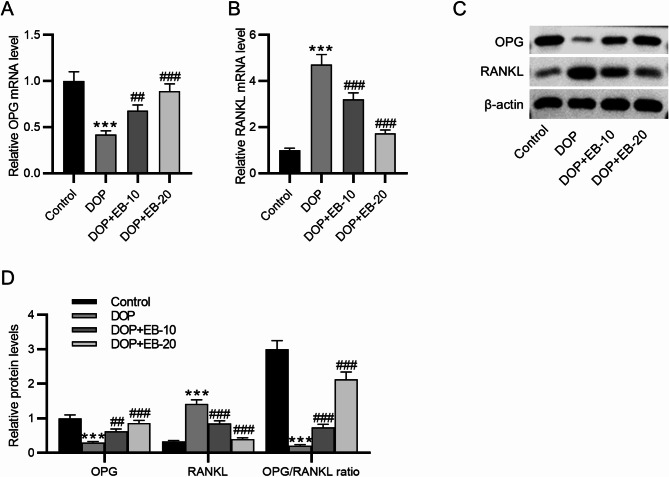
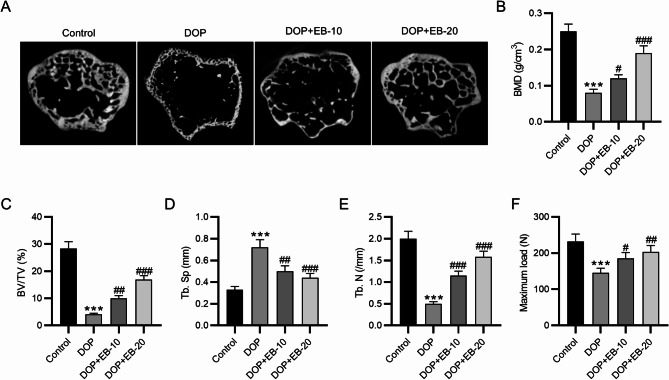
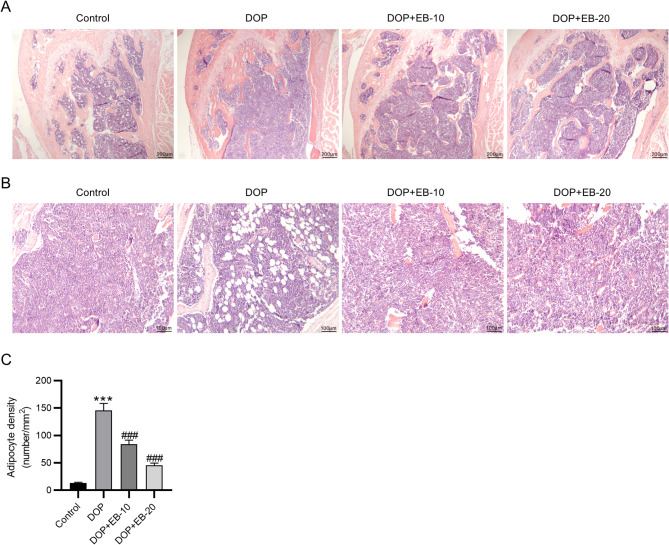
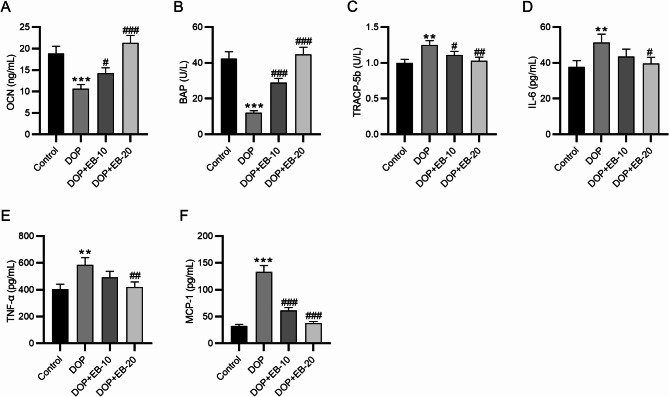
EB improved weight loss and lowered blood glucose of DOP rats. EB promoted the formation of bone trabeculae and altered several bone microstructure parameters in DOP rats. EB ameliorated improved bone structure, restored histological abnormalities of femoral bone, and reduced the number of bone marrow adipocytes in DOP rats. EB inhibited excessive bone resorption and inflammation and increased bone formation in DOP rats. EB regulated the OPG/RANKL axis in DOP rats.
EB attenuates STZ-induced DOP in rats by maintaining the balance between bone formation and resorption and inhibiting inflammation through regulating the OPG/RANKL axis.
糖尿病是导致骨质疏松的常见疾病。淫羊藿苷B(EB)是淫羊藿的主要成分,已被发现可有效预防小鼠骨质疏松。然而,EB改善糖尿病性骨质疏松(DOP)的潜力仍不清楚。在本研究中,我们的目标是研究EB在DOP进展中的作用及其潜在机制。
通过高脂饮食联合腹腔注射链脲佐菌素(STZ)建立DOP大鼠模型。DOP大鼠每天通过灌胃给予EB或赋形剂,持续8周。在给药期间,每4周测量一次体重和血糖水平。采集血样和股骨组织进行进一步分析。检测骨参数和骨组织病理学变化。使用酶联免疫吸附测定试剂盒检测骨形成和骨吸收标志物以及炎症因子。进行逆转录定量聚合酶链反应和蛋白质印迹法以测量骨保护素(OPG)和Rev-Erbα、核因子κB受体活化因子配体(RANKL)的表达。
EB改善了DOP大鼠的体重减轻并降低了血糖。EB促进了DOP大鼠骨小梁的形成并改变了几个骨微结构参数。EB改善了骨结构,恢复了股骨的组织学异常,并减少了DOP大鼠骨髓脂肪细胞的数量。EB抑制了DOP大鼠过度的骨吸收和炎症,并增加了骨形成。EB调节了DOP大鼠的OPG/RANKL轴。
EB通过维持骨形成和骨吸收之间的平衡并通过调节OPG/RANKL轴抑制炎症来减轻STZ诱导的大鼠DOP。