
两年期前交叉韧带重建中四股绳肌肌腱与单束股四头肌肌腱移植物的比较:随机对照试验的系统评价和荟萃分析
4-Strand hamstring versus single-bundle quadriceps tendon grafts in anterior cruciate ligament reconstruction at 2 years: A systematic review and meta-analysis of randomised controlled trials.
作者信息
Elias Jonathan, Kaplan Mitchell, Shah Kunal, Bickford Michael, McNamara Chelsea, Ford Elizabeth, McMillan Sean
机构信息
Rowan-Virtua School of Osteopathic Medicine Stratford New Jersey USA.
Futures Forward Research Institute Toms River New Jersey USA.
出版信息
J Exp Orthop. 2025 Apr 22;12(2):e70244. doi: 10.1002/jeo2.70244. eCollection 2025 Apr.
PURPOSE
To compare the 2-year postoperative outcomes of hamstring tendon (HT) grafts to quadriceps tendon (QT) grafts in anterior cruciate ligament (ACL) reconstruction. We hypothesised no significant differences between the two methods.
METHODS
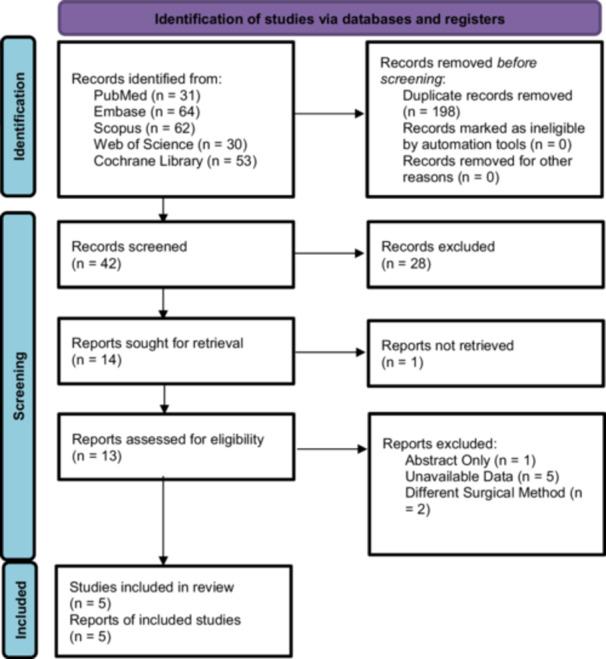
A systematic review and meta-analysis were conducted following the 2020 PRISMA guidelines. Five online databases (Cochrane, Embase, PubMed, Scopus and Web of Science) were screened for prospective randomised controlled trials (RCT). IKDC, Lysholm, Tegner, side-to-side KT-1000 scores and ages were collected. Statistical analysis was conducted with SPSS v29. Between the two groups, a test of between-subgroup homogeneity -value < 0.05 was used to assess statistical significance, while a Cohen's ≥ 0.8 was used to assess clinical significance.
RESULTS
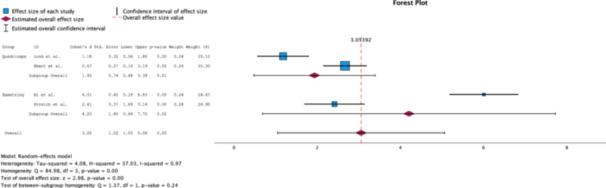
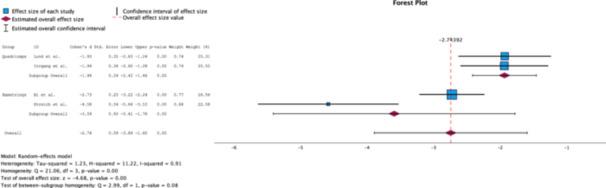
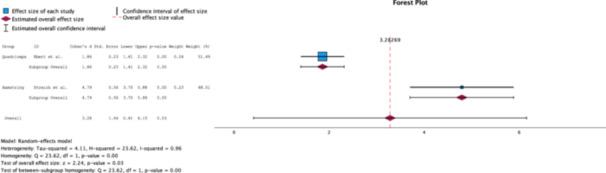
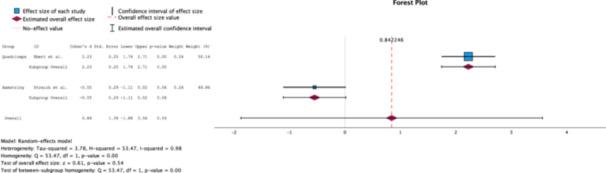
Five RCTs were included in the final analysis. The HT group included 87 patients, and the QT group included 93 patients. The mean ages for the HT and QT groups were 28.3 ± 6.6 and 26.5 ± 8.4 years, respectively. HTs yielded clinically higher IKDC scores ( Cohen's = 2.27, = 0.24), clinically lower side-to-side KT-1000 differences ( Cohen's = 1.65, = 0.08), and clinically and statistically higher Lysholm scores ( Cohen's = 2.93, = 0.00). However, QT yielded higher Tegner scores ( Cohen's = 1.68, = 0.00), whereas HT led to a moderate clinical reduction (Cohen's = -0.55, = 0.06, 95% CI [-1.11 to 0.02]).
CONCLUSIONS
Compared with the use of the QT graft, the HT graft for ACL reconstruction may result in greater knee function and stability, while QT ACL reconstruction may be associated with increased levels of postsurgical activity in terms of return to sports and work. Future long-term RCTs are needed to confirm our findings.
LEVEL OF EVIDENCE
Level I.
目的
比较腘绳肌腱(HT)移植物与股四头肌肌腱(QT)移植物在前交叉韧带(ACL)重建术后2年的疗效。我们假设两种方法之间无显著差异。
方法
按照2020年PRISMA指南进行系统评价和荟萃分析。检索了五个在线数据库(Cochrane、Embase、PubMed、Scopus和Web of Science),以查找前瞻性随机对照试验(RCT)。收集IKDC、Lysholm、Tegner、双侧KT - 1000评分和年龄。使用SPSS v29进行统计分析。在两组之间,采用亚组间同质性检验(P值<0.05)评估统计学意义,而Cohen's d≥0.8用于评估临床意义。
结果
最终分析纳入了5项RCT。HT组包括87例患者,QT组包括93例患者。HT组和QT组的平均年龄分别为28.3±6.6岁和26.5±8.4岁。HT在临床上产生更高的IKDC评分(Cohen's d = 2.27,P = 0.24),临床上更低的双侧KT - 1000差异(Cohen's d = 1.65,P = 0.08),以及临床上和统计学上更高的Lysholm评分(Cohen's d = 2.93,P = 0.00)。然而,QT产生更高的Tegner评分(Cohen's d = 1.68,P = 0.00),而HT导致临床中度降低(Cohen's d = -0.55,P = 0.06,95%CI[-1.11至0.02])。
结论
与使用QT移植物相比,HT移植物用于ACL重建可能会带来更好的膝关节功能和稳定性,而QT ACL重建在恢复运动和工作方面可能与术后活动水平增加有关。未来需要长期RCT来证实我们的发现。
证据级别
I级。
 Zotero 插件