Duque-Granda Daniela, Vivero-Gómez Rafael José, González Ceballos Laura Alejandra, Junca Howard, Duque Santiago R, Aroca Aguilera María Camila, Castañeda-Espinosa Alejandro, Cadavid-Restrepo Gloria, Gómez Giovan F, Moreno-Herrera Claudia Ximena
Grupo de Microbiodiversidad y Bioprospección, Laboratorio de Biología Celular y Molecular, Laboratorio de Procesos Moleculares, Facultad de Ciencias, Universidad Nacional de Colombia at Medellín, Street 59A #63-20, Medellín 050003, Colombia.
RG Microbial Ecology: Metabolism, Genomics & Evolution, Div. Ecogenomics & Holobionts, Microbiomas Foundation, LT11A, Chia 250008, Colombia.
Insects. 2025 Mar 4;16(3):269. doi: 10.3390/insects16030269.
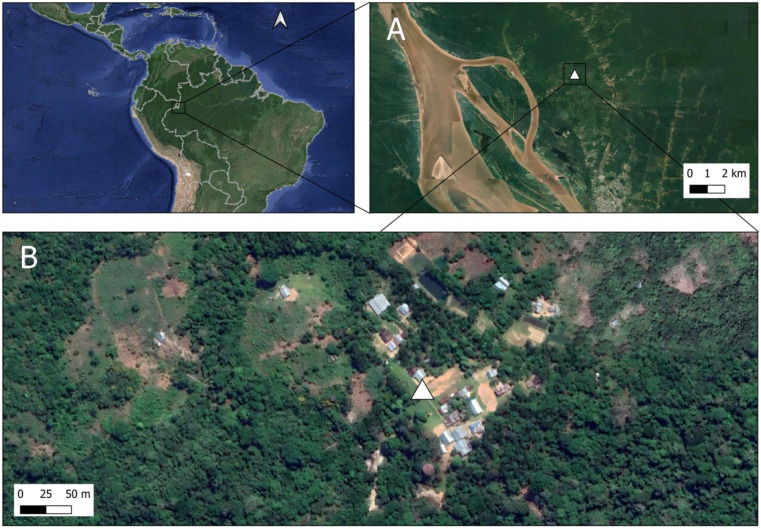
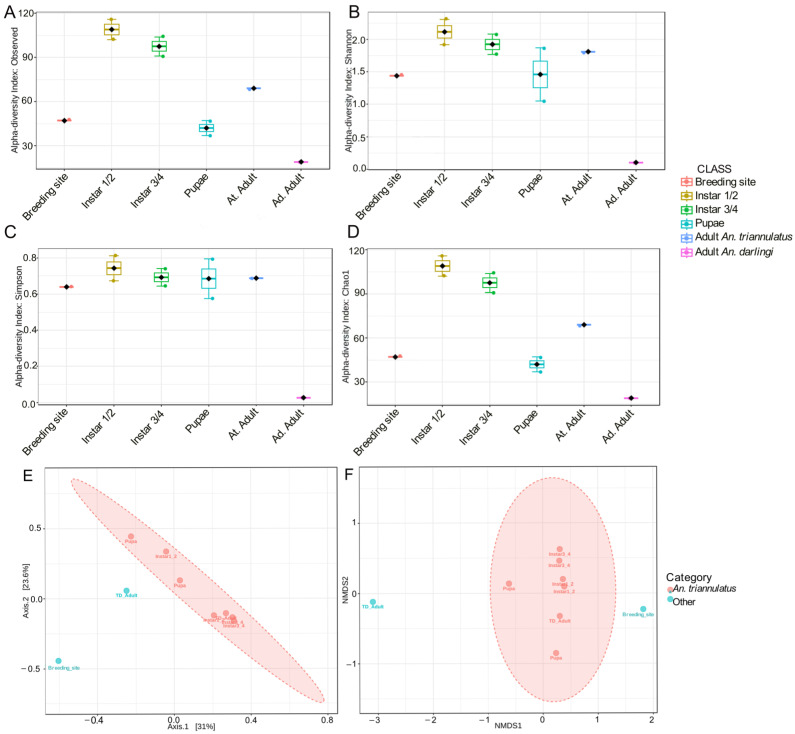
Malaria disease affects millions of people annually, making the Amazon Basin a major hotspot in the Americas. While traditional control strategies rely on physical and chemical methods, the microbiome offers a promising avenue for biological control, as certain bacteria can inhibit parasite development and alter vector immune and reproductive systems, disrupting the transmission cycle. For this reason, this study aimed to explore the bacterial communities in and s.l., including breeding sites, immature stages, and adults from San Pedro de los Lagos (Leticia, Amazonas) through next-generation sequencing of the 16S rRNA gene. The results revealed a higher bacterial genus richness in the L1-L2 larvae of s.l. and were prevalent in most samples, with abundances of 52.51% in L3-L4 larvae and 48.88% in pupae of s.l., respectively. In breeding site water, Verrucomicrobiota bacteria were the most dominant (52.39%). We also identified (15.46%) in s.l. pupae and Asaia (98.22%) in , linked to inhibition, and , in low abundances, along with and , known for paratransgenesis potential. Considering the high bacterial diversity observed across the different mosquito life stages, identifying bacterial composition is the first step towards developing new strategies for malaria control. However, the specific roles of these bacteria in anophelines and the malaria transmission cycle remain to be elucidated.
疟疾每年影响数百万人,使亚马逊流域成为美洲的一个主要热点地区。虽然传统的控制策略依赖于物理和化学方法,但微生物组为生物控制提供了一条有前景的途径,因为某些细菌可以抑制寄生虫发育并改变媒介的免疫和生殖系统,从而破坏传播周期。因此,本研究旨在通过对16S rRNA基因进行下一代测序,探索亚马逊疟蚊复合体(包括繁殖地、未成熟阶段以及来自圣佩德罗德洛斯拉戈斯(莱蒂西亚,亚马孙省)的成虫)中的细菌群落。结果显示,亚马逊疟蚊复合体L1-L2幼虫中的细菌属丰富度更高,伯克霍尔德菌属和沙雷氏菌属在大多数样本中普遍存在,在亚马逊疟蚊复合体L3-L4幼虫中的丰度分别为52.51%,在蛹中的丰度分别为48.88%。在繁殖地水中,疣微菌门细菌最为占主导地位(52.39%)。我们还在亚马逊疟蚊复合体蛹中鉴定出了奇异变形杆菌(15.46%),在埃及伊蚊中鉴定出了亚细亚菌属(98.22%),它们与疟原虫抑制有关,以及低丰度的嗜线虫沙雷氏菌、肺炎克雷伯菌和球形赖氨酸芽孢杆菌,它们具有昆虫共生菌转基因的潜力。考虑到在不同蚊子生命阶段观察到的高细菌多样性,确定细菌组成是制定疟疾控制新策略的第一步。然而,这些细菌在按蚊和疟疾传播周期中的具体作用仍有待阐明。