
先有鸡还是先有蛋?解释与感知到的射频电磁场暴露相关的躯体化的归因假说和反安慰剂假说。
Chicken or egg? Attribution hypothesis and nocebo hypothesis to explain somatization associated to perceived RF-EMF exposure.
作者信息
Ariccio S, Traini E, Portengen L, Martens A, Slottje P, Vermeulen R, Huss A
机构信息
Institute for Risk Assessment Sciences, Utrecht University, Utrecht, Netherlands.
PBL Environmental Assessment Agency, The Hague, Netherlands.
出版信息
Front Public Health. 2025 Apr 9;13:1561373. doi: 10.3389/fpubh.2025.1561373. eCollection 2025.
INTRODUCTION
The aim of this study is to understand the temporal relationship between the somatization usually attributed to RF-EMFs, and to evaluate the attribution hypothesis and the nocebo hypothesis in this context.
METHOD
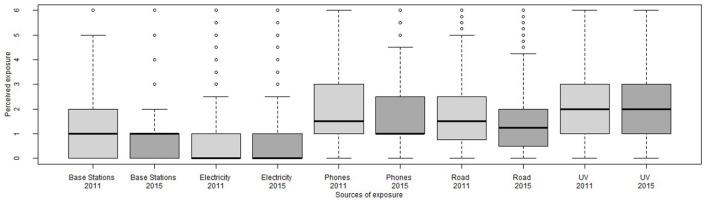
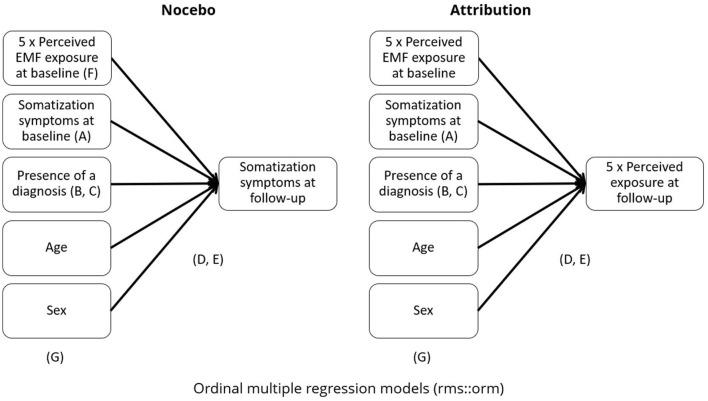
In this longitudinal study, data from the Dutch Occupational and Environmental Health Cohort Study (AMIGO) was analyzed, consisting of a baseline questionnaire collected in 2011 (14,829 participants) and a follow-up questionnaire collected in 2015 (7,904 participants). Participants completed a questionnaire providing information on their health status, perceived environmental exposures, and demographics. Two sets of multiple regressions were conducted to evaluate the two hypotheses.
RESULTS
Results show that the attribution hypothesis overall explained symptom reporting in association to perceived RF-EMF base station exposure and perceived electricity exposure more frequently than the nocebo hypothesis.
DISCUSSION
This finding stands out from most of the existing literature, which primarily points to the nocebo effect as the main explanation for somatization in response to RF-EMF exposure. While this does not exclude, in absolute terms, the existence of a nocebo effect, potentially at other time scales, this finding has relevant consequences at the policy making level. The emerging relevance of the attribution hypothesis moves the focus on the discomfort of people with unexplained symptoms and their need to find a plausible explanation for their discomfort.
引言
本研究的目的是了解通常归因于射频电磁场的躯体化之间的时间关系,并在此背景下评估归因假设和反安慰剂假设。
方法
在这项纵向研究中,分析了荷兰职业与环境健康队列研究(AMIGO)的数据,该数据包括2011年收集的基线问卷(14829名参与者)和2015年收集的随访问卷(7904名参与者)。参与者完成了一份问卷,提供了有关他们健康状况、感知到的环境暴露和人口统计学信息。进行了两组多元回归以评估这两个假设。
结果
结果表明,总体而言,归因假设比反安慰剂假设更能解释与感知到的射频电磁场基站暴露和感知到的电暴露相关的症状报告。
讨论
这一发现与大多数现有文献不同,现有文献主要指出反安慰剂效应是对射频电磁场暴露产生躯体化的主要解释。虽然从绝对意义上讲,这并不排除反安慰剂效应在其他时间尺度上可能存在,但这一发现在政策制定层面具有相关影响。归因假设的新相关性将焦点转移到有不明症状的人的不适以及他们为自己的不适寻找合理解释的需求上。
 Zotero 插件