Surbeck Martin, Cheng Leveda, Kreyer Melodie, Gort Gerrit, Mundry Roger, Hohmann Gottfried, Fruth Barbara
Harvard University, Department of Human Evolutionary Biology, Cambridge, USA.
Max Planck Institute for Evolutionary Anthropology, Leipzig, Germany.
Commun Biol. 2025 Apr 24;8(1):550. doi: 10.1038/s42003-025-07900-8.
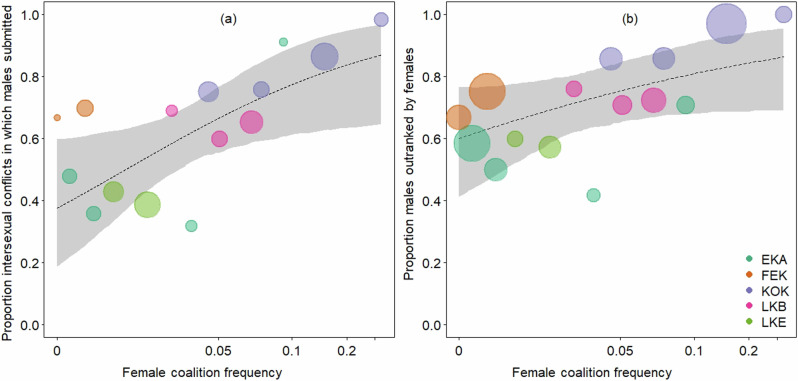
In mammals, female dominance over males is a rare phenomenon. However, recent findings indicate that even in species with sexual dimorphism biased towards males, females sometimes occupy high status. Here we test three main hypotheses explaining intersexual power relationships, namely the self-reinforcing effects of winning and losing conflicts, the strength of mate competition, and female coalition formation. We test these for bonobos (Pan paniscus), one of our closest living relatives, where females have high status relative to males despite male-biased size dimorphism. We compiled demographic and behavioral data of 30 years and 6 wild living communities. Our results only support predictions of the female coalition hypothesis. We found that females target males in 85% of their coalitions and that females occupy higher ranks compared to males when they form more frequent coalitions. This result indicates that female coalition formation is a behavioral tool for females to gain power over males.
在哺乳动物中,雌性对雄性的支配是一种罕见的现象。然而,最近的研究结果表明,即使在性别二态性偏向雄性的物种中,雌性有时也占据较高地位。在这里,我们检验了解释两性权力关系的三个主要假设,即输赢冲突的自我强化效应、配偶竞争的强度以及雌性联盟的形成。我们对倭黑猩猩(Pan paniscus)进行了检验,倭黑猩猩是与我们亲缘关系最近的现存物种之一,尽管体型二态性偏向雄性,但雌性相对于雄性具有较高地位。我们收集了30年里6个野生群落的人口统计学和行为数据。我们的结果仅支持雌性联盟假设的预测。我们发现,在85%的联盟中雌性以雄性为目标,并且当雌性形成更频繁的联盟时,它们的等级比雄性更高。这一结果表明,雌性联盟的形成是雌性获得对雄性权力的一种行为工具。