Department of Experimental Psychology, University of São Paulo, São Paulo, Brazil.
Theoretical Research in Evolutionary Life Sciences, TRÊS, Groningen Institute for Evolutionary Life Sciences, University of Groningen, Groningen, Netherlands.
PLoS One. 2021 Apr 19;16(4):e0249039. doi: 10.1371/journal.pone.0249039. eCollection 2021.
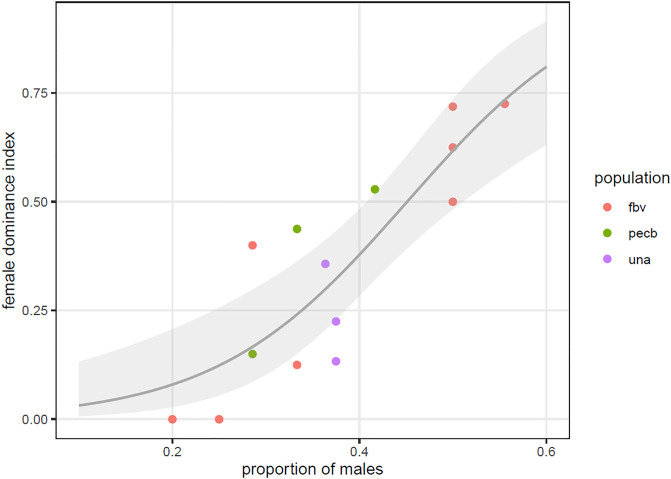
In most group-living animals, a dominance hierarchy reduces the costs of competition for limited resources. Dominance ranks may reflect prior attributes, such as body size, related to fighting ability or reflect the history of self-reinforcing effects of winning and losing a conflict (the winner-loser effect), or both. As to prior attributes, in sexually dimorphic species, where males are larger than females, males are assumed to be dominant over females. As to the winner-loser effect, the computational model DomWorld has shown that despite the female's lower initial fighting ability, females achieve some degree of dominance of females over males. In the model, this degree of female dominance increases with the proportion of males in a group. This increase was supposed to emerge from the higher fraction of fights of males among themselves. These correlations were confirmed in despotic macaques, vervet monkeys, and in humans. Here, we first investigate this hypothesis in DomWorld and next in long-term data of 9,300 observation hours on six wild groups of robust capuchin monkeys (Sapajus libidinosus; S. nigritus, and S. xanthosternos) in three Brazilian sites. We test whether both the proportion of males and degree of female dominance over males are indeed associated with a higher relative frequency of aggression among males and a higher relative frequency of aggression of females to males. We confirm these correlations in DomWorld. Next, we confirm in empirical data of capuchin monkeys that with the proportion of males in the group there is indeed an increase in female dominance over males, and in the relative frequency of both male-male aggression and aggression of females to males and that the female dominance index is significantly positively associated with male male aggression. Our results reveal that adult sex ratio influences the power relation between the sexes beyond predictions from socioecological models.
在大多数群居动物中,等级制度可以降低对有限资源竞争的成本。等级地位可能反映了与战斗能力相关的先天属性,如体型,或者反映了赢得和输掉冲突的自我强化效应(胜利者-失败者效应)的历史,或者两者兼而有之。就先天属性而言,在性二态物种中,雄性比雌性大,雄性被认为比雌性更具优势。至于胜利者-失败者效应,计算模型 DomWorld 表明,尽管雌性的初始战斗能力较低,但雌性在某种程度上对雄性具有支配地位。在该模型中,这种雌性支配地位的程度随着群体中雄性比例的增加而增加。这种增加被认为是由于雄性之间的战斗比例较高而出现的。这些相关性在专制猕猴、普通狨猴和人类中得到了证实。在这里,我们首先在 DomWorld 中检验了这一假设,然后在对六个巴西研究地点的六只野生强壮卷尾猴( Sapajus libidinosus ; S. nigritus 和 S. xanthosternos )进行了 9300 小时的长期观察数据中进行了检验。我们检验了雄性比例和雌性对雄性支配地位的程度是否确实与雄性之间的攻击相对频率以及雌性对雄性的攻击相对频率有关。我们在 DomWorld 中证实了这些相关性。接下来,我们在卷尾猴的实证数据中证实了,随着群体中雄性比例的增加,雌性对雄性的支配地位确实增加了,雄性之间的攻击和雌性对雄性的攻击的相对频率也增加了,并且雌性支配地位指数与雄性之间的攻击呈显著正相关。我们的研究结果表明,成年性别比例影响了性别之间的权力关系,超出了社会生态模型的预测。