Oktavia Nike Sari, Mustika Arifa, Hidayati Afif Nurul
Doctoral Program of Medical Science, Faculty of Medicine, Universitas Airlangga, Surabaya, Indonesia.
Department of Midwifery, Polytechnic of Health Ministry of Health Padang, Padang, Indonesia.
Open Vet J. 2025 Mar;15(3):1264-1278. doi: 10.5455/OVJ.2025.v15.i3.18. Epub 2025 Mar 31.
The incidence of wound complications after breast cancer surgery is > 30%. Delayed wound healing increases the risk of systemic recurrence up to three-fold after excisional surgery for primary breast cancer. Patients with breast malignant tumors exhibit immune system dysfunction while T cells play a major role in the inflammatory process of wound healing. The time required to achieve wound closure depends on the severity of the wound. The content of ethanol extract contains alkaloids, flavonoids, tannins, steroids, and polyphenols. Flavonoid and polyphenol compounds are antioxidant, antidiabetic, anticancer, antiseptic, and anti-inflammatory.
To determine whether extract increases interleukin-10 (IL-10) levels, TGF-β1 and VEGF expression, collagen density, and the clinical features of wounds, and how the mechanism works on wound healing of Wistar rats after excision of mammary tumors.
This study used 35 female Wistar rats, 30 mammary tumor models by injecting 3-5% benzopyrene as much as 50 mg/Kg.BW in 5 injections into the mammary glands/mammae every 2 days as much as 10 mg/kg.BW. Thirty rats were divided into 5 groups; red betel extract gel 50%, 25%, and 12.5%; povidone iodine group as a positive control; and carboxymethyl cellulose natrium (CMC na) group as a negative control, 5 normal wounds as controls. Treatment was given 2 times a day for 14 days.
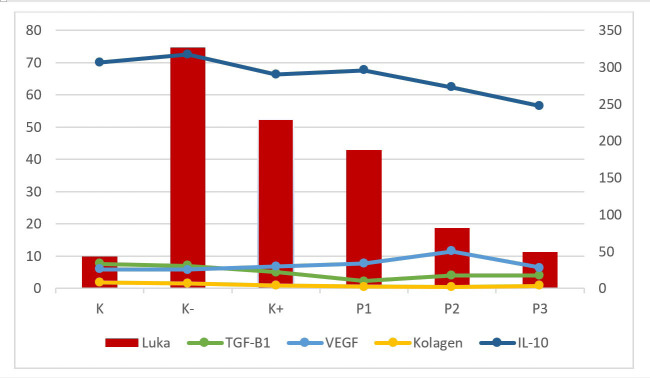
Multiple linear regression results; extract decreased IL-10 levels by -0.64 ( = 0.025), decreased TGF-β1 expression -0.832 ( = 0.001), increased VEGF expression by 0.638 ( = 0.026), and decreased collagen density by -0.605 ( = 0.037) in mammary tumor post-excision rat wounds.
There is an effect of extract on the wound of Wistar rats after excision of mammary tumor by the mechanism of decreased IL-10 levels and TGF-β1 expression, increased VEGF expression, and decreased collagen density through increased VEGF expression is studied in this article.
乳腺癌手术后伤口并发症的发生率超过30%。原发性乳腺癌切除术后伤口愈合延迟会使全身复发风险增加两倍。乳腺恶性肿瘤患者表现出免疫系统功能障碍,而T细胞在伤口愈合的炎症过程中起主要作用。伤口闭合所需时间取决于伤口的严重程度。乙醇提取物的成分包含生物碱、黄酮类化合物、单宁、甾体和多酚。黄酮类和多酚类化合物具有抗氧化、抗糖尿病、抗癌、防腐和抗炎作用。
确定提取物是否能提高白细胞介素-10(IL-10)水平、转化生长因子-β1(TGF-β1)和血管内皮生长因子(VEGF)的表达、胶原蛋白密度以及伤口的临床特征,以及该机制如何作用于切除乳腺肿瘤后的Wistar大鼠的伤口愈合。
本研究使用35只雌性Wistar大鼠,通过每2天向乳腺注射5次3-5%的苯并芘,每次50mg/Kg体重,共注射10mg/kg体重,建立30个乳腺肿瘤模型。30只大鼠分为5组;分别为50%、25%和12.5%的红槟榔提取物凝胶组;聚维酮碘组作为阳性对照;羧甲基纤维素钠(CMC钠)组作为阴性对照,5个正常伤口作为对照。每天治疗2次,持续14天。
多元线性回归结果显示;提取物使切除乳腺肿瘤后的大鼠伤口中IL-10水平降低-0.64(P = 0.025),TGF-β1表达降低-0.832(P = 0.001),VEGF表达增加0.638(P = 0.026),胶原蛋白密度降低-0.605(P = 0.037)。
本文研究了提取物通过降低IL-10水平和TGF-β1表达、增加VEGF表达以及通过增加VEGF表达降低胶原蛋白密度的机制,对切除乳腺肿瘤后的Wistar大鼠伤口产生影响。