Chen Yilin, Yang Lu, Huang Yuhong, Zhu Teng, Zhang Liulu, Cheng Minyi, Wu Cangui, Li Peiyong, Liang Minting, Zhang Xiaoqi, Peng Hao, Wang Kun
Department of Breast Cancer, Guangdong Provincial People's Hospital, Guangdong Academy of Medical Sciences, Southern Medical University, 106 Zhongshan Er Road, Yuexiu District, Guangzhou 510080, People's Republic of China.
School of Medicine, South China University of Technology, Guangzhou, Guangdong, China.
J Immunother Cancer. 2025 Apr 24;13(4):e010365. doi: 10.1136/jitc-2024-010365.
Neoadjuvant immunotherapy combined with chemotherapy (Chemo-IM) is associated with significantly improved pathological complete response (pCR) rates and long-term survival outcomes in patient with early-stage triple-negative breast cancer (TNBC). However, only a small proportion of patients benefit from the addition of immunotherapy. Here, we explored and confirmed the role of intratumoral microbiota in screening patients with TNBC who are likely to benefit from neoadjuvant Chemo-IM.
Patients with previously untreated, non-metastatic TNBC receiving neoadjuvant Chemo-IM were enrolled. Differences in the intratumoral microbiota between the pCR and non-pCR groups were explored via 16S rDNA sequencing (16S-seq). Single-cell transcriptome sequencing (scRNA-seq) was employed to profile the tumor microenvironment (TME). Moreover, correlations between the intratumor microbiota and the TME were explored. Finally, machine-learning models based on the intratumoral microbiota were constructed to predict pCR.
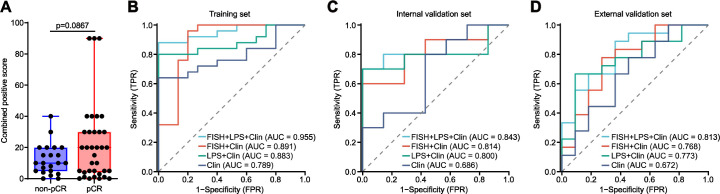
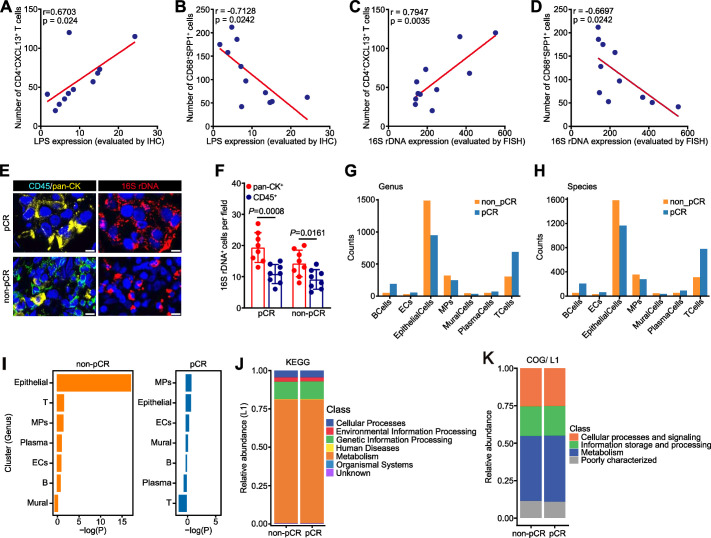
A total of 89 female patients with early-stage TNBC treated by neoadjuvant Chemo-IM were enrolled. We found that the pCR group had greater diversity and a higher load of intratumoral microbiota than the non-pCR group. Intriguingly, scRNA-seq revealed significantly increased T cell infiltration and decreased tumor-associated macrophage infiltration into tumors in the pCR group. Moreover, intratumoral microbiota load was positively associated with CD4CXCL13 T cell infiltration and negatively associated with CD68SPP1 macrophage infiltration. Combined analysis of 16S-seq and scRNA-seq data revealed that intratumoral microbiota were present in both cancer and immune cells. Finally, we developed a model incorporating intratumoral microbiota and clinicopathological characteristics, and it showed strong power for predicting pCR to neoadjuvant Chemo-IM.
Intratumoral microbiota may serve as a strong and specific predictor of the response of patients with early-stage TNBC to neoadjuvant Chemo-IM. Our findings could contribute to the development of individualized Chemo-IM strategies for treating TNBC.
新辅助免疫疗法联合化疗(化疗 - 免疫疗法)与早期三阴性乳腺癌(TNBC)患者病理完全缓解(pCR)率显著提高及长期生存结果改善相关。然而,仅有一小部分患者能从免疫疗法的加入中获益。在此,我们探索并证实了瘤内微生物群在筛选可能从新辅助化疗 - 免疫疗法中获益的TNBC患者中的作用。
纳入接受新辅助化疗 - 免疫疗法的未经治疗、非转移性TNBC患者。通过16S核糖体DNA测序(16S - seq)探索pCR组和非pCR组之间瘤内微生物群的差异。采用单细胞转录组测序(scRNA - seq)分析肿瘤微环境(TME)。此外,还探索了瘤内微生物群与TME之间的相关性。最后,构建基于瘤内微生物群的机器学习模型来预测pCR。
共纳入89例接受新辅助化疗 - 免疫疗法治疗的早期TNBC女性患者。我们发现pCR组的瘤内微生物群多样性更高、负荷更大,比非pCR组更为显著。有趣的是,scRNA - seq显示pCR组肿瘤中T细胞浸润显著增加,肿瘤相关巨噬细胞浸润减少。此外,瘤内微生物群负荷与CD4CXCL13 T细胞浸润呈正相关,与CD68SPP1巨噬细胞浸润呈负相关。16S - seq和scRNA - seq数据的联合分析表明,瘤内微生物群存在于癌细胞和免疫细胞中。最后,我们开发了一个结合瘤内微生物群和临床病理特征的模型,该模型在预测新辅助化疗 - 免疫疗法的pCR方面显示出强大的能力。
瘤内微生物群可能是早期TNBC患者对新辅助化疗 - 免疫疗法反应的有力且特异性的预测指标。我们的研究结果可能有助于制定治疗TNBC的个体化化疗 - 免疫疗法策略。