Mourmans Sanne G J, Achten Anouk, Hermans Raquel, Scheepers Marijne J E, D'Alessandro Elisa, Swennen Geertje, Woudstra Janneke, Appelman Yolande, Goor Harry van, Schalkwijk Casper, Knackstedt Christian, Weerts Jerremy, Eringa Etto C, van Empel Vanessa P M
Department of Cardiology, Cardiovascular Research Institute Maastricht (CARIM), Maastricht University Medical Centre (MUMC+), Maastricht, The Netherlands.
Department of Physiology, Cardiovascular Research Institute Maastricht (CARIM), Maastricht, The Netherlands.
Cardiovasc Diabetol. 2025 Apr 25;24(1):182. doi: 10.1186/s12933-025-02679-8.
Empagliflozin is an effective treatment for heart failure with preserved ejection fraction (HFpEF), but its definite mechanism of action is unclear. Systemic microvascular dysfunction strongly relates to HFpEF aetiology, and we hypothesised that empagliflozin improves microvascular function in HFpEF.
To investigate the effect of the sodium-glucose cotransporter-2 inhibitor empagliflozin on peripheral microvascular function in HFpEF.
This is a pre-post intervention study in patients diagnosed with HFpEF who are eligible for treatment with empagliflozin. Microvascular function assessment using laser speckle contrast analysis of the dorsal forearm during iontophoresis of vasoactive stimuli (acetylcholine, insulin sodium nitroprusside) was performed at baseline and after 3 months of empagliflozin treatment (10 mg daily). The primary outcome was the difference in blood flow measured in the forearm microvasculature between baseline and at follow-up (cutaneous vascular conductance, CVC). Secondarily we investigated quality-of-life based on the EQ-5D-5 L questionnaire at baseline and follow-up.
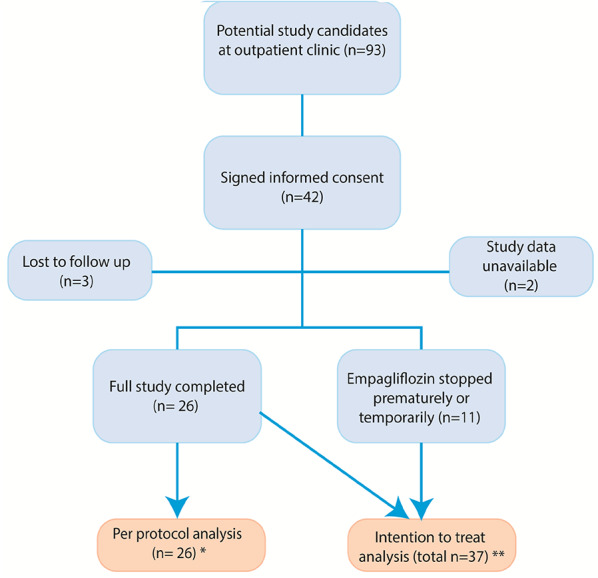
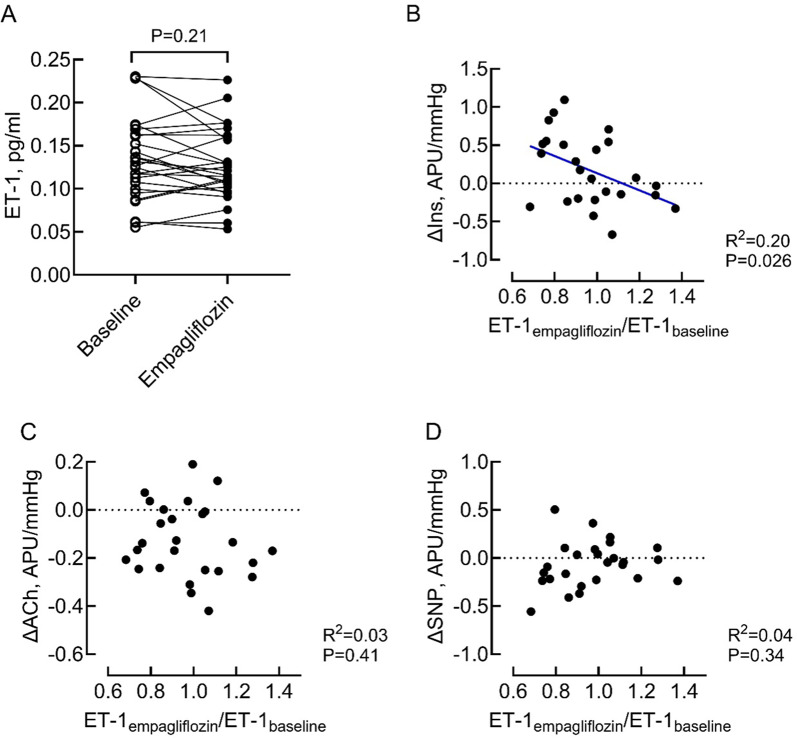
Twenty six patients finished the study according to protocol (mean age of 74 ± 7 years, 62% female). We observed a decreased blood flow response to acetylcholine after 3 months of empagliflozin (CVC: 0.77 ± 0.24 vs. 0.64 ± 0.20, p < 0.001). In contrast, the response to insulin improved (CVC: 0.61 ± 0.43 vs. 0.81 ± 0.32, p = 0.03), and the response to sodium nitroprusside remained stable after 3 months. No significant correlations were found between the changes in blood flow and quality of life.
This study shows that three months treatment with empagliflozin changed peripheral microvascular function in patients with HFpEF. Empagliflozin may enhance microvascular blood flow specifically via vascular actions of insulin, rather than a general effect on endothelial vasoregulation or smooth muscle cell function. As such, systemic microvascular dysfunction can be a modifiable factor in patients with HFpEF, while the clinical implications thereof warrant further investigations.
The trial was preregistered at clinicaltrials.gov (NCT06046612).
恩格列净是射血分数保留的心力衰竭(HFpEF)的有效治疗药物,但其确切作用机制尚不清楚。全身微血管功能障碍与HFpEF的病因密切相关,我们推测恩格列净可改善HFpEF患者的微血管功能。
研究钠-葡萄糖协同转运蛋白2抑制剂恩格列净对HFpEF患者外周微血管功能的影响。
这是一项对符合恩格列净治疗条件的HFpEF患者进行的干预前后研究。在基线和恩格列净治疗3个月(每日10毫克)后,采用激光散斑对比分析对接受血管活性刺激剂(乙酰胆碱、胰岛素、硝普钠)离子导入的前臂背侧进行微血管功能评估。主要结局是基线和随访时在前臂微血管中测得的血流差异(皮肤血管传导率,CVC)。其次,我们根据EQ-5D-5L问卷在基线和随访时调查生活质量。
26例患者按方案完成研究(平均年龄74±7岁,62%为女性)。我们观察到恩格列净治疗3个月后对乙酰胆碱的血流反应降低(CVC:0.77±0.24对0.64±0.20,p<0.001)。相比之下,对胰岛素的反应有所改善(CVC:0.61±0.43对0.81±0.32,p=0.03),对硝普钠的反应在3个月后保持稳定。血流变化与生活质量之间未发现显著相关性。
本研究表明,恩格列净治疗3个月改变了HFpEF患者的外周微血管功能。恩格列净可能通过胰岛素的血管作用特异性地增强微血管血流,而不是对内皮血管调节或平滑肌细胞功能产生普遍影响。因此,全身微血管功能障碍可能是HFpEF患者的一个可调节因素,其临床意义值得进一步研究。
该试验已在clinicaltrials.gov上预注册(NCT06046612)。