Dimitropoulou Panagiota, Filippatou Diamanto, Gkoutzourela Stamatia, Griva Anthi, Pachiti Iouliani, Michaelides Michalis
Department of Psychology, University of Crete, 74150 Rethymno, Greece.
Department of Psychology, National and Kapodistrian University of Athens, 15784 Athens, Greece.
Behav Sci (Basel). 2025 Apr 9;15(4):503. doi: 10.3390/bs15040503.
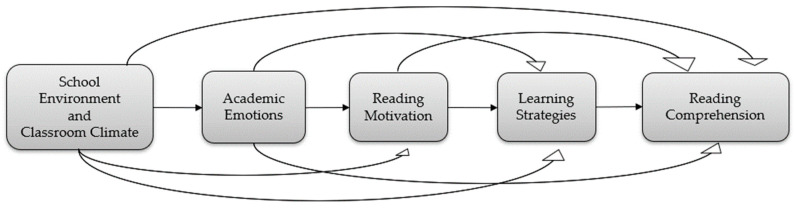
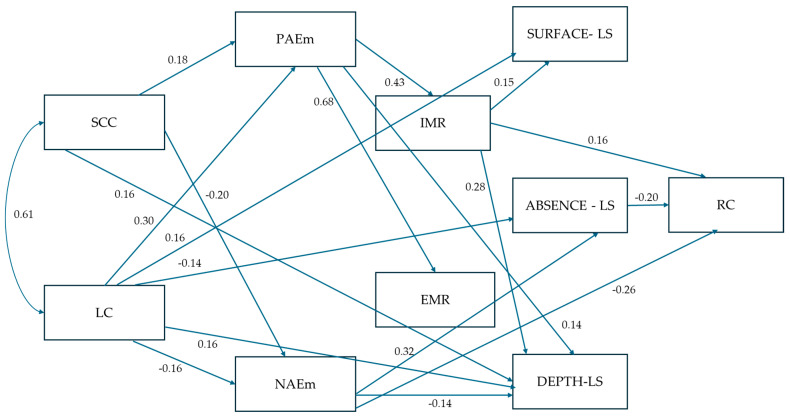
This study examines the relationship between school climate, motivation, and academic emotions in shaping learning outcomes, with a focus on reading comprehension. Based on the control-value theory of academic emotions and self-determination theory, it explores how students' perceptions of a caring school community and a positive learning climate influence their emotions, motivation, learning strategies, and reading performance. A total of 296 fifth- and sixth-grade students completed self-report measures assessing these factors. For the collection of the data, the participants completed the following scales: Motivation for Reading Questionnaire-MRQ, Achievement Emotions Questionnaire Pre-Adolescents (AEQ-PA), Learning Climate Questionnaire (LCQ), School as a Caring Community Profile-II-(SCCP-II), learning strategies questionnaire, and reading comprehension. The correlation and path analysis results revealed that students who viewed their school as supportive experienced more positive academic emotions and fewer negative ones. Positive emotions were linked to higher intrinsic and extrinsic reading motivation, while negative emotions correlated with lower motivation and disengagement. Intrinsic motivation significantly predicted deep learning strategies and improved reading comprehension, whereas the absence of learning strategies negatively impacted performance. These findings underscore the role of a supportive school environment in fostering motivation and emotional engagement. The educational implications of this study highlight the need for teaching practices that cultivate positive emotions, intrinsic motivation, and effective learning strategies to enhance reading comprehension and overall academic success.
本研究考察了学校氛围、动机和学业情绪在塑造学习成果(尤其是阅读理解)方面的关系。基于学业情绪的控制-价值理论和自我决定理论,本研究探讨了学生对关怀型学校社区和积极学习氛围的认知如何影响他们的情绪、动机、学习策略和阅读表现。共有296名五年级和六年级学生完成了评估这些因素的自我报告测量。为了收集数据,参与者完成了以下量表:阅读动机问卷(MRQ)、青少年前期成就情绪问卷(AEQ-PA)、学习氛围问卷(LCQ)、关怀型学校社区量表-II(SCCP-II)、学习策略问卷和阅读理解测试。相关分析和路径分析结果显示,那些认为学校具有支持性的学生体验到更多积极的学业情绪,消极情绪则较少。积极情绪与较高的内在和外在阅读动机相关,而消极情绪与较低的动机和学习投入度相关。内在动机显著预测深度学习策略和阅读理解能力的提高,而缺乏学习策略则对表现产生负面影响。这些发现强调了支持性学校环境在促进动机和情感投入方面的作用。本研究的教育意义在于强调需要采用培养积极情绪、内在动机和有效学习策略的教学实践,以提高阅读理解能力和整体学业成就。