Kang Seok-Hui, Park So-Young, Lim Yu-Jeong, Kim Bo-Yeon, Choi Ji-Young, Do Jun-Young, Kim A-Young
Division of Nephrology, Department of Internal Medicine, College of Medicine, Yeungnam University, Daegu 42415, Republic of Korea.
Department of Physiology, College of Medicine, Yeungnam University, Daegu 42415, Republic of Korea.
J Clin Med. 2025 Apr 18;14(8):2812. doi: 10.3390/jcm14082812.
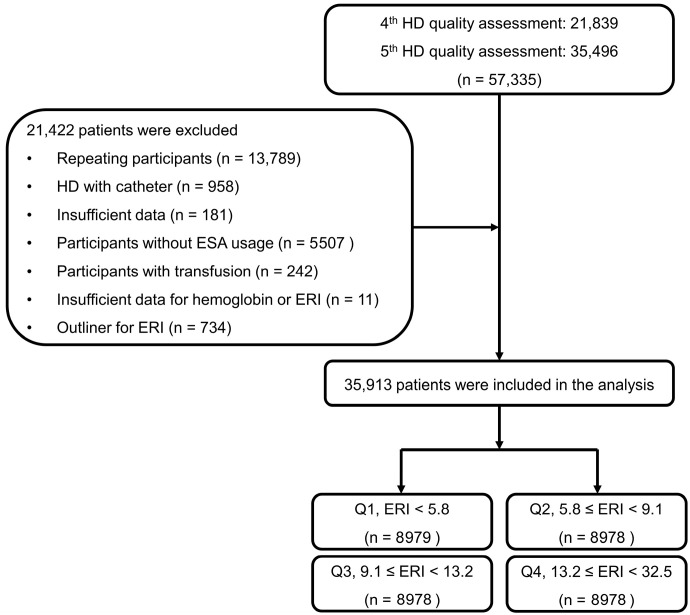
Although erythropoiesis-stimulating agent (ESA) therapy is fundamental for correcting anemia, excessive ESA administration is associated with increased risks. This study aimed to investigate the impact of the erythropoietin resistance index (ERI) on clinical outcomes in a population-based cohort of hemodialysis (HD) patients. This retrospective study analyzed datasets from patients who underwent periodic HD quality assessments and their claims data. Overall, we included 35,913 patients. Participants were divided into quartiles based on the ERI during the 6-month assessment period: Q1, Q2, Q3, and Q4 groups. The 5-year survival rates were 68.8% (Q1), 67.8% (Q2), 66.9% (Q3), and 60.2% (Q4) ( < 0.001). Multivariable analysis showed the same trends as the univariable analysis. Additionally, a spline curve using the multivariable model indicated that the increased ERI was linked to all-cause mortality. However, cardiovascular events were not associated with ERI quartiles in Cox regression analyses. Subgroup analysis revealed that in most subgroups, the all-cause mortality was significantly higher in those with a high ERI than in those with a low ERI. Further analysis using the balanced cohort, which attenuated baseline characteristic differences, confirmed that the high mortality in those with a high ERI was maintained. Our population-based cohort study reveals an association between the ERI and all-cause mortality in HD patients.
尽管促红细胞生成素(ESA)治疗是纠正贫血的基础,但过量使用ESA会增加风险。本研究旨在调查促红细胞生成素抵抗指数(ERI)对以人群为基础的血液透析(HD)患者队列临床结局的影响。这项回顾性研究分析了接受定期HD质量评估患者的数据集及其理赔数据。总体而言,我们纳入了35913名患者。在6个月评估期内,参与者根据ERI被分为四分位数:Q1、Q2、Q3和Q4组。5年生存率分别为68.8%(Q1)、67.8%(Q2)、66.9%(Q3)和60.2%(Q4)(<0.001)。多变量分析显示出与单变量分析相同的趋势。此外,使用多变量模型的样条曲线表明,ERI升高与全因死亡率相关。然而,在Cox回归分析中,心血管事件与ERI四分位数无关。亚组分析显示,在大多数亚组中,ERI高的患者全因死亡率显著高于ERI低的患者。使用平衡队列进行的进一步分析减弱了基线特征差异,证实了ERI高的患者死亡率仍然较高。我们基于人群的队列研究揭示了HD患者中ERI与全因死亡率之间的关联。