Lim Yujin, Kim Aelim, Shin Eunyeong, Cho Hwangeui
Institute of New Drug Development, School of Pharmacy, Jeonbuk National University, Jeonju 54896, Republic of Korea.
Pharmaceuticals (Basel). 2025 Mar 26;18(4):465. doi: 10.3390/ph18040465.
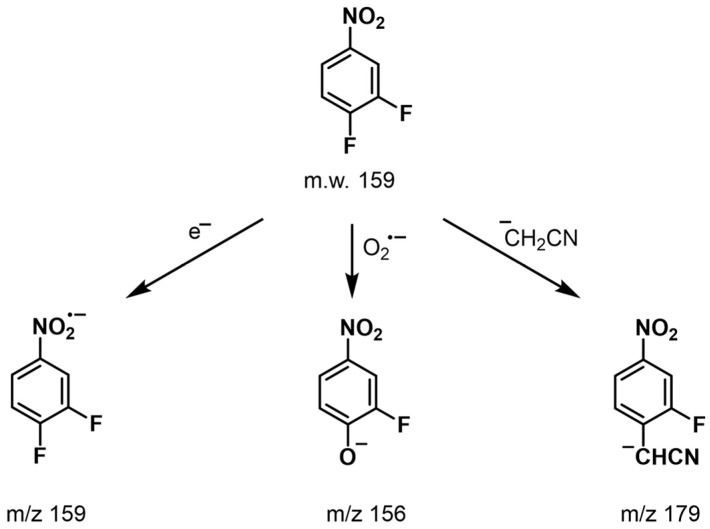
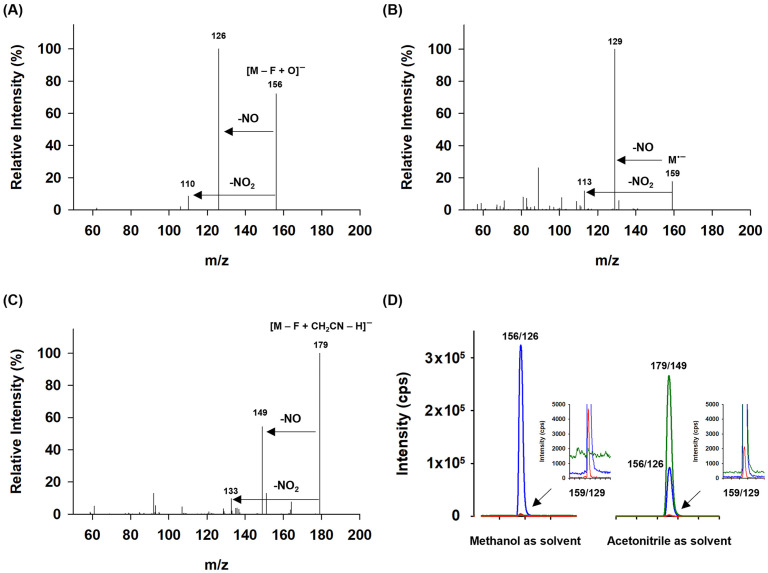
: Oxazolidinones are novel antimicrobial agents used to combat bacterial infections, particularly multidrug-resistant strains. However, the synthesis of oxazolidinone derivatives, such as linezolid, often involves the use of 3,4-difluoronitrobenzene (DFNB) as an initiator. Despite its effectiveness, residual DFNB in drug products raises significant health concerns due to its structural similarity to toxic and carcinogenic nitrobenzenes. This contamination is particularly concerning in pharmaceutical formulations, where it poses potential patient safety hazards. Therefore, strict concentration limits for this impurity are necessary. : To ensure tight control of DFNB concentrations, this study established an 8.3 µg/g target limit. An advanced high-performance liquid chromatography-tandem mass spectrometry (LC-MS/MS) method was developed to overcome current limitations in detecting trace DFNB. Under negative atmospheric pressure chemical ionization (APCI) conditions, DFNB exhibited characteristic ion formations, including [M] through electron capture and [M - F + O] via substitution reactions. The quantitative method utilizes MS/MS ion transitions of the substitution product while optimizing chromatographic and spectrometric parameters to enhance both sensitivity and specificity. : Validation tests confirm the efficiency, precision, and accuracy of this method, with a low limit of quantification (LOQ) of 5 ng/mL (0.83 µg/g). This technique enables accurate detection and quantification of DFNB in linezolid active pharmaceutical ingredient (API) and various formulations, providing a reliable tool for quality control. This method ensures the safe use of linezolid by effectively monitoring and minimizing the risks associated with DFNB contamination.
恶唑烷酮类是用于对抗细菌感染,特别是多重耐药菌株的新型抗菌剂。然而,恶唑烷酮衍生物(如利奈唑胺)的合成通常涉及使用3,4 - 二氟硝基苯(DFNB)作为引发剂。尽管其有效,但药品中残留的DFNB因其与有毒和致癌的硝基苯结构相似而引发了重大的健康问题。这种污染在药物制剂中尤其令人担忧,因为它对患者安全构成潜在危害。因此,对这种杂质设定严格的浓度限值是必要的。
为确保对DFNB浓度进行严格控制,本研究设定了8.3 µg/g的目标限值。开发了一种先进的高效液相色谱 - 串联质谱(LC - MS/MS)方法,以克服当前检测痕量DFNB的局限性。在负大气压化学电离(APCI)条件下,DFNB呈现出特征性的离子形成,包括通过电子捕获产生的[M]以及通过取代反应产生的[M - F + O]。定量方法利用取代产物的MS/MS离子跃迁,同时优化色谱和光谱参数以提高灵敏度和特异性。
验证测试证实了该方法的有效性、精密度和准确性,定量下限(LOQ)低至5 ng/mL(0.83 µg/g)。该技术能够准确检测和定量利奈唑胺活性药物成分(API)及各种制剂中的DFNB,为质量控制提供了可靠工具。该方法通过有效监测和最小化与DFNB污染相关的风险,确保了利奈唑胺的安全使用。